Sophia
Heard about Bitcoin’s wild price swings on the news? Seen friends talking about Ethereum, Dogecoin, or something called an NFT? If you feel like you’re standing on the outside of a massive technological shift, trying to peer in through a complicated window, you’re definitely not alone.
The world of cryptocurrency can seem like a private club with its own language, inside jokes, and a high barrier to entry. It feels complex, volatile, and maybe even a little intimidating. But here’s the good news: it doesn’t have to be.
This guide is your roadmap. We’re going to break down cryptocurrency investing for beginners into simple, understandable steps. Forget the confusing jargon and the hype. We’ll give you the foundational knowledge you need to get started with crypto safely and intelligently. By the time you finish reading, you’ll have a clear plan to make your first investment with confidence.
What is Cryptocurrency, Really? A Simple Explanation
Before you invest a single dollar, it’s crucial to understand what you’re actually buying. So, what is cryptocurrency? Let’s strip away the complexity.
Beyond Digital Money
At its core, a cryptocurrency is a digital or virtual asset secured by cryptography, which makes it nearly impossible to counterfeit or double-spend. Think of it less like a digital version of a dollar and more like a secure entry in a global, online database that no single person or entity controls.
The Technology That Powers It – Blockchain Explained
The magic behind most cryptocurrencies is a technology called blockchain.
Imagine a shared digital receipt book that is distributed across thousands of computers worldwide.
- Every time someone makes a transaction, a new receipt (a “block”) is created.
- This block is then linked to the previous one, forming a “chain.”
- Every computer in the network gets a copy of the entire book.
Because everyone has a copy, it’s incredibly difficult for anyone to cheat the system. To alter a single transaction, a hacker would need to change that block on thousands of computers simultaneously, all while new blocks are being added. This is the blockchain explained in its simplest form: it’s a transparent, permanent, and decentralized way of recording information.
Key Concepts for Beginners
- Decentralization: This is the big one. Traditional money is controlled by banks and governments (centralized). Cryptocurrency is managed by its network of users (decentralized). There’s no CEO of Bitcoin or a central server to shut down.
- Keys & Wallets: To access your crypto, you use a pair of cryptographic keys. The best analogy is email:
- Public Key: Like your email address. You can share it with others to receive funds.
- Private Key: Like your email password. It proves you own your crypto. NEVER share your private key with anyone.
- Coins vs. Tokens: You’ll hear these terms a lot. A coin (like Bitcoin or Ethereum) operates on its own unique blockchain. A token is built on top of an existing blockchain, like an app running on an operating system.
Why Invest in Cryptocurrency? The Pros and Cons
Now that you know what it is, you might be asking, “is crypto a good investment?” The honest answer is: it depends on your goals and risk tolerance. Let’s look at both sides of the coin.
The Potential Upside (The Pros)
- Potential for High Returns: Let’s be honest, this is what attracts most people. As a new and growing asset class, crypto has the potential for significant growth that is hard to find in traditional markets.
- Decentralization and Self-Custody: You can be your own bank. With crypto, you have the ability to hold and control your assets without relying on a third party, giving you true ownership.
- Technological Innovation: You’re investing in more than just a currency; you’re investing in a groundbreaking technology that is powering a new wave of applications in finance (DeFi), art (NFTs), and online identity.
- Portfolio Diversification: Holding assets that aren’t directly tied to the stock or bond markets can help diversify your investment portfolio and potentially hedge against inflation.
The Inherent Risks (The Cons)
- Market Volatility: This is the most significant of all cryptocurrency risks. Prices can swing dramatically—sometimes by 10-20% or more in a single day. You must have the stomach to handle these ups and downs without panicking.
- Regulatory Uncertainty: Governments around the world are still figuring out how to regulate crypto. New laws or restrictions could significantly impact prices.
- Security Risks: Because you are your own bank, you are also your own security guard. If you lose your private keys or fall for a scam, there’s often no one to call to get your money back.
- Complexity and a Steep Learning Curve: The space is constantly evolving. Staying informed requires a commitment to learning about new technologies and projects.
Getting Started – Your 5-Step Guide to Making Your First Crypto Investment
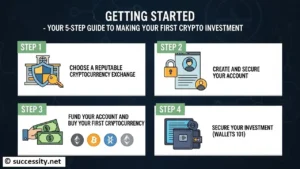
Ready to take the plunge? Here’s a clear, step-by-step guide on how to buy cryptocurrency for the very first time.
Step 1 – Choose a Reputable Cryptocurrency Exchange
A cryptocurrency exchange is a platform where you can buy, sell, and trade cryptocurrencies. Think of it like a stock brokerage, but for digital assets. For a beginner, the best crypto exchange is one that prioritizes:
- Security: Look for platforms with strong security track records and features like Two-Factor Authentication (2FA).
- Ease of Use: A clean, intuitive interface will make your first purchase far less intimidating.
- Fees: Understand the fee structure for buying, selling, and withdrawing.
- Available Coins: Make sure the exchange offers the cryptocurrencies you’re interested in.
Well-known, beginner-friendly options in many regions include Coinbase, Kraken, and Gemini. Do some research to see which one is the best fit for you.
Step 2 – Create and Secure Your Account
Once you’ve chosen an exchange, you’ll need to set up a crypto account. This usually involves providing your personal information, including a government-issued ID, to comply with “Know Your Customer” (KYC) regulations.
During this step, you will be prompted to set up Two-Factor Authentication (2FA), usually through an app like Google Authenticator. This is not optional. 2FA adds a critical layer of security that protects your account from unauthorized access.
Step 3 – Fund Your Account
Next, you need to connect a funding source to deposit traditional currency (like USD, EUR, etc.) into your exchange account. Common methods include:
- Bank Transfer (ACH)
- Debit Card
- Wire Transfer
Be aware that debit card purchases are often instant but may come with higher fees, while bank transfers are typically cheaper but can take a few days to process.
Step 4 – Buy Your First Cryptocurrency
This is the exciting part! Navigate to the “trade” or “buy/sell” section of the exchange.
- Select the cryptocurrency you want to buy (e.g., Bitcoin – BTC).
- Enter the amount you want to purchase in your local currency.
- Review the transaction details, including fees.
- Confirm your purchase.
Congratulations! You are now a cryptocurrency owner. But you’re not done yet.
Step 5 – Secure Your Investment (Wallets 101)
Leaving your crypto on an exchange is like leaving your cash with the store clerk after you’ve bought something. It’s convenient for a moment, but not safe for the long term. To truly own and secure your crypto, you need a wallet.
A crypto wallet is a digital wallet that stores your public and private keys. There are two main types:
- Hot Wallets (Software Wallets): These are apps on your phone or computer (like MetaMask or Trust Wallet). They are connected to the internet, making them convenient for frequent transactions but more vulnerable to online threats. They are great for holding small amounts.
- Cold Wallets (Hardware Wallets): These are physical devices, like a USB drive (from brands like Ledger or Trezor), that store your keys offline. This is the gold standard for security and is highly recommended for holding any significant amount of crypto for the long term. This is the difference in the hot wallet vs cold wallet debate: online convenience vs. offline security.
What Cryptocurrencies Should a Beginner Consider?
This is one of the most common questions, but also one of the riskiest to answer.
Disclaimer: This is purely for educational purposes and is not financial advice. The crypto market is volatile, and you should always do your own research (DYOR) before investing.
The “Blue Chips” – Starting with the Leaders
For most beginners, it’s wise to start with the most established and well-known projects.
- Bitcoin (BTC): What is Bitcoin? It’s the original cryptocurrency and is often seen as “digital gold”—a store of value and a hedge against inflation. It has the largest market capitalization and the most secure network.
- Ethereum (ETH): What is Ethereum? It’s more than just a digital currency. It’s a decentralized computing platform that allows developers to build applications on its blockchain. It powers thousands of tokens, DeFi projects, and NFTs.
Exploring Beyond the Top Two – Altcoins
Any cryptocurrency that isn’t Bitcoin is referred to as an “altcoin.” There are thousands of them, each with a different purpose. While some have incredible potential, many will fail. If you decide to explore what are altcoins, it’s generally recommended that beginners stick to well-established projects in the top 10-20 by market capitalization, as they tend to have more robust communities and proven use cases.
Basic Investment Strategies for Beginners

Gambling is buying something without a plan. Investing is buying something with a strategy. Here are three simple strategies to help you navigate your crypto journey.
Dollar-Cost Averaging (DCA) – The Stress-Free Approach
Dollar-cost averaging (DCA) is perhaps the best crypto investment strategy for beginners. It involves investing a fixed amount of money at regular intervals (e.g., $50 every Friday), regardless of the price.
This approach removes the stress of trying to “time the market.” When the price is high, you buy a little less; when the price is low, your fixed amount buys a little more. Over time, this smooths out your average purchase price and reduces the impact of volatility.
Buy and Hold (HODL) – Playing the Long Game
“HODL” is a famous term in the crypto community that started as a typo for “hold” and is now often said to mean “Hold On for Dear Life.” The HODL meaning is simple: it’s a long-term investment philosophy. Instead of trying to make short-term trades, you buy an asset you believe in and hold it through the market’s ups and downs, betting on its long-term success.
Diversification – Don’t Put All Your Eggs in One Basket
While it’s good to start with Bitcoin and Ethereum, it’s also wise to diversify your crypto portfolio over time. Holding a small basket of different, high-quality projects can reduce your risk if one of them underperforms. Remember, true diversification also includes holding assets outside of crypto, like stocks and bonds.
Common Mistakes Every Crypto Beginner Must Avoid
Learning from others’ mistakes is cheaper than making them yourself. Here are some of the most common crypto investing mistakes to steer clear of.
- FOMO (Fear Of Missing Out): You see a coin’s price skyrocketing and jump in at the top, fearing you’ll miss out on gains. This is often a recipe for buying high and selling low. Stick to your strategy.
- Panic Selling: The market drops 15%, and you sell everything in a panic to “cut your losses.” Volatility is normal in crypto. If you believed in the asset when you bought it, a price drop shouldn’t be the only reason you sell.
- Investing More Than You Can Afford to Lose: This is the golden rule. Never invest money that you need for rent, bills, or emergencies. Assume that any money you put into crypto could go to zero.
- Ignoring Security: Reusing passwords, not using 2FA, and—worst of all—sharing your wallet’s private key or seed phrase. Treat your seed phrase like the keys to your entire financial life. Write it down and store it in a secure, offline location.
- Falling for Scams: If an offer seems too good to be true (e.g., “Send me 1 ETH and I’ll send you 2 ETH back!”), it is 100% a scam. Legitimate projects will never ask for your private keys or ask you to send them crypto for a giveaway.
Final Thoughts – Your Next Steps in Crypto
You’ve made it. You now have a solid foundation in the basics of cryptocurrency investing.
We’ve covered what crypto is, why it’s a compelling (yet risky) asset, and the exact steps to make your first purchase. We’ve explored simple strategies to build your portfolio and highlighted the critical mistakes to avoid.
The key takeaways are simple: start small, prioritize security above all else, commit to continuous learning (DYOR), and adopt a long-term mindset. Your journey doesn’t have to start with a big investment. It can start today by simply choosing a reputable exchange and creating a secure account.
Welcome to the future of finance. The learning has just begun.
Frequently Asked Questions (FAQ)
How much money should I invest in crypto to start?
Start with a very small amount—an amount you would be completely comfortable losing. For some, that’s $50; for others, it’s $500. The goal is to learn the process without taking on significant financial risk.
Are my cryptocurrency profits taxable?
Yes. In most countries, including the United States, cryptocurrencies are treated as property for tax purposes. This means you may owe capital gains tax when you sell, trade, or spend your crypto for a profit. It’s best to consult with a tax professional in your jurisdiction.
How long should I hold my cryptocurrency?
This depends entirely on your personal financial goals and risk tolerance. Many successful investors adopt a long-term mindset (HODL), holding for multiple years. There is no one-size-fits-all answer.
Is it too late to invest in Bitcoin?
While the days of buying Bitcoin for a few dollars are long gone, many investors believe it is still early in its adoption curve. Rather than asking if it’s “too late,” a better question is: “Do I believe this asset will be more valuable in the next 5-10 years?”
About the Author