Sophia
It happens every Sunday afternoon. That familiar, tightening knot in your stomach—the “Sunday Scaries.” You’re not just dreading Monday; you’re dreading the entire week stretching ahead: the crammed calendar, the late emails, the feeling that you’re constantly dropping balls at work or at home.
If the struggle to maintain equilibrium between your professional life and your personal existence feels exhausting, you are not alone. In our always-on world, the line between the office and the living room has evaporated, leaving many of us feeling perpetually stressed, underperforming, and guilty.
This is not a guide about simple time management hacks. This is a framework for Mastering Work-Life Balance by fundamentally redefining your relationship with time, productivity, and, most importantly, yourself.
Achieving true balance is the bedrock of Sustainable Personal Growth—it’s how you move from merely surviving your schedule to actively designing a life of purpose and personal fulfillment.
What is Work-Life Balance (and Why We Need to Redefine It)
The term “work-life balance” is often misleading because it suggests a perfect, 50/50 split. We picture a flawless scale where professional duties sit perfectly opposite personal joy.
But life isn’t a scale; it’s a dynamic, ever-changing journey. A more accurate goal is Work-Life Harmony or Work-Life Integration. It means making conscious decisions about where you allocate your time and energy based on your current priorities, ensuring that when you are focused on one area, the other isn’t suffering catastrophically.
This requires proactive effort—it’s not something you find; it’s something you build.
Identifying the Imbalance
Recognizing the Signs of Poor Work-Life Harmony
You can’t fix a problem until you clearly understand its symptoms. An imbalance often creeps up slowly, manifesting in subtle ways before leading to full-blown crisis. Learning to read these signals is the first step toward reclaiming control.
The Physical and Emotional Costs (The Onset of Burnout)
When the imbalance tips too far toward work, your body and mind pay the price. If you recognize these symptoms, you may be experiencing the early signs of burnout:
- Chronic Fatigue: You feel tired even after eight hours of sleep. Sleep quality is poor, or you suffer from insomnia.
- The Short Fuse: Increased irritability, anxiety, and a reduced capacity to handle minor setbacks or frustrations.
- Physical Manifestations: Stress often surfaces physically—frequent headaches, muscle tension, or recurrent stomach issues.
- Emotional Detachment: Feeling cynical or indifferent toward your job, family, or hobbies that you used to enjoy.
The Productivity Paradox
We often believe that working longer equals achieving more. In reality, the opposite is true. This is the productivity paradox: past a certain threshold, the quality of your output decreases dramatically due to diminishing returns.
When you are constantly running on empty, your focus wanes, mistakes increase, and the time spent on tasks inflates. Achieving balance is not about doing less; it’s about being vastly more effective during the time you do work.
The Foundation – Mindset & Boundaries
The single most powerful lever you have for improving your work-life harmony is establishing firm, clear boundaries. Without them, every aspect of your time becomes negotiable.
Essential Strategies for Setting and Maintaining Boundaries
1. The Power of “No” (Protecting Your Time)
The fear of disappointing others drives many people to overcommit. Learning how to set boundaries at work and in life is an act of self-respect, not selfishness.
- Define Your Non-Negotiables: Identify 3-5 things that absolutely must happen for you to feel sane and balanced (e.g., family dinner at 6 PM, 30 minutes of exercise, reading a book before bed). Treat these like mandatory, unmovable meetings.
- How to Decline Without Guilt: Instead of a flat, defensive “No,” offer a compassionate alternative. Try: “I appreciate you thinking of me for that task, but I currently need to dedicate my focus to Project X to meet the deadline. Can we revisit this next week?”
2. Master Digital Boundaries (The Tech Detox)
Our technology is designed to demand our attention constantly. Reclaiming control requires intentional, structured rules.
- Implement a Digital Sundown: Set a fixed time (e.g., 8:00 PM) after which you do not check work email, Slack, or any project management tools. This trains your brain to transition into rest mode.
- Use the “Delete, Delegate, Delay” rule: When checking email during non-working hours, do not respond. Simply decide if the email can be deleted, delegated to a colleague, or delayed until the morning. This prevents the mental rabbit hole.
- Adopt a True Digital Detox Strategy: Implement one tech-free day per week (or half-day). This recharges your mental battery and fosters a greater sense of presence.
3. Creating a Clear Shutdown Ritual
For knowledge workers, the commute traditionally provided a physical and mental transition. Without it, the workday bleeds into home life. Create a clear shutdown ritual to signal to your brain that the workday is over:
- Write down your top 3 priorities for the next day.
- Clean your desk (physical and digital clutter).
- Say goodbye to the computer (literally close the laptop and put it away).
- Stand up and perform a “commute substitute” (see Section 4).
Actionable Time and Energy Management
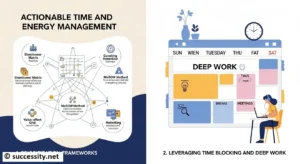
Work-life harmony doesn’t just rely on saying “no” to interruptions; it requires maximizing your efficiency when you say “yes.” This involves proven time management techniques rooted in focusing your limited energy.
Practical Tools for Achieving Time Efficiency and Focus
1. Prioritization Frameworks
If everything feels urgent, nothing is urgent.
- The Eisenhower Matrix: Divide tasks into four quadrants: Urgent & Important (Do Now), Important but Not Urgent (Schedule), Urgent but Not Important (Delegate), and Neither (Eliminate). By focusing on the “Important but Not Urgent” quadrant, you work proactively, not reactively.
- “Eat the Frog”: Identify the single, most difficult, high-impact task of your day (the “frog”). Tackle it first thing in the morning when your willpower and focus are highest. The rest of the day feels easier by comparison.
2. Leveraging Time Blocking and Deep Work
Don’t just use your calendar to track meetings; use it to schedule the time you need to execute tasks.
- Time Blocking: Dedicate specific blocks of time to specific tasks. Critically, time blocking non-work activities (like “Gym,” “Hobby,” or “Meal Prep”) forces you to prioritize them as highly as a client meeting.
- Deep Work Sessions: Schedule concentrated blocks (90-120 minutes) where you shut off all communication and focus only on high-value cognitive tasks. This is the opposite of shallow work (emails, meetings, admin).
3. Scheduling White Space
Every block of focused work must be counterbalanced by recovery time. Scheduled downtime is not a luxury; it is a necessity for peak cognitive performance.
Leave gaps between meetings, step away from your desk for lunch, and intentionally build 15-minute “buffer zones” into your schedule. This allows for mental processing and stress reduction.
Adapting WLB to Modern Challenges
Work-Life Balance in the Age of Remote Work and Hybrid Models
Remote work revolutionized our flexibility but obliterated our physical separation. These modern challenges require conscious architectural strategies to manage remote work boundaries.
1. The Separation of Space
If you work, eat, and relax in the same 400 square feet, your brain never gets a break.
- The Dedicated Zone: If possible, designate a specific area strictly for work. If that’s impossible, establish a clear routine for putting away work tools (out of sight, out of mind).
- The “Commute Substitute”: Since you don’t have a drive or train ride to decompress, create a sensory transition. This might be a 15-minute walk around the block, listening to a specific podcast, or changing out of “work clothes” before sitting down for dinner. This ritual acts as a psychological buffer between roles.
2. Handling “Availability Creep”
In remote environments, there is often pressure to be constantly visible and responsive, leading to availability creep.
- Set Asynchronous Communication Norms: Work with your team to establish when responses are truly needed immediately (synchronous) versus when they can wait (asynchronous). If it’s not urgent, an email sent at 10 PM doesn’t need a response until 9 AM.
- The Disconnection Protocol: If you take a vacation, establish a firm protocol: fully log out of all accounts, remove Slack and email from your phone, and designate one emergency point-of-contact other than yourself. True rest requires a true disconnect.
Navigating Relationships and Organizational Culture
The effort you put into balancing your life will fail if it clashes constantly with the expectations of those around you—your manager, your team, and your family. Work-life balance is rarely achieved in isolation; it requires clear communication and alignment with your environment.
Communicating Your Needs and Managing Expectations
1. Aligning with Management and Organizational Culture
Many employees fear that establishing firm boundaries will make them look less dedicated. The key is to communicate your boundaries in the context of efficiency and high performance, rather than absenteeism.
- Proactive Negotiation: If you need to leave early for a consistent personal commitment, inform your manager: “I need to block 4:30 PM for a necessary personal commitment, but I will ensure all critical tasks are completed by 4:00 PM, and I’ll be logged back in at 7:00 PM to handle anything urgent.” This demonstrates commitment alongside boundary setting.
- The Power of Asynchronous Work: Advocate for organizational culture shifts that support asynchronous communication. This means valuing thoughtful, focused work over immediate, frantic responses. Pitch this change as an increase in team productivity and a reduction in meeting fatigue.
- Modeling Balance: If you are a leader or a senior team member, the most effective way to change the environment is to practice visible balance. When you leave on time and encourage others to do the same, you demonstrate that professional success does not require endless hours.
2. Enlisting Partner and Family Support
Your biggest supporters in achieving harmony are your loved ones, but they need to know the plan.
- Communicate the “Why”: Explain to your partner or family why you are implementing digital boundaries or working certain focused hours. (e.g., “I am turning off my phone tonight so I can be fully present with you, which is important for my well-being.”)
- Designate “Sacred Time”: Schedule specific, protected time for family, dates, or kids’ activities. When these are on the calendar, treat them with the same respect as a board meeting. This reinforces that partner support is a vital part of your WLB strategy.
- Share the Mental Load: Balance isn’t just about work hours; it’s about the emotional and logistical weight of running a household. Ensure that the division of labor in your personal life is also balanced and equitable, preventing one partner from feeling disproportionately drained.
Overcoming Internal Barriers
Even when external circumstances are managed, the greatest obstacles to balance are often internal: the psychological baggage we carry about work, success, and self-worth. Achieving true work-life balance requires deep self-development to address these emotional blocks.
Dealing with Work Guilt and Perfectionism
1. Unlinking Self-Worth from Productivity
Many high-achieving individuals struggle with the subconscious belief that their worth as a person is directly tied to their professional output or availability. This leads to work guilt whenever they step away from the keyboard.
- Challenge the Core Belief: Ask yourself: “If I miss this email, will my world collapse? Is my entire identity based on this one project?” The answer is almost always no. Work is what you do, not who you are.
- Embrace Self-Compassion: Treat your downtime and need for rest with the same respect you would offer a trusted friend. True emotional resilience comes from giving yourself permission to recharge without judgement.
2. The Trap of Perfectionism
Perfectionism is a primary driver of overwork. It tells you that a task is never truly finished, driving you to spend excessive time on marginal gains.
- Implement the “Good Enough” Rule: Determine the necessary standard of quality for a task and stop once that standard is met. Recognize that 80% effort often delivers 95% of the result. Pushing for that final 5% is where imbalance thrives.
- Countering Imposter Syndrome: Often, overworking is a defense mechanism against feelings of inadequacy or imposter syndrome. If you work harder than anyone else, you can’t possibly be found out. Address the root fear by focusing on your proven competence, not your hours logged.
- The Joy of the Unscheduled: Schedule time where you are intentionally unproductive. Cultivating hobbies, rest, and play reminds you that life’s value lies in experiences, not just accomplishments. This psychological shift is fundamental to long-term harmony.
The Sustained Self-Development Approach
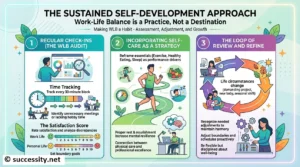
Work-life balance is not a destination; it’s a practice. For it to be truly sustainable work-life balance, it must be integrated into your ongoing journey of self-development.
Making WLB a Habit – Assessment, Adjustment, and Growth
1. Regular Check-Ins (The WLB Audit)
Once a quarter, conduct a simple audit of where your time and energy are actually going, versus where you want them to go.
- Time Tracking: For one week, rigorously track every 30-minute block. Are you spending 15 hours a week in unnecessary meetings? Are you dedicating zero time to your hobbies?
- The Satisfaction Score: Rate the satisfaction level of your work life and personal life on a scale of 1 to 10. If there’s a huge discrepancy, analyze the cause and set a boundary goal to address it.
2. Incorporating Self-Care as a Strategy
Often, when we are busy, the first things to go are self-care essentials: exercise, healthy eating, and sleep. Reframe these as crucial performance drivers.
You don’t exercise to earn free time; you exercise to ensure your brain and body can handle the demands of your focused work time. Proper rest and nourishment increase your mental resilience, making you less susceptible to stress and burnout. This connection between physical care and professional excellence is the essence of holistic personal growth.
3. The Loop of Review and Refine
Your life circumstances change—a demanding project, a new baby, a seasonal shift. What works now won’t necessarily work six months from now. Recognize that you will need to adjust your boundaries and your schedules proactively to maintain harmony. Be flexible, but be disciplined about the underlying principles of prioritizing your well-being.
Your Journey to a More Balanced Life Starts Now
The quest for Mastering Work-Life Balance is perhaps the most important form of self-development you can undertake. It is the active choice to honor your time, respect your energy, and set clear personal boundaries so that you can show up fully—for your career, your family, and, most importantly, yourself.
This is not a passive waiting game. It requires action, consistency, and the courage to say “no” to what depletes you, so you can say a resounding “yes” to what truly fulfills you.
What is your greatest struggle in maintaining work-life harmony? Share your top work-life balance strategy in the comments below!
Frequently Asked Questions
Is Work-Life Balance Really a 50/50 Split?
No, the goal is better defined as Work-Life Harmony—a dynamic state where time allocation aligns with your changing priorities, ensuring consistent well-being and productivity.
How Can I Start Setting Boundaries Without Conflict?
Begin by communicating your needs proactively, framing boundaries as a way to increase efficiency, not reduce effort. Define and uphold your personal “Non-Negotiables” without compromise.
What is the Most Effective Way to Fight Digital Burnout?
Implement a strict “Digital Sundown” rule where you turn off work notifications and email at a set time each evening. Use a disconnection protocol to take real, uninterrupted vacations.
How Do I Know If I Am Successfully Improving My Balance?
Success is measured by reduced anxiety, improved sleep quality, and a higher satisfaction score in both your personal and professional life. Regular WLB audits help quantify these results.
How Do I Deal with the Guilt of Not Working Enough?
Challenge the deep-seated belief that your self-worth is tied to constant productivity. Embrace self-compassion and recognize that rest and hobbies are essential inputs for high performance.
About the Author