Sophia
Ever felt like you were talking, but nobody was truly listening? Or sent an email that was completely misunderstood? These aren’t just awkward moments; they’re symptoms of a gap in communication skills—an ability that shapes everything from your career to your personal relationships. It’s a bigger issue than we think: 86% of executives blame ineffective communication for major workplace failures.
But here’s the good news: being a great communicator isn’t a rare talent. It’s a skill that anyone can learn and master, and this guide is your roadmap to doing just that. We’ll break down the four core types of communication and give you actionable strategies to transform how you connect with the world.
Ready to unlock your superpower?
Why Are Communication Skills a Crucial Superpower?
Calling communication skills a “superpower” isn’t an exaggeration. They are the invisible engine driving your success in almost every area of life. When you sharpen these skills, the benefits ripple outward.
In the Workplace
Strong communication skills in the workplace are the difference between a chaotic team and a high-performing one. When team members can clearly express ideas, provide constructive feedback, and listen to one another, projects move forward smoothly. It leads to:
- Better Collaboration: Fewer misunderstandings mean less friction and more synergy.
- Increased Productivity: Clear instructions and open dialogue ensure everyone is working on the right task, at the right time.
- Stronger Leadership: Leaders who communicate with clarity and empathy inspire trust and motivate their teams to do their best work.
In Personal Relationships
Outside of the office, communication is the very foundation of our connections. It’s how we build trust, navigate disagreements, and share our lives with others. Improving your communication skills helps you:
- Build Deeper Connections: Truly listening to a friend or partner makes them feel seen and valued.
- Resolve Conflict Effectively: Empathy and clear expression allow you to address problems constructively instead of letting resentment build.
- Create Trust and Understanding: When you say what you mean and mean what you say, you build a reliable foundation for any relationship.
For Career Advancement
You can be the most talented person in your field, but if you can’t communicate your value, your career will stall. Effective communication is essential for:
- Nailing Job Interviews: Articulating your strengths and experiences clearly.
- Networking with Confidence: Building rapport and making memorable connections.
- Earning Promotions: Presenting your ideas persuasively and demonstrating leadership potential.
The 4 Core Types of Communication Skills (with Examples)
Effective communication isn’t just about the words you say. It’s a complex dance that involves your body, your tone, and even the visuals you use. Think of it as a four-part harmony—when all parts work together, the message is powerful and clear.
Let’s break down the four types of communication skills.
1. Verbal Communication Skills
This is what most people think of first: using spoken words to share information. It’s about what you say and how you say it. Strong verbal communication skills go beyond just talking.
- Examples:
- Clarity and Conciseness: Getting your point across without rambling.
- Asking Thoughtful Questions: Using open-ended questions to encourage dialogue.
- Public Speaking: Presenting ideas to a group with confidence.
- Confident Tone of Voice: Using your pitch, volume, and pace to convey conviction.
2. Non-Verbal Communication Skills
Often more powerful than words, non-verbal communication is the message you send without saying a thing. It’s the unspoken language of your body, face, and presence. Research suggests that the majority of a message’s impact comes from these non-verbal cues.
- Examples:
- Body Language: An open posture (uncrossed arms, facing the person) signals approachability, while a slumped posture can convey disinterest.
- Eye Contact: Shows you are engaged, confident, and honest.
- Facial Expressions: A smile, a furrowed brow, or a nod can add critical context to your words.
- Gestures: Using your hands to emphasize points can make your verbal message more dynamic.
3. Written Communication Skills
In our digital world, your ability to write clearly is non-negotiable. From a quick Slack message to a formal report, your written communication skills represent you when you’re not in the room. Poor writing can lead to confusion, while strong writing builds credibility.
- Examples:
- Professional Emails: Crafting clear, concise, and polite emails with a specific call to action.
- Clear Messaging: Writing easy-to-understand messages on platforms like Slack or Microsoft Teams.
- Proofreading and Grammar: Ensuring your writing is free of errors that can distract from your message.
- Reports and Presentations: Structuring complex information in a logical and understandable way.
4. Visual Communication Skills
A picture really is worth a thousand words. Visual communication is the art of using images, graphs, charts, and other visual aids to convey information. In a world of data and short attention spans, this skill is becoming increasingly vital.
- Examples:
- Creating Charts and Graphs: Turning spreadsheet data into an easy-to-understand visual story.
- Designing Infographics: Combining text, images, and data to explain a topic quickly.
- Using Slides in Presentations: Choosing powerful images and minimal text to support your spoken message.
- Whiteboarding Ideas: Sketching out a process or concept during a meeting to create shared understanding.
How to Improve Communication Skills – 10 Actionable Strategies
Knowing the types of communication is one thing; improving them is another. The good news is that with conscious effort, you can make significant strides. Here are ten practical strategies you can start using today.
1. Practice Active Listening
There is a huge difference between hearing words and actively listening to the message. Active listening skills mean you are fully concentrated on what is being said, understanding it, and responding thoughtfully. It’s the most respectful and effective way to communicate.
- How to do it:
- Pay Full Attention: Put your phone away. Close your laptop. Make eye contact and show you’re engaged.
- Paraphrase to Confirm: Repeat what you heard in your own words. “So, if I’m understanding correctly, you’re saying the main priority is…” This confirms you’re on the same page and shows you were practicing active listening.
- Avoid Interrupting: Let the person finish their thought completely before you formulate your response.
2. Master Your Non-Verbal Cues
Your body is always communicating, whether you intend it to or not. Becoming aware of your body language and that of others will give you a massive communication advantage.
- How to do it:
- Maintain an Open Posture: Avoid crossing your arms, which can signal defensiveness. Keep your posture upright to project confidence.
- Use Eye Contact Effectively: Aim for a natural balance—too little can seem dishonest, while too much can feel aggressive.
- Notice Your Facial Expressions: Are you frowning while listening to a new idea? A neutral or slightly positive expression makes you more approachable.
3. Be Clear and Concise
In a busy world, clarity is a gift. Avoid jargon, corporate-speak, and rambling. The goal is to make your message as easy as possible for your audience to understand.
- How to do it:
- Think Before You Speak: Take a second to organize your thoughts. What is the one key message you want to deliver?
- Use Simple Language: Don’t use a complex word when a simple one will do.
- Get to the Point: State your main idea upfront, then provide supporting details if necessary. This is especially important in written communication.
4. Develop Empathy
Empathy is the ability to understand and share the feelings of another person. It doesn’t mean you have to agree with them, but it does mean you make an effort to see the world from their perspective. It’s the secret ingredient to effective communication.
- How to do it:
- Listen to Understand, Not to Reply: Focus on their feelings and perspective, not on what you’re going to say next.
- Acknowledge Their Feelings: Use phrases like, “I can see why that would be frustrating,” or “That sounds really challenging.” This validates their experience and builds trust.
Of course. Let’s continue right where we left off, diving deep into the remaining strategies for improving your communication skills.
5. Tailor Your Message to Your Audience
The way you explain a project to a senior executive should be very different from how you explain it to a new intern. A one-size-fits-all approach to communication is a recipe for failure. The most effective communicators are chameleons; they instinctively adjust their style, tone, and level of detail to fit their audience.
- How to do it:
- Consider Their Perspective: Before you speak or write, ask yourself: Who am I communicating with? What do they already know? What is most important to them?
- Focus on the “WIIFM” (What’s In It For Me?): Frame your message around their interests and needs. An executive might care about the budget and timeline, while a teammate might care about their specific tasks and dependencies.
- Avoid Jargon with Mixed Audiences: If you’re in a meeting with people from different departments, drop the technical acronyms and use language everyone can understand.
6. Ask Great Questions
The most interesting and respected people are often not those who talk the most, but those who ask the best questions. Questions are a powerful tool to show you’re engaged, clarify ambiguity, and encourage deeper thinking.
A simple trick is to shift from “closed” questions (which get a “yes” or “no” answer) to “open-ended” questions.
- Closed: “Did you finish the report?”
- Open: “What’s the progress on the report, and are there any roadblocks I can help with?”
See the difference? The second question opens the door for a real conversation.
- How to do it:
- Use “What,” “How,” and “Why”: These words invite detailed responses. “What are your thoughts on this approach?” or “How can we make this process better?”
- Ask for Specific Examples: If someone makes a vague statement, like “The launch was okay,” follow up with, “Can you give me an example of what went well and what could be improved?”
7. Seek and Provide Constructive Feedback
Communication is a feedback loop. To become a better communicator, you need to understand how your messages are being received. This requires both the courage to ask for feedback and the skill to give it constructively.
- How to Give Feedback:
- Be Specific, Not Vague: Instead of “Your presentation was good,” try “Your slides were incredibly clear, and the way you explained the data really helped me understand the key takeaways.”
- Use the “Sandwich Method” (Sparingly): Start with a positive, provide the constructive criticism, and end with another positive or encouraging remark. This can soften the blow, but use it genuinely.
- How to Receive Feedback:
- Listen Without Defensiveness: Your first instinct may be to justify your actions. Resist it. Just listen and absorb.
- Ask Clarifying Questions: “When you say my emails are sometimes unclear, could you give me an example so I know what to work on?”
- Show Gratitude: Thank the person for their input. They are giving you a gift to help you grow.
8. Manage Your Emotions
Have you ever sent an angry email and regretted it instantly? Strong emotions can hijack your ability to communicate clearly. Emotional intelligence—the ability to recognize and manage your own emotions and those of others—is a cornerstone of advanced communication.
A heated moment is precisely when you need to slow down, not speed up.
- How to do it:
- Pause and Breathe: When you feel a strong emotion like anger or frustration, take a deep breath before you speak or type. This simple act creates a buffer between feeling and reaction.
- Use “I” Statements: Instead of saying, “You always interrupt me,” which sounds accusatory, try, “I feel like I can’t finish my thought when I’m interrupted.” This focuses on the behavior and your feelings, not on blaming the person.
- Recognize Your Triggers: Know what situations or topics tend to provoke an emotional response in you, and be extra mindful when they arise.
9. Refine Your Writing Skills
Every email, report, and instant message you send is a reflection of you. Sloppy writing with typos and unclear sentences can make you seem careless, while clear, professional writing builds your credibility. Devoting time to improving your written communication skills pays huge dividends.
- How to do it:
- Proofread Everything: Read your message aloud before you send it. This simple trick helps you catch typos and awkward phrasing.
- Use Tools: Don’t be afraid to use tools like Grammarly or the built-in spell checker to catch errors.
- Keep it Brief and Scannable: Use short paragraphs, bullet points, and bold text to highlight key information. People rarely read long walls of text online.
10. Practice, Practice, Practice
Mastering communication skills is like learning a musical instrument. You can’t just read a book about it; you have to put in the hours. The more you consciously practice, the more natural and effortless it will become.
- How to do it:
- Join a Group: Organizations like Toastmasters are fantastic for practicing public speaking and leadership in a supportive environment.
- Volunteer for Opportunities: Offer to give that presentation at the team meeting or to write the project summary email. Step outside your comfort zone.
- Set a Weekly Goal: Choose one skill to focus on each week. For example: “This week, I will paraphrase what the other person said in every important conversation,” or “This week, I will make sure every email I send has a clear subject line and call to action.”
Of course. Here is the next section, focusing on applying these skills in the modern workplace.
Communication Skills in the Workplace – A Practical Guide

While the core principles of communication are universal, the workplace is a unique ecosystem with its own set of rules and expectations. Applying these skills with professional savvy is what separates top performers from the rest of the pack. Here’s how to put business communication skills into practice where they matter most.
Leading and Participating in Effective Meetings
Meetings can be either a massive time-sink or a powerful engine for progress. The difference almost always comes down to communication.
- For Meeting Leaders:
- Set a Clear Agenda (and Stick to It): An agenda is your meeting’s roadmap. Send it out at least 24 hours in advance with clear topics and desired outcomes. Example: “Goal of this meeting: Decide on the Q4 marketing slogan.”
- Facilitate Inclusive Discussion: Your job is to be the conductor, not the soloist. Actively draw out quieter team members (“Sarah, you’ve worked on similar projects. What are your thoughts?”) and politely steer conversations back on track if they derail.
- Summarize Action Items: End every meeting by clearly stating who is responsible for what, and by when. Follow up with a written summary so nothing falls through the cracks.
- For Meeting Participants:
- Prepare Beforehand: Review the agenda and come with your thoughts prepared. Don’t be the person thinking about the topic for the first time during the meeting.
- Contribute Concisely: When you speak, make your point clearly and then pass the baton. Respect everyone’s time by avoiding long, rambling stories.
- Listen to Understand: Pay as much attention when others are speaking as you do when you’re waiting for your turn. You might learn something that changes your perspective.
Writing Professional Emails and Instant Messages
Your digital communication is a direct reflection of your professionalism. Mastering the etiquette for different platforms is a crucial modern skill.
- Email Etiquette:
- Craft a Specific Subject Line: “Quick Question” is useless. “Question About Q4 Marketing Budget” is perfect. It gives the recipient context before they even open the email.
- Structure for Readability: Start with a polite opening, state your main point or request in the first paragraph, use bullet points for lists, and end with a clear call to action.
- Maintain a Professional Tone: Avoid overly casual language, emojis (unless you know the recipient well and it fits the culture), and all caps. Always proofread for typos.
- Instant Messaging (Slack/Teams):
- Know When to Use It: IM is for quick questions and urgent updates, not for complex feedback or sensitive topics. If your message is more than two paragraphs long, it should probably be an email.
- Respect Status Indicators: If someone’s status is “In a meeting” or “Focusing,” respect it. Don’t bombard them with messages unless it’s a true emergency.
- Avoid the “Machine Gun”: Don’t send five separate messages for one thought.
Hey
Got a sec?
Question about the report
The one for Friday
It’s about the data
Instead, type your full thought in one message and press send. It’s far less disruptive.
Presenting Ideas with Confidence and Clarity
Whether you’re pitching a new project to leadership or sharing findings with your team, your ability to present information persuasively can define your career trajectory.
- Structure a Compelling Narrative: The human brain is wired for stories. Don’t just list facts. Frame your presentation with a simple structure:
- The Problem: Start with the challenge or opportunity. “Our customer churn rate increased by 15% last quarter.”
- The Solution: Present your idea as the answer. “I propose we implement a new onboarding program.”
- The Benefit: Explain the positive outcome. “This will help customers find value faster, reducing churn and increasing loyalty.”
- Use Visuals to Support, Not Distract: Your slides should be a backdrop, not the main event. Use powerful images, simple charts, and minimal text. The audience should be listening to you, not reading your slides.
- Manage Q&A with Poise: Welcome questions as a sign of engagement. Listen to the full question, repeat it for the benefit of the room (“The question was about the budget for this initiative…”), and give a concise answer. If you don’t know the answer, it’s perfectly fine to say, “That’s a great question. I don’t have that data right now, but I will find out and get back to you.”
Adapting Your Communication for the Digital and Remote World
The rise of remote and hybrid work has fundamentally changed the communication landscape. The “water cooler” chat has been replaced by a Slack channel, and the conference room has become a grid of faces on a screen. Thriving in this new environment requires mastering a new set of virtual communication skills.
Video Conferencing Excellence (Zoom, Google Meet, Teams)
Video calls are the new handshake. Your presence on camera is your presence, period. Small details can make a huge difference in how you are perceived.
- Master Non-Verbal Cues on Camera:
- Look at the Camera: It’s tempting to look at the faces on your screen, but looking directly at your webcam simulates eye contact with the person you’re speaking to. It creates a much stronger connection.
- Be Visually Engaged: Your non-verbal feedback is even more important on video. Nod when you agree. Smile. Lean in slightly to show you’re paying attention. Avoid multitasking (like checking your email) at all costs—people can tell.
- Check Your Background: A cluttered or distracting background can pull focus from your message. Use a virtual background or find a simple, professional-looking spot.
- Fight “Zoom Fatigue”:
- Is This Meeting Necessary? Before scheduling a video call, ask if the goal can be accomplished asynchronously (via email or a shared doc).
- Keep it Short and Sweet: Virtual attention spans are shorter. Keep meetings to 30 minutes if possible, and always have a clear purpose.
- Technical Etiquette:
- Mute is Your Best Friend: Mute your microphone whenever you are not speaking. Background noise is incredibly distracting for everyone.
- Invest in Good Audio: A decent microphone will do more for your professional presence than an expensive webcam. If your audio is garbled, your message is lost.
Mastering Asynchronous Communication
Asynchronous communication is any communication that doesn’t happen in real-time (think email, project management comments, or recorded videos). For remote teams spread across different time zones, it is the lifeblood of collaboration.
- Best Practices for Clarity:
- Provide Full Context: The biggest mistake in async communication is assuming the other person knows what you’re talking about. Over-explain. Provide links to documents, screenshots, and background information so they have everything they need to respond without a dozen follow-up questions.
- Set Clear Expectations: Clearly state what you need and by when. Instead of “Let me know what you think,” try “Please provide feedback on the ‘Key Messaging’ section of this document by end-of-day Tuesday.”
Building Rapport and Trust Virtually
In a remote setting, you can’t build relationships by bumping into someone in the kitchen. You have to be intentional about creating personal connections.
- How to do it:
- Schedule “Non-Agenda” Time: Set up virtual coffee chats with teammates just to catch up on a personal level.
- Use the First 5 Minutes Wisely: Don’t jump straight into business in every meeting. Start with a quick, “How was your weekend?” It humanizes the interaction.
- Use a Friendly Tone: In written communication, your tone is easily lost. A well-placed “Thanks!” or “Hope you have a great day!” can go a long way in making you seem approachable and collaborative.
Of course. Here is the final part of the article, bringing everything together.
Overcoming Common Communication Barriers
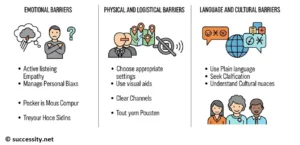
Even with the best intentions, communication can break down. Recognizing the barriers that stand in our way is the first step to dismantling them. Most obstacles fall into one of three categories.
Emotional Barriers
These are internal walls we build that prevent open and honest dialogue. They are often the most difficult to overcome because they are tied to our sense of self.
- Fear and Mistrust: If you don’t trust the person you’re speaking with, you’ll be guarded. If you’re afraid of being judged or rejected, you’ll hesitate to share your true thoughts. Building psychological safety—where people feel safe to speak up without fear of punishment—is crucial, especially in a team setting.
- Ego and Defensiveness: Sometimes, we’re more focused on being “right” than on reaching a mutual understanding. When we receive feedback, our ego can flare up, causing us to become defensive instead of listening with an open mind. The solution is to practice humility and separate the feedback from our self-worth.
Physical and Logistical Barriers
These are the practical, environmental hurdles that get in the way of clear communication. In our modern world, these are increasingly common.
- Remote Work and Time Zones: When you can’t read someone’s body language or have a quick follow-up chat, misunderstandings are more likely. Working across different time zones creates delays and makes real-time collaboration a challenge. The key is to be extra clear and contextual in asynchronous communication.
- Background Noise and Distractions: Trying to have an important conversation in a noisy open-plan office or with notifications constantly popping up on your screen is nearly impossible. To communicate effectively, you need to create an environment conducive to focus, even if that means stepping into a quiet room or turning off your notifications.
Language and Cultural Barriers
The words we use and the way we use them are deeply influenced by our culture and background. What is considered direct and efficient in one culture might be seen as rude and abrupt in another.
- Different Communication Styles: Some cultures value direct, low-context communication where the message is explicit. Others prefer indirect, high-context communication where meaning is embedded in context, tone, and relationships.
- Idioms and Jargon: Using colloquialisms or industry-specific acronyms can easily confuse people who don’t share your background. When communicating with a diverse audience, always strive for simple, universally understood language. The solution is curiosity and respect—ask questions to understand different norms and avoid making assumptions.
Final Thoughts – Start Your Journey
If there’s one thing to take away from this guide, it’s this: Effective communication is a learnable skill, not a fixed trait you’re born with. It’s a muscle that gets stronger with conscious practice. Your journey doesn’t require a dramatic overhaul; it begins with small, intentional steps—choosing to listen more deeply in your next conversation, rereading an email before sending it, or simply noticing your body language in a meeting.
By focusing on clarity, empathy, and adapting to your audience, you are not just improving a soft skill; you are investing in a superpower. This investment will profoundly enhance your career, deepen your relationships, and amplify your impact on the world. So, what will be your first step?
Which communication skill from this guide will you focus on improving this week? Share your goal in the comments below
Frequently Asked Questions
What is the single most important communication skill?
Most experts point to active listening. It is the foundation for understanding, empathy, and crafting a meaningful response, making all other skills more effective.
How can I sound more confident when I speak?
Focus on speaking at a moderate pace and avoiding filler words like “um” or “like.” Maintain an upright posture and make steady eye contact to project self-assurance.
What is a simple trick for difficult conversations?
Use “I” statements to express your feelings instead of “you” statements that can sound accusatory. This focuses on the problem’s impact on you, not on blaming the other person.
Can introverts be great communicators?
Absolutely. Introverts are often excellent listeners and deep thinkers, which are communication superpowers. They tend to excel in thoughtful one-on-one conversations and well-crafted writing.
How can I be concise without sounding rude?
The key is to pair your brevity with a warm and polite tone. Simple additions like “Please,” “Thank you,” or a friendly opening can ensure your concise message is received positively.
About the Author