Sophia
Do you ever feel like you and your partner are speaking completely different languages? You say one thing, they hear another, and before you know it, a simple conversation about who was supposed to take out the trash has spiraled into a cold silence that lasts for hours.
If you’ve ever felt this way, you’re not just “bad at communicating”—and you’re certainly not alone. The myth we’re often sold is that great communication is a magical chemistry that some couples just have. The truth is far more empowering: good communication isn’t a talent you’re born with; it’s a skill you build together.
Mastering communication skills for couples isn’t about finding magic words or never disagreeing. It’s about building a new foundation for your relationship—one of trust, intimacy, and genuine teamwork. It’s the single most powerful investment you can make in your shared future.
In this guide, we’ll move beyond the clichés and give you the practical tools you need. You will learn:
- The foundational skills to truly hear and be heard.
- A powerful framework for navigating disagreements constructively.
- Actionable couple communication exercises you can start using tonight.
Let’s begin.
The Foundation – Why Effective Communication is Non-Negotiable
Before we dive into the “how,” let’s solidify the “why.” Prioritizing effective communication for couples is like tending to the root system of a tree. When the roots are strong and healthy, the entire tree can withstand storms and continue to grow. When they are neglected, the whole structure becomes vulnerable.
Here are the four pillars of a relationship built on a foundation of strong communication:
1. Building Unbreakable Trust
Trust isn’t just about fidelity; it’s about feeling safe. When you can share your thoughts, fears, and vulnerabilities without fear of judgment or ridicule, you create a sanctuary in your relationship. Consistent, honest dialogue is the bedrock of that safety and is essential to build trust in a relationship.
2. Deepening Emotional Intimacy
Many couples get stuck in “logistical” communication—coordinating schedules, paying bills, discussing the kids. While necessary, it doesn’t feed your connection. Healthy communication skills allow you to move beyond the surface and share your inner worlds, which is the very essence of intimacy.
3. Navigating Conflict Constructively
Conflict is not a sign that your relationship is failing; it’s a sign that you are two different people trying to build a life together. The difference between a thriving couple and a struggling one is not the absence of conflict, but the ability to resolve conflicts in relationships effectively. Good communication turns disagreements from damaging battles into opportunities for growth and deeper understanding.
4. Creating a True Partnership
A strong relationship is a team effort. To operate as a team, you need a shared playbook. Communication is how you define your goals, navigate challenges, celebrate wins, and ensure both partners feel valued and respected. This is the essence of healthy communication in marriage and long-term partnerships.
The 5 Essential Communication Skills Every Couple Needs to Master
Ready to start building your toolkit? These five skills are the fundamental building blocks. Don’t try to master them all at once. Pick one to focus on this week and build from there.
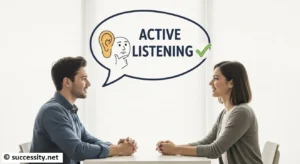
1. Active & Reflective Listening – Hearing What Isn’t Said
We live in a world of distractions. Too often, when our partner is talking, we’re not truly listening. We’re thinking about our rebuttal, checking a notification on our phone, or waiting for our turn to speak. This is passive hearing, and it makes your partner feel invisible.
Active listening is a conscious choice to give your full attention. It’s about listening to understand, not just to respond.
How to Practice Active Listening:
- Put Distractions Away: When the conversation matters, put your phone down, turn off the TV, and make eye contact. Signal with your body that you are present.
- Paraphrase Back What You Heard: This is the single most effective listening tool. Before you share your own perspective, reflect what you heard them say. Use phrases like:
- “So, if I’m understanding you correctly, you’re feeling…”
- “What I’m hearing is that you’re frustrated about…”
- “It sounds like the main issue for you is…”
- Ask Clarifying Questions: Show you’re engaged by trying to understand more deeply. “Can you tell me more about the part that upset you the most?”
- Listen for the Feelings, Not Just the Facts: Sometimes the most important information is the emotion behind the words. Are they sad? Scared? Overwhelmed? Acknowledging the feeling is a powerful form of connection. Improving your listening skills for couples is half the battle.
2. Expressing Yourself with “I-Statements” – Own Your Feelings
One of the most common communication problems in relationships is the use of “You-statements.” They sound like this:
- “You never help me around the house.”
- “You always make me feel stupid.”
- “You ruined our evening.”
“You-statements” feel like an attack. They automatically put your partner on the defensive, making it nearly impossible for them to hear your actual point.
The antidote is the “I-statement.” It shifts the focus from blaming your partner to expressing your own experience. The simple, powerful formula for “I-statements” for couples is:
I feel [your emotion] when [a specific, non-judgmental behavior] because [the impact it has on you].
Let’s see it in action:
- Instead of: “You never help with the dishes.”
- Try: “I feel overwhelmed and unsupported when the dishes are left in the sink after dinner because it feels like the responsibility for cleaning up automatically falls on me.”
- Instead of: “You’re always on your phone.”
- Try: “I feel lonely and unimportant when we’re spending time together and you’re scrolling on your phone because it makes me feel like I’m not as interesting as what’s on your screen.”
This isn’t about being soft; it’s about being clear, honest, and effective. It’s a way to state your needs without starting a fight.
3. Understanding Nonverbal Cues – The Unspoken Language

Experts estimate that the majority of communication is nonverbal. Your tone of voice, facial expressions, posture, and gestures often say more than your words ever could.
A classic example is the partner who says “I’m fine” through gritted teeth while avoiding eye contact and folding their arms. Their words say one thing, but their body is screaming another. When verbal and nonverbal cues don’t match, people almost always believe the nonverbal.
How to Improve:
- Pay Attention to Your Own Body: Are you clenching your jaw? Raising your voice? Pointing a finger? Be aware of the signals you’re sending.
- Gently Notice Your Partner’s Cues: Instead of accusing (“Why are you rolling your eyes?”), try observing. “I notice you seem quiet today. Is everything okay?”
4. Timing is Everything – Choosing the Right Moment to Talk
Bringing up a serious issue five minutes before your partner has to leave for a stressful work presentation is a recipe for disaster. The same goes for trying to resolve a deep-seated conflict when you’re both exhausted at 11 PM.
A crucial, yet often overlooked, skill is learning to recognize when not to talk. Use the simple H.A.L.T. acronym:
Don’t have important conversations when either of you is:
- Hungry
- Angry
- Lonely
- Tired
If a topic needs to be discussed, but the timing is wrong, agree to table it. “I really want to talk about this, but I can see we’re both exhausted. Can we set aside 20 minutes after breakfast tomorrow to figure this out?” This honors both the person and the problem.
5. Validation and Empathy – You Don’t Have to Agree to Understand
Validation is one of the most powerful and healing communication tools. It is the act of acknowledging your partner’s feelings and perspective as valid, even if you don’t agree with them.
It’s the difference between “You’re overreacting” and “I can see why that would be so frustrating for you.”
So many arguments escalate because both people are fighting to feel heard and understood. When you offer validation first, you immediately de-escalate the tension. You show your partner that you are on the same team, even when you see things differently.
Simple Validating Phrases:
- “That makes sense.”
- “I can understand why you would feel that way.”
- “It sounds like that was a really difficult experience.”
- “Thank you for explaining your perspective to me. I’m starting to see it.”
Validation is not concession. It’s connection.
Navigating Disagreements – The Rules of Fair Fighting
Every couple disagrees. The goal isn’t to eliminate conflict; it’s to learn how to improve communication in a relationship even when you’re in the middle of a heated moment. This is where conflict resolution for couples comes in. Think of it as establishing “rules of engagement” for your arguments.
Adopting a set of fair fighting rules ensures that you can address the issue at hand without causing lasting damage to each other or to your relationship.
Rule #1 – Attack the Problem, Not the Person
The moment a disagreement shifts from the issue (“The credit card bill is higher than we planned”) to a personal attack (“You’re so irresponsible with money”), the conversation is no longer productive. Ban name-calling, insults, and character assassinations.
Rule #2 – Stick to One Issue at a Time
This is about avoiding “kitchen-sinking”—throwing every past grievance into the current argument. When you’re discussing the credit card bill, don’t bring up that time they were late to dinner two weeks ago. It derails the conversation and makes the problem feel impossibly large. Solve one thing at a time.
Rule #3 – It’s Okay to Take a Time-Out
When emotions run high, our brains go into “fight-or-flight” mode, and rational thought goes out the window. If you feel yourself getting overwhelmed (flooded), call a time-out. Agree on a signal or a safe word. The crucial follow-up is to agree on a time to come back to the conversation, usually within 24 hours. This isn’t about avoiding the issue; it’s about ensuring you can discuss it productively. This can also be a healthy way to set healthy boundaries in relationships during tense moments.
Rule #4 – Ban the Words “Always” and “Never”
“You always do this.” “You never listen to me.” These words are rarely true. They are exaggerations that immediately trigger defensiveness in your partner, who will then try to find a single exception to prove you wrong, and the original point is lost. Stick to the specifics of the current situation.
Rule #5 – Aim for Compromise and Repair
The goal of a relationship argument is not to win. If one person “wins,” the relationship loses. The goal is to find a solution or a compromise that works for both of you. And after the conflict is resolved, don’t forget to repair. This can be as simple as an apology, a hug, or a thank you for working through it together.
3 Simple Couple Communication Exercises to Try This Week
Learning these skills is one thing; implementing them is another. Here are three structured exercises to help you turn theory into practice.
Exercise 1 – The Speaker-Listener Technique
This exercise forces you to practice active listening by slowing down the conversation.
- How it works: Set a timer for 10-15 minutes. Designate one person as the “Speaker” and one as the “Listener.”
- The Speaker’s Job: Talk about their feelings on a specific topic using “I-statements.”
- The Listener’s Job: Your only job is to listen and then paraphrase what you heard. You cannot share your own opinion, defend yourself, or offer solutions. Simply reflect back: “So, what I’m hearing is that you felt hurt when…”
- Switch Roles: After the time is up, switch roles. This is one of the most transformative couple communication exercises for breaking bad habits.
Exercise 2 – The Weekly “State of the Union” Meeting
This is a proactive check-in designed to keep small issues from becoming big ones.
- How it works: Schedule 20-30 minutes once a week when you’re both relaxed.
- The Structure:
- Start with Appreciations: Each partner shares something they appreciated about the other person this past week. (“I really appreciated that you took care of dinner on Tuesday when I had a long day.”)
- Discuss What’s Working Well: Talk about one or two things that are going well in your relationship.
- Address One Issue: Each partner can bring up one issue or area for improvement, using the “I-statement” formula.
- Plan for Fun: End the meeting by planning one fun, connecting activity for the upcoming week.
Exercise 3 – The “Appreciation and Admiration” Exchange
This is a simple, quick exercise that combats the natural tendency to focus on the negative.
- How it works: Every day, either verbally or via text, share one specific thing you appreciate or admire about your partner.
- Be Specific: Instead of “Thanks for being great,” try “I really admired how patiently you handled that stressful phone call with the insurance company today.” Specificity makes the compliment more meaningful and reinforces positive behavior. Learning to show appreciation in a relationship is a small habit with massive returns.
Overcoming Common Roadblocks
Even with the best intentions, you might run into recurring negative patterns. Dr. John Gottman, a leading relationship researcher, calls these “The Four Horsemen of the Apocalypse” because they are so predictive of relationship failure. Recognizing them is the first step to stopping them in their tracks.
Here are three of the most common communication problems in relationships and how to get past them.
What to Do About Stonewalling (The Silent Treatment)
Stonewalling is when one partner completely withdraws from a conversation. They shut down, stop responding, and may even physically leave the room. It often looks like a power move, but it’s usually a sign of being completely physiologically overwhelmed (flooded).
- If you are the stonewaller: Recognize the feeling of being flooded. Instead of just shutting down, learn to ask for a break. Say, “I’m feeling too overwhelmed to talk about this right now. I need 20 minutes to calm down, and then we can come back to it.”
- If your partner stonewalls: Resist the urge to pursue them or escalate the situation to get a response. Pushing them will only make it worse. Instead, say, “I can see that you need a break. Let’s take 20 minutes, and we can try again when we’re both calmer.” This validates their need for space while ensuring the conversation isn’t abandoned forever.
What to Do About Defensiveness
Defensiveness is a natural reaction to feeling attacked. It’s the impulse to explain, justify, or reverse the blame. It sounds like, “I only did that because you did…” or “It’s not my fault!” The problem is, defensiveness blocks you from hearing your partner’s perspective and escalates the conflict.
- How to overcome it: The antidote to defensiveness is taking some responsibility, even if it’s just for a small part of the conflict. Try to find the kernel of truth in what your partner is saying. You can say, “You’re right, I could have handled that better,” or “I can see how my actions contributed to this situation.” This immediately softens the conversation and signals that you’re willing to work as a team.
What to Do About Assumptions & Mind-Reading
“I know what you’re thinking.” “You did that on purpose just to annoy me.” Assuming you know your partner’s intentions or feelings is a dangerous shortcut that often leads to misunderstandings. You are projecting your own fears and insecurities onto them.
- How to overcome it: Replace assumptions with curiosity. Instead of stating what you think their motive was, ask a question.
- Instead of, “You’re ignoring me.”
- Try, “I’m feeling a bit disconnected. Is everything okay?”
- Instead of, “You don’t care about how messy the house is.”
- Try, “I’m feeling stressed about the state of the house. Can we talk about a plan to tackle it together?”
When to Seek Professional Help
Can you dramatically improve your communication on your own? Absolutely. But sometimes, patterns are so deeply ingrained or the damage is so significant that you need a neutral third party to help you find your way back to each other.
Thinking about couples counseling isn’t a sign of failure; it’s a sign of courage and commitment. A good therapist acts as a coach and a translator, helping you both use the tools described in this guide when emotions are too high to do it on your own.
Consider seeking professional help if:
- Arguments are constant and never get resolved. You have the same fight over and over again with no progress.
- Communication has completely shut down. You live like roommates, avoiding any topic of substance.
- There has been a major breach of trust, such as infidelity, that you can’t seem to move past.
- You feel contempt or resentment toward your partner most of the time.
- You simply feel stuck and know you need help but don’t know where to start.
Final Thoughts – Communication is a Practice, Not a Perfection
Improving your communication skills for couples is a journey, not a destination. You will make mistakes. You will fall back into old habits. You will have moments where you feel like you’re speaking different languages all over again.
That’s okay.
The goal isn’t perfect communication; it’s a commitment to a more conscious and connected way of relating. It’s about choosing to listen when you’d rather interrupt. It’s about using an “I-statement” when blame is on the tip of your tongue. It’s about taking a deep breath and choosing the team—your relationship—over the need to be right.
Every small effort you make is an investment in the health, longevity, and happiness of your partnership. Start today. Start small. And watch how these skills unlock a deeper connection than you ever thought possible.
What’s Your Next Step?
What is the one communication skill from this guide you are going to practice this week? Share your commitment in the comments below! Taking the step to name it makes it real.
Frequently Asked Questions (FAQ)
How can we fix a communication breakdown?
Start by re-establishing safety with active listening and “I-statements.” Agree to talk when you are both calm, focusing on understanding your partner’s perspective before sharing your own.
What if my partner refuses to communicate?
Gently express how their silence makes you feel, using a non-blaming “I-statement.” Suggest low-pressure times to connect and consider a therapist to help facilitate difficult conversations.
How can we stop having the same argument repeatedly?
Look for the deeper, unmet need beneath the recurring topic. Apply fair fighting rules to move beyond blame and work together to find a new solution or compromise you can both live with.
What are the 3 C’s of communication for couples?
The key pillars are Communication (clear, honest dialogue), Compromise (the willingness to find middle ground), and Commitment (the shared dedication to working through challenges together).
Can a relationship survive without good communication?
A relationship can exist with poor communication, but it cannot thrive. Without it, trust, intimacy, and emotional safety erode, making it nearly impossible to sustain long-term happiness.
About the Author