Sophia
[Imagine this scenario: It’s Monday morning. You spill coffee on your shirt, traffic is a nightmare, and you walk into the office five minutes late only to find a curt email from your boss.
Do you:
A) Spiral into a panic, snap at a coworker, and spend the rest of the day fuming?
B) Take a deep breath, acknowledge the frustration, clean up, and focus on resolving the email calmly?
If you chose B, you’re exercising Emotional Intelligence (EQ).
In the pursuit of Daily Life Mastery, we often obsess over productivity hacks, workout routines, and financial literacy. Yet, the invisible engine that drives our success—and our happiness—is our ability to navigate emotions.
Whether you are looking to advance your career, deepen your relationships, or simply find more peace in a chaotic world, understanding EQ is the game-changer you’ve been looking for.
EQ vs. IQ – What’s the Difference?
For decades, society placed the highest value on IQ (Intelligence Quotient). We were taught that cognitive intelligence—your ability to learn, solve logic puzzles, and retain facts—was the golden ticket to success.
But research tells a different story. While a high IQ might get you through med school or land you the job interview, it is Emotional Intelligence (EQ) that determines who gets promoted, who leads effective teams, and who enjoys a fulfilling marriage.
Think of it this way: IQ is the hardware of your brain (processing speed), while EQ is the software (how you handle data and interact with other systems). You can have the fastest computer in the world, but if the software is glitchy and incompatible with others, it’s useless.
3 Common Myths About Emotional Intelligence
As EQ has become a buzzword in self-development, several misconceptions have clouded what it actually means. Let’s clear the air.
Myth 1 – EQ just means “being nice.”
Truth: High EQ sometimes requires being tough. It includes the ability to have difficult conversations, set firm boundaries, and give honest feedback. It’s about being effective and respectful, not necessarily being a “pushover.”
Myth 2 – You are emotional, so you have high EQ.
Truth: simply having a lot of feelings doesn’t mean you have high emotional intelligence. In fact, if your emotions constantly overwhelm you or dictate your actions, your EQ might need work. EQ is about managing emotions, not just experiencing them.
Myth 3 – EQ is fixed at birth.
Truth: While some people are naturally more empathetic, emotional intelligence is a set of skills that can be learned, practiced, and mastered—much like learning a new language or playing the piano.
The 5 Pillars of Emotional Intelligence
To truly master your inner world, we need to break EQ down into actionable parts. Based on the framework popularized by psychologist Daniel Goleman, there are five core components of emotional intelligence.
1. Self-Awareness
This is the foundation of the entire structure. Self-awareness is the ability to recognize your own emotions as they happen. It’s the difference between slamming a door in anger and thinking, “I am feeling a spike of anger right now because I feel disrespected.”
People with high self-awareness understand their emotional triggers. They know that lack of sleep makes them irritable or that constructive criticism makes them defensive. They don’t just feel; they observe their feelings.
2. Self-Regulation
Once you are aware of the emotion, what do you do with it? Self-regulation isn’t about suppressing your feelings or being a robot. It’s about expressing them appropriately. It’s the ability to hit the “pause” button between a stimulus (the trigger) and your response.
If you have strong self-regulation, you don’t make impulsive decisions based on temporary moods. You are the master of your actions, not a slave to your impulses.
3. Motivation
We aren’t talking about money or status here. In the context of EQ, motivation refers to an inner passion to work for internal reasons. It’s a resilience that keeps you going when things get tough.
High-EQ individuals are driven by a desire for achievement and personal growth. They are optimistic, even in the face of failure, viewing setbacks as learning opportunities rather than personal indictments.
4. Empathy
Empathy is the ability to understand the emotional makeup of other people. It’s moving beyond your own perspective to see the world through someone else’s eyes.
This is a critical soft skill in the modern world. It’s not just about “being nice”; it’s about reading power dynamics in a boardroom, understanding why a partner is silent, or sensing tension in a negotiation.
5. Social Skills
The final pillar is where it all comes together. Social skills are about managing relationships to move people in the desired direction. This includes persuasion, conflict management, and leadership. It’s friendliness with a purpose.
Signs of Low Emotional Intelligence
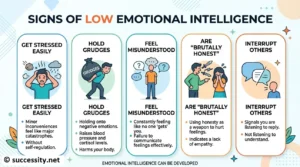
How do you know if your EQ needs a tune-up? Emotional intelligence isn’t fixed; it’s a muscle. If it’s weak, it shows. Here are common signs of low emotional intelligence:
- You get stressed easily: Without self-regulation, minor inconveniences feel like major catastrophes.
- You hold grudges: Holding onto negative emotions raises your blood pressure and cortisol levels, literally harming your body.
- You feel misunderstood: If you constantly feel like no one “gets” you, it might be a failure to communicate your feelings effectively.
- You are “brutally honest”: Using honesty as a weapon to hurt feelings usually indicates a lack of empathy.
- You interrupt others: This signals that you are listening to reply, not listening to understand.
Measuring Your EQ – How to Know Where You Stand
You might be reading this wondering, “Okay, but how do I actually measure this?” Unlike IQ, which has standardized testing, measuring emotional intelligence is more subjective, but there are ways to gauge your baseline.
Standardized Assessments:
There are professional tests like the EQ-i 2.0 or the Mayer-Salovey-Caruso Emotional Intelligence Test (MSCEIT). These are often used in corporate training environments to give a detailed breakdown of your strengths.
The “360 Feedback” Method
For a free, real-world assessment, conduct your own survey. Ask three people (a boss, a close friend, and a family member) to describe how you handle stress and conflict. The gap between how you think you handle stress and how they see you handle it is your area for growth.
Self-Reflection Audits
Pay attention to the “aftermath” of your interactions. Do you frequently leave conversations feeling regretful? Do people often leave conversations with you looking drained? These are qualitative data points that indicate where your social skills or self-awareness may be lagging.
How to Improve Emotional Intelligence in Daily Life
The good news? Unlike IQ, which is relatively static, you can improve your emotional intelligence at any age. Here are actionable exercises to incorporate into your self-development routine today.
The “Name It to Tame It” Technique
You cannot manage what you do not acknowledge. When a strong emotion hits you, stop and label it specifically.
- Instead of: “I feel bad.”
- Try: “I feel anxious because I’m unsure about the future,” or “I feel jealous of my friend’s success.”
Research shows that simply labeling an emotion reduces activity in the amygdala (the brain’s panic center).
The 3-Second Pause
This is the holy grail of self-regulation. When something triggers you—a rude comment, a spilled drink, a defiant child—force yourself to count to three before you say or do anything.
In those three seconds, your brain shifts from the emotional center to the rational prefrontal cortex. That pause saves relationships.
Practice Active Listening
Most of us are guilty of waiting for our turn to speak. To build empathy and social skills, try active listening.
- Put your phone away.
- Maintain eye contact.
- Wait until they are finished speaking.
- Reflect back what they said: “It sounds like you’re really overwhelmed by the project workload, is that right?”
Journal for Patterns
Every evening, spend five minutes reviewing your day. Ask yourself:
- When did I feel the most negative emotion today?
- What triggered it?
- How did I react?
- How could I have reacted better?
Identifying patterns is the fastest route to self-awareness.
Ask for Feedback (The Courage Step)
Ask a trusted friend or mentor: “How do I handle stress?” or “Do I interrupt people?” Listen to the answer without defending yourself. Treat their feedback as data, not an attack.
Emotional Intelligence in the Workplace
In the professional realm, technical skills are the baseline; EQ is the accelerator.
Emotional intelligence in the workplace is becoming a top priority for recruiters. Why? Because high-EQ employees navigate office politics effectively, resolve conflicts without drama, and handle constructive criticism well.
For leaders, EQ is non-negotiable. A leader without empathy cannot retain top talent. If you want to advance your career, focus less on being the smartest person in the room and more on being the most self-aware person in the room.
Emotional Intelligence in the Digital Age
We live in a world of screens, where face-to-face interaction is often replaced by texts, emails, and Slack messages. This presents a unique challenge for emotional intelligence. Without tone of voice, facial expressions, or body language—which make up the vast majority of human communication—it is alarmingly easy to misinterpret intent.
High EQ in the digital age means practicing digital empathy. It involves:
The “Re-Read” Rule: Before hitting send on a sensitive email, read it aloud. Does it sound aggressive? Could the recipient interpret that period at the end of the sentence as passive-aggressive?
Assuming Positive Intent: When you receive a message that feels short or rude, a high-EQ approach is to pause (Self-Regulation) and consider that the person might just be in a rush, rather than assuming they are angry with you.
Knowing When to Switch Mediums: An emotionally intelligent person knows when a text thread is becoming heated and has the social skill to say, “Let’s hop on a quick call to sort this out,” preventing a digital disaster.
How High EQ Transforms Romantic Relationships

While EQ helps you get ahead at work, it is absolutely vital for surviving and thriving in your personal life. Many relationship breakdowns stem not from a lack of love, but from a lack of emotional understanding.
In romantic partnerships, high emotional intelligence shifts the dynamic from “Me vs. You” to “Us vs. The Problem.”
- Validating, Not Fixing: Often, partners just want to be heard. A high-EQ partner knows that when their significant other is venting, the goal is often empathy (“That sounds really frustrating”), not immediate problem-solving.
- Navigating Conflict: Low EQ leads to stonewalling or defensive shouting matches. High EQ allows you to express needs without attacking the other person’s character. It’s the difference between saying “You’re so lazy” (Attack) and “I feel overwhelmed when the chores aren’t shared” (Expression).
- Repair Attempts: Psychologist John Gottman notes that successful couples use “repair attempts”—small gestures to lower tension during a fight. Spotting and accepting a repair attempt requires high emotional awareness.
The Benefits of High EQ
Why put in all this effort? The benefits of emotional intelligence ripple out into every aspect of your existence:
- Better Physical Health: By managing stress and regulating cortisol, you lower your risk of heart disease and stroke.
- Stronger Relationships: Empathy and communication are the bedrock of intimacy.
- Mental Well-being: High EQ is linked to lower rates of anxiety and depression.
- Higher Performance: You become more productive because you aren’t wasting energy on emotional spirals.
Final Thoughts – The Journey to Mastery
Emotional Intelligence isn’t a destination; it’s a daily practice. Some days you will be a Zen master; other days you will lose your temper. That is part of being human.
Daily Life Mastery is about progress, not perfection. By committing to understanding your emotions and the emotions of those around you, you are handing yourself the keys to a richer, more successful, and deeply connected life.
Start today. Pause. Breathe. Observe. You are in control.
Frequently Asked Questions About Emotional Intelligence
Can emotional intelligence be learned?
Yes, unlike IQ which is relatively fixed, emotional intelligence is a flexible skill set rather than a fixed trait. Through daily practice of self-awareness and empathy exercises, anyone can increase their EQ regardless of age.
Is EQ more important than IQ?
While IQ helps you process information, EQ allows you to navigate life and relationships effectively. Many experts believe EQ is a stronger predictor of leadership success, career longevity, and overall life satisfaction.
What are examples of high emotional intelligence?
High EQ looks like staying calm during a stressful deadline, actively listening to a partner without interrupting, or recognizing your own frustration and taking a break before reacting impulsively.
What are the main components of emotional intelligence?
The five core components are self-awareness, self-regulation, internal motivation, empathy, and social skills. Mastering these pillars allows you to manage your own emotions and influence the emotions of others.
How does emotional intelligence affect the workplace?
High EQ fosters better teamwork, improves conflict resolution, and helps leaders retain top talent. Employees with strong emotional intelligence can navigate office politics and handle constructive criticism without becoming defensive.]
About the Author