Sophia
We’ve all been there. It’s 2:00 AM, you’re staring at the ceiling, and your partner is sound asleep beside you. While they dream, you are replaying an argument from three days ago, nursing a knot of anger in your chest.
Conflict is unavoidable when two imperfect human beings build a life together. But what happens after the conflict? Do you repair the breach, or do you let the bricks of resentment build a wall between you?
Forgiveness in relationships is one of the hardest, most confusing, and yet most essential skills you can master. It isn’t just about saying “I’m sorry” or “It’s okay.” It is a deep, psychological process of releasing the heavy burden of anger so that love has room to breathe again.
If you are struggling with letting go of resentment, or if you’re wondering how to forgive a partner who has deeply hurt you, this guide is for you. Let’s explore how to navigate this messy terrain and move toward a true healing process.
What Is (and Isn’t) Forgiveness?
Before we can practice it, we have to define it. There are so many misconceptions about what forgiveness looks like in a romantic context.
Defining Forgiveness
At its core, forgiveness is a deliberate, conscious decision to release feelings of resentment or vengeance toward a person who has harmed you, regardless of whether they actually deserve your forgiveness. It is a shift in your internal landscape. It is reclaiming your peace of mind.
Bursting the Myths
To understand the psychology of forgiveness, we have to unlearn some bad advice:
- Myth #1: Forgiveness means forgetting.
The phrase “forgive and forget” is catchy, but biologically impossible. You aren’t a computer; you can’t wipe your hard drive. True forgiveness isn’t about erasing the memory; it’s about remembering the event without the accompanying emotional sting. - Myth #2: Forgiveness means condoning bad behavior.
Absolutely not. You can forgive your partner for lying while still maintaining that lying is unacceptable. Forgiveness acknowledges the hurt; it doesn’t excuse it. - Myth #3: You have to feel “warm and fuzzy” to forgive.
Forgiveness is often an act of will, not a feeling. You might decide to forgive your partner while you are still hurting. The feelings often follow the decision, not the other way around.
Why Is Forgiveness Crucial for Long-Term Love?
Why bother? Why not just stay angry? After all, anger feels powerful. It feels protective.
However, holding onto a grudge is like drinking poison and expecting the other person to die. The benefits of forgiveness extend far beyond just “getting along.”
- Physical Health: Chronic anger keeps your body in fight-or-flight mode, flooding your system with cortisol. Studies show that people who practice forgiveness have lower blood pressure and a stronger immune system.
- Emotional Intelligence and Mental Health: Holding a grudge takes immense mental energy. It fuels anxiety and depression. Letting go frees up that energy for joy and creativity.
- Restoring Intimacy: You cannot be fully vulnerable with someone you resent. Unresolved conflict acts as a blockade to intimacy. Forgiveness clears the debris so you can reconnect.
- Breaking the Cycle: In relationships lacking forgiveness, arguments become a game of historical scorekeeping (“Well, you did this three years ago!”). Forgiveness stops the scorekeeping and focuses on relationship conflict resolution in the present.
The Psychology of Resentment – Why Is It So Hard?
If forgiveness is so good for us, why is it so difficult to do?
Usually, it’s because our ego is trying to protect us. When we get hurt, we feel vulnerable. To counter that vulnerability, we put on the armor of anger. Staying angry allows us to feel morally superior to our partner. We become the “victim,” and they become the “villain.”
This dynamic might feel safe temporarily, but it destroys relationship satisfaction. It prevents us from seeing our partner as a flawed human being and keeps us stuck in a loop of pain. Overcoming this requires high emotional intelligence—the ability to observe our own emotions without letting them drive the bus.
Sneaky Signs You Haven’t Actually Let Go
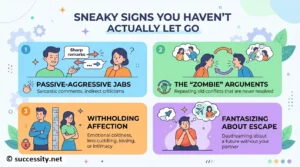
Sometimes, we say “I forgive you” just to end an argument, or because we desperately want things to go back to normal. But burying your feelings alive never works—they eventually claw their way back to the surface.
If you are wondering if you’ve truly moved on or if you are just suppressing emotional pain, look out for these red flags of hidden resentment:
- Passive-Aggressive Jabs: You make snide comments or jokes with a sharp edge. If you find yourself saying, “I was just kidding,” but you meant to sting, the anger is still there.
- The “Zombie” Arguments: You find that current arguments constantly resurrect the “dead” issue. If a debate about dirty dishes suddenly turns into a debate about that time they texted their ex three years ago, you haven’t released the grip.
- Withholding Affection: You might not be yelling, but you are punishing your partner by withdrawing intimacy, sex, or emotional support. This is a defense mechanism that screams trust issues.
- Fantasizing About Escape: You frequently daydream about being single or finding a partner who “would never treat you like this.” This indicates deep, unresolved relationship dissatisfaction.
Recognizing these signs isn’t a failure; it’s an invitation to go back and do the deeper work of healing.
How to Forgive Your Partner – A 5-Step Framework
You can’t just snap your fingers and forgive. It is a journey. Here is a practical framework to help you move through the healing process.
Step 1 – Acknowledge and Validate Your Emotions
You cannot heal what you do not feel. Don’t rush to “everything is fine.” If you are angry, be angry. If you are devastated, be devastated. Sit with the pain. Acknowledging the depth of the wound is the first step toward cleaning it out.
Step 2 – Understand the “Why”
This is the hardest part. Try to understand—not excuse—why your partner hurt you. Were they stressed? scared? acting out of their own past trauma?
- Note: Understanding their perspective doesn’t mean you agree with it. It just means you are stepping out of the victim role and looking at the situation objectively.
Step 3 – Communicate the Hurt
Using calm, clear communication, express how the action affected you. Avoid “You” statements (“You always ignore me”). Instead, use “I” statements (“I felt incredibly lonely and unimportant when you forgot our anniversary”). This lowers defensiveness and opens the door for conflict resolution strategies.
Step 4 – Make the Choice
Forgiveness is an active choice. It is a declaration. You can say to yourself (or your partner), “I am choosing to release this resentment. I am choosing to stop punishing you for this.”
Step 5 – Release the Grip
This is the maintenance phase. When you find yourself brooding over the event a week later, gently remind yourself: “I have forgiven this.” Refuse to weaponize the past in future arguments.
Navigating Different Levels of Hurt
Not all offenses are created equal. Forgiveness in relationships looks different depending on the severity of the wound.
Minor Annoyances (The Wet Towel on the Bed)
For daily irritations—chores, tone of voice, forgetfulness—practice “Decisional Forgiveness.” Make a quick, snap decision to let it go for the sake of the relationship. Ask yourself: Is this worth ruining our evening over?
Major Betrayals (Infidelity and Lies)
When deep trust issues are at play, such as infidelity, forgiveness is a marathon, not a sprint.
- Seeking Help: In these cases, couples counseling is often necessary. A third party can help navigate the trauma.
- Rebuilding Trust: Forgiveness can be granted, but trust must be earned back. The partner who caused the hurt must show consistent, transparent behavior over time.
- Apology Languages: Just like Love Languages, people apologize differently. Some need to hear “I was wrong,” while others need to see restitution. Discuss what a meaningful apology looks like to you.
When You Are the One Who Messed Up – How to Seek Forgiveness
Relationships are a two-way street. Sometimes you are the wounded, and sometimes you are the wounder. If you have broken your partner’s trust, simply saying “sorry” isn’t a magic eraser. You must actively participate in the reconciliation process.
Here is how to apologize in a way that promotes healing:
- Ditch the “But”: “I’m sorry I yelled, but you made me so mad.” That is not an apology; it is a deflection. A true apology takes 100% accountability for your reaction, regardless of the trigger.
- Validate Their Pain: Do not tell your partner they are “overreacting.” You don’t get to decide how much your actions hurt someone else. Listen to their feelings without getting defensive.
- Offer Reassurance and Repair: Words are cheap. You need to show changed behavior. If you broke trust through financial secrecy, offer full transparency with bank accounts. If you were emotionally distant, schedule regular check-ins.
- Be Patient: You cannot rush your partner’s healing process. Asking “Are you still mad about that?” only shows that you are more interested in your own comfort than their recovery.
Forgiveness vs. Reconciliation

This is a vital distinction for your safety and well-being.
Forgiveness takes one person. It is an internal release of anger.
Reconciliation takes two people. It is the restoration of a relationship.
You can forgive someone and still end the relationship. If your partner is abusive, unrepentant, or a serial cheater, forgiveness is a gift you give yourself to heal your heart so you can walk away without carrying the baggage of bitterness.
Forgiveness says: “I release the anger.”
Reconciliation says: “I trust you again.”
Do not confuse the two. You can forgive your ex-partner for the sake of your own mental health without ever speaking to them again.
Don’t Forget Yourself – The Importance of Self-Forgiveness
In the storm of relationship conflict, we often overlook the person we judge the harshest: ourselves.
When a relationship hits a rocky patch—especially involving betrayal or abuse—it is common to internalize the blame. You might beat yourself up thinking, “How could I be so stupid?” or “Why didn’t I see the signs earlier?” or “I stayed too long.”
Self-forgiveness is a critical component of emotional intelligence. If you are holding onto shame regarding your own choices, you will project that negativity onto your partner.
- Release the Hindsight Bias: You are judging your past self with your present knowledge. That is unfair. You did the best you could with the information and emotional tools you had at the time.
- Separate Worth from Mistakes: Making a mistake in a relationship, or tolerating bad behavior, does not decrease your value as a human being.
- Treat Yourself Like a Friend: If your best friend came to you with this story, would you berate them? No. You would offer compassion. Extend that same grace to yourself.
You cannot build a healthy, loving relationship with someone else if you are at war with yourself.
Practical Exercises to Foster Forgiveness
If you feel stuck, try these exercises to flex your forgiveness muscle:
- The Journal Release: Write a letter to your partner pouring out every ounce of your anger. Be vicious, be petty, be honest. Then, burn it or shred it. Do not send it. This is about getting the poison out of your system.
- The 90-Second Rule: Neurologists suggest that the chemical surge of an emotion only lasts about 90 seconds. When you feel a wave of old anger, breathe through it for 90 seconds. If you don’t feed the thought, the feeling will often pass.
- Empathy Mapping: Sit down with your partner. For 5 minutes, they explain their side, and you can only listen (no interrupting). Then, you repeat back what you heard to ensure you understood. Then switch. This builds empathy, which is the antidote to resentment.
Final Thoughts
Forgiveness in relationships isn’t a sign of weakness; it is the ultimate sign of strength. It is the refusal to let the past hold the future hostage.
Whether you are dealing with a minor misunderstanding or a major breach of trust, remember that healing is not linear. Some days you will feel free; other days you will feel angry again. That is normal. Be patient with yourself.
By choosing to forgive, you aren’t just saving your relationship; you are saving yourself. You are choosing peace over pain, and love over fear.
Frequently Asked Questions (FAQ)
How do you forgive someone who isn’t sorry?
You can forgive an unapologetic partner for your sake, not theirs. This is often called “accepting the reality.” You accept that they cannot or will not apologize, and you choose to release the anger so it doesn’t consume you. However, you should evaluate if a relationship without accountability is healthy for you.
How long does it take to forgive cheating?
There is no set timeline. For major trust issues like infidelity, it can take months or even years to fully process the pain. It often comes in waves. Patience and professional support (like couples counseling) are key.
Can a relationship survive without forgiveness?
No. A relationship without forgiveness will eventually crumble under the weight of accumulated resentment. Forgiveness is the “reset button” that allows love to continue.
Is it possible to forgive and forget?
As mentioned, you cannot wipe your memory. True forgiveness is when you remember the event, but it no longer triggers a visceral, emotional reaction. You have integrated the experience into your life story and moved on.
About the Author