Sophia
Whether you’re looking to finally tackle high-interest credit card debt, kickstart that long-overdue kitchen renovation, or handle an unexpected expense that life has thrown your way, a personal loan can be an incredibly effective financial tool. But let’s be honest—the world of borrowing can feel complicated, filled with confusing terms and hidden details.
That’s exactly why we created this guide.
Think of this as your friendly, straightforward map to understanding everything about personal loans. We’ll walk you through what they are, how they work, what it takes to get one, and how to confidently choose the absolute best option for your unique situation. By the end, you’ll have the knowledge you need to make a smart, empowered financial decision.
What Is a Personal Loan?
At its core, what is a personal loan? It’s a type of loan where you borrow a specific amount of money from a lender—like a bank, credit union, or online company—and agree to pay it back over a set period. You receive the money as a single, lump-sum payment, and you repay it in predictable, equal monthly installments.
Here are the key features that make personal loans so popular:
- Mostly Unsecured: The vast majority of personal loans are “unsecured,” which is a fancy way of saying you don’t have to put up collateral (like your house or car) to get the money. Approval is based on your financial trustworthiness.
- Fixed Interest Rates: Most personal loans come with a fixed Annual Percentage Rate (APR). This is great news for your budget because it means your interest rate and your monthly payment will never change over the life of the loan. No surprises.
- Fixed Repayment Term: You’ll know exactly when your loan will be paid off. Terms typically range from two to seven years, allowing you to choose a timeline and payment that works for you.
- Use It for Almost Anything: Unlike an auto loan or a mortgage, personal loans are flexible. The money can be used for a wide range of purposes, from consolidating debt to financing a wedding.
How Do Personal Loans Work? The 4-Step Process
The process of getting a personal loan might seem intimidating, but it breaks down into four simple steps from start to finish.
1. Application & Qualification: First, you fill out an application. The lender will then review your financial profile—primarily your credit score, income, and existing debts—to determine if you qualify and how much you can safely borrow.
2. Approval & Offer: If you meet the lender’s criteria, you’ll be approved! The lender will present you with a formal loan offer that details the loan amount, your specific APR (interest rate), the loan term (how long you have to repay it), and your fixed monthly payment.
3. Funding: Once you review and accept the loan offer, you’ll sign the final agreement. The lender then deposits the full loan amount directly into your bank account. With many online lenders, this can happen in as little as one business day.
4. Repayment: Now, you simply make your fixed monthly payments on the same day each month until the loan is fully paid off. Many lenders offer an autopay option to make this step effortless.
That’s it—the entire lifecycle of a loan in four straightforward steps.
Types of Personal Loans: Secured vs. Unsecured
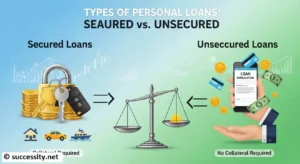
While most personal loans are unsecured, it’s important to understand the difference between the two main types.
Unsecured Personal Loans
This is the most common type of personal loan. As mentioned, “unsecured” means it isn’t backed by any collateral. The lender is giving you the loan based on its trust in your ability to repay, which is determined by your credit history, income, and other financial factors. Because the lender takes on more risk, the interest rates may be slightly higher compared to a secured loan, especially for borrowers with less-than-perfect credit.
Secured Personal Loans
A secured personal loan requires you to pledge an asset you own as collateral. This could be a savings account, a certificate of deposit (CD), or even a vehicle. This collateral acts as a safety net for the lender; if you fail to repay the loan, the lender has the legal right to take the asset to recoup its losses.
Because this collateral reduces the lender’s risk, secured loans are often easier to qualify for, especially if you have a lower credit score. They may also come with more favorable personal loan rates.
| Feature | Unsecured Personal Loan | Secured Personal Loan |
|---|---|---|
| Collateral Required? | No | Yes (e.g., savings, car) |
| Basis for Approval | Credit score, income, DTI | Credit score + value of collateral |
| Lender’s Risk | Higher | Lower |
| Interest Rates | Can be slightly higher | Often lower |
| Best For | Borrowers with good to excellent credit | Borrowers with fair/poor credit or who want a lower rate |
Common Uses for Personal Loans (And When to Use One)
One of the best things about personal loans is their versatility. Here are some of the most popular and practical ways people use them:
Debt Consolidation
This is the number one reason people get a personal loan. If you have multiple high-interest debts (like credit cards or medical bills), you can take out a single personal loan to pay them all off. This leaves you with just one manageable monthly payment, often at a much lower interest rate, which can save you a significant amount of money and help you get out of debt faster.
Home Improvement Projects
Want to remodel your bathroom, update your kitchen, or fix a leaky roof? A personal loan can provide the funds you need without requiring you to take out a home equity loan or line of credit (HELOC), which uses your house as collateral.
Major Purchases
For a large, one-time purchase—like new appliances, a new furniture set, or even an engagement ring—a personal loan can be a more structured and often cheaper alternative to putting it on a high-interest credit card.
Medical and Dental Bills
Unexpected medical expenses can be overwhelming. A personal loan allows you to pay off healthcare providers immediately and then repay the cost over time in predictable installments.
Emergency Expenses
If your emergency fund can’t cover a sudden, critical expense like a major car repair or an urgent trip, a personal loan can be a financial lifesaver.
How to Qualify for a Personal Loan: What Lenders Look For
To get approved, lenders need to feel confident you can pay back what you borrow. They assess this by looking at a few key personal loan requirements.
Your Credit Score
Your credit score is a three-digit number that summarizes your credit history and is one of the most important factors for loan approval.
- Excellent Credit (720+): You’ll likely qualify for the best personal loans with the lowest interest rates.
- Good Credit (690-719): You should have no problem getting approved with competitive rates.
- Fair Credit (630-689): You can still qualify, but your interest rates will be higher.
- Poor Credit (Below 630): Approval is more challenging, but options like secured loans or applying with a co-signer exist.
Debt-to-Income (DTI) Ratio
Your DTI ratio compares how much you owe each month to how much you earn. To calculate it, add up all your monthly debt payments (rent/mortgage, credit cards, auto loans, etc.) and divide that by your gross monthly income. Most lenders prefer a DTI ratio below 43%, as a lower DTI shows you have enough room in your budget to handle a new loan payment.
Income and Employment History
Lenders need to see that you have a steady and reliable source of income. They’ll want to verify your employment and salary to ensure you can afford the monthly payments.
Required Documents
Be prepared to provide some paperwork. Common documents include:
- A government-issued photo ID (driver’s license, passport)
- Proof of income (recent pay stubs, W-2s, tax returns)
- Proof of address (utility bill, lease agreement)
- Bank statements
Step-by-Step: How to Apply for a Personal Loan
Ready to move forward? Following this process will help you find the best deal with the least amount of stress. This is how to get a personal loan the smart way.
Step 1: Check Your Credit Score
Before you do anything else, know where you stand. You can get your credit report for free from sites like AnnualCreditReport.com. Knowing your score helps you set realistic expectations for the rates you might receive.
Step 2: Calculate How Much You Need
Figure out the exact amount you need to borrow. It’s tempting to ask for more, but borrowing only what you need will keep your payments lower and save you money on interest.
Step 3: Pre-Qualify with Multiple Lenders
This is the most important step for saving money. “Pre-qualification” lets you see the potential rates and terms you could get from various lenders based on a soft credit check, which does not hurt your credit score. Compare offers from at least 3-5 lenders, including your local bank, a credit union, and several online lenders.
Step 4: Compare Loan Offers:
Don’t just look at the monthly payment. Carefully compare the key details of each offer:
- The APR: This is the true cost of the loan, including interest and fees. Aim for the lowest APR.
- Origination Fees: Some lenders charge a fee to process the loan, which is deducted from your funds. A no-fee loan is ideal.
- The Term Length: A shorter term means higher monthly payments but less interest paid overall. A longer term lowers your payment but costs more in the long run.
Step 5: Choose a Lender and Submit a Formal Application
Once you’ve chosen the best offer, you’ll complete a full application. This step will trigger a hard credit inquiry, which may temporarily dip your credit score by a few points.
Step 6: Close the Loan and Receive Your Funds
After final approval and signing the loan documents, the money will be deposited into your account. You’re ready to go!
Understanding Personal Loan Rates and Fees
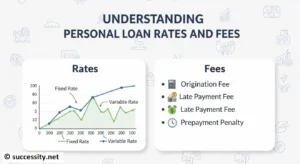
To truly compare offers, you need to speak the language. Here are the key terms to know.
Annual Percentage Rate (APR)
This is the most important number. It represents the total annual cost of borrowing, including your interest rate and any mandatory fees (like origination fees). Always compare loans using the APR, not just the interest rate.
Origination Fees
This is a one-time, upfront fee some lenders charge for processing your loan. It’s typically 1% to 8% of the loan amount and is usually deducted from the funds you receive. For example, if you borrow $10,000 with a 5% origination fee, you will only receive $9,500.
Prepayment Penalties
This is a fee charged if you pay off your loan ahead of schedule. The good news is that most reputable personal lenders do not have these penalties, but it’s always wise to check.
Late Fees
If you miss a payment due date, you’ll be charged a late fee. These fees can be costly, so always aim to pay on time.
Alternatives to Personal Loans
A personal loan is a great option, but it’s not the only one. Depending on your situation, you might consider:
- 0% APR Credit Cards: For smaller expenses, an introductory 0% APR credit card can be a good choice, as long as you can pay off the entire balance before the high-interest rate kicks in.
- Home Equity Loan or HELOC: If you’re a homeowner with significant equity, these can offer very low interest rates. However, they are secured by your home, which is a major risk to consider.
- 401(k) Loan: Borrowing from your retirement account is possible, but it comes with significant risks, including potential taxes, penalties, and hurting your long-term retirement goals. It should be considered a last resort.
- Peer-to-Peer (P2P) Lending: These platforms connect individual borrowers with individual investors who fund the loans. They can sometimes offer competitive rates, especially for those with fair credit.
Conclusion
A personal loan can be a bridge to achieving your financial goals, but the key to using it successfully is knowledge. By understanding how they work, what lenders look for, and how to compare offers effectively, you’ve already taken the most important step. Remember to borrow responsibly, have a clear plan for repayment, and always choose the loan that best fits your budget.
You’re now equipped to navigate the process with confidence. Your next step is to see what options are available to you.
Frequently Asked Questions
How fast can I get a personal loan?
It varies by lender. Traditional banks can take a week or more. Online lenders are much faster, with many offering approval in minutes and funding in as little as one to two business days.
Will applying for a personal loan hurt my credit score?
Getting pre-qualified with multiple lenders uses a soft credit check and will not affect your score. Submitting a formal application after choosing an offer will result in a hard credit inquiry, which can cause a small, temporary dip in your score.
Can I get a personal loan with bad credit?
Yes, it is possible to get personal loans for bad credit. You should expect to pay a much higher interest rate. Your best options may be to look for a secured loan, apply through a credit union (which can be more flexible), or ask a trusted friend or family member with good credit to be a co-signer.
What is a good APR for a personal loan?
A “good” APR depends heavily on your credit score and current market conditions. As of 2024, borrowers with excellent credit might see rates from 7% to 12%, while those with fair or poor credit could see rates of 20% to 36%.
What happens if I can’t repay my personal loan?
If you can’t pay, contact your lender immediately. They may offer a hardship plan. If you default, it will severely damage your credit score, you will incur late fees, and your account could be sent to a collections agency.
About the Author