Sophia
Retirement. It’s a word that can feel miles away, like a distant city on a map you’ll visit… someday. For many, thinking about it brings a mix of excitement and anxiety. It feels complex, full of strange terms like “401(k)” and “Roth IRA,” and the numbers involved can seem impossibly large.
But what if you could trade that anxiety for confidence?
The truth is, a comfortable and secure retirement isn’t reserved for Wall Street wizards or lottery winners. It’s the result of a simple, consistent plan. This guide is your roadmap. We are going to break down exactly how to save for retirement, step by step. Whether you’re 22 and just starting your career, or you want to aggressively plan for early retirement, the principles are the same.
Your journey to financial freedom starts not with a giant leap, but with a single, informed step. Let’s take that step together.
Why You Can’t Afford to Wait – The Power of Compound Interest
Before we dive into the “how,” we need to understand the “why.” The single most powerful force in your financial life is compound interest. Albert Einstein reportedly called it the eighth wonder of the world.
In simple terms, compound interest is your money making money. To truly understand how compound interest works, consider this: you invest money, it earns a return. The next year, you earn a return on your original investment plus the return you earned last year. It creates a snowball effect that starts small but grows exponentially over time.
Time is the fuel for this engine. Consider two friends:
- Sarah starts saving at age 25. She puts away $200 every month.
- Ben waits until he’s 35. To catch up, he saves $300 every month.
Assuming an 8% average annual return, by the time they both reach age 65:
- Sarah will have approximately $695,000.
- Ben will have approximately $410,000.
Despite saving less money each month, Sarah ends up with over a quarter-million dollars more than Ben, simply because she gave her money a 10-year head start. The lesson is clear: the best time to start saving for retirement was yesterday. The second-best time is right now.
Step 1: Determine How Much You Actually Need to Save for Retirement
So, what’s the magic number? While it’s different for everyone, you don’t have to guess. Here are a few reliable methods used in retirement planning to get a solid estimate.
The 25x Rule (and the 4% Rule)
This is a fantastic back-of-the-napkin way to find your retirement savings goal.
- The Concept: Take the annual income you think you’ll want in retirement and multiply it by 25.
- How it Works: This rule is the inverse of the 4% Rule, which suggests you can safely withdraw 4% of your retirement savings each year without running out of money.
- Example: If you want to live on $60,000 per year in retirement, your goal would be:
- $60,000 x 25 = $1,500,000
This number might seem daunting, but remember the power of compound interest. It’s an achievable goal with decades of consistent saving and investing.
Use a Retirement Savings Calculator
For a more personalized and detailed picture, a retirement savings calculator is your best friend. These online tools factor in your current age, income, current savings, and desired retirement lifestyle to give you a much more specific target.
Actionable Step: Take 10 minutes right now to use a calculator. It will transform “retirement” from a vague idea into a tangible goal with a clear finish line.
Factors That Influence Your Goal
Your number will be unique. Consider these questions:
- Do you plan to travel the world or stay close to home?
- Will your mortgage be paid off?
- What will your healthcare costs look like?
- Do you want to leave an inheritance for family?
Thinking about these things now will help you create a more accurate and realistic retirement plan.
Step 2 – Choose the Right Retirement Savings Accounts

You don’t want to just stuff cash under your mattress. To supercharge your savings, you need to use special accounts that give you massive tax breaks. These are the heavy hitters of retirement saving.
Start with Your Employer – The 401(k) or 403(b)
If your employer offers a retirement plan like a 401(k) (for private companies) or a 403(b) (for non-profits and schools), this is your starting point.
- The Golden Rule: The Employer Match. Many employers will “match” your contributions up to a certain percentage of your salary. For example, they might match 100% of your contributions up to 4% of your pay.
- Why it’s Critical: This is free money. It’s an instant 100% return on your investment. Not contributing enough to get the full match is like turning down a pay raise. Before you do anything else, contribute enough to get every last penny of your employer’s match.
Open an Individual Retirement Account (IRA)
An IRA is an account you open on your own, giving you more control and often more investment options than a 401(k). After you’ve secured your full 401(k) match, an IRA is your next best move. There are two main types.
Traditional IRA vs. Roth IRA – What’s the Difference?
The main difference between these two powerful retirement savings accounts is when you get your tax break.
| Feature | Traditional IRA | Roth IRA |
|---|---|---|
| Tax Benefit | Tax deduction today (pre-tax) | Tax-free withdrawals in retirement (post-tax) |
| How it Works | You contribute money before taxes, lowering your taxable income for the year. | You contribute money you’ve already paid taxes on. |
| Withdrawals | You pay income tax on all withdrawals in retirement. | Your qualified withdrawals in retirement are 100% tax-free. |
| Best For… | People who think they’ll be in a lower tax bracket in retirement. | People who think they’ll be in a higher tax bracket in retirement (like young professionals). |
Many financial experts favor the Roth IRA for younger savers, as tax-free growth and withdrawals are incredibly powerful over several decades.
For the Self-Employed and Small Business Owners
If you work for yourself, you have fantastic options too! Look into accounts like the SEP IRA, SIMPLE IRA, or a Solo 401(k). These accounts allow you to save a significant portion of your income with similar tax advantages.
The “Secret Weapon” – The Health Savings Account (HSA)
Often overlooked, an HSA is one of the best retirement savings tools available if you have a high-deductible health plan. It has a unique triple-tax advantage:
- Contributions are tax-deductible.
- The money grows tax-free.
- Withdrawals for qualified medical expenses are tax-free, at any time.
After age 65, you can withdraw money for any reason (not just medical) and it’s simply taxed as regular income, just like a Traditional IRA. It’s a fantastic, flexible tool for both healthcare and retirement.
Step 3 – Build Your Simple, Automated Savings Strategy
Knowing about the accounts is one thing; consistently funding them is what builds wealth. The key is to make it automatic so you never have to think about it.
Here is the simple, prioritized order of operations for your money:
- Priority #1: Contribute to Your 401(k) Up to the Full Employer Match. Don’t leave free money on the table. Ever.
- Priority #2: Fully Fund Your Roth or Traditional IRA. Contribute the maximum allowed by law each year.
- Priority #3: Go Back to Your 401(k) and Max It Out. If you still have money to save, increase your 401(k) contributions until you hit the annual limit.
- Priority #4: Invest in a Taxable Brokerage Account. If you’ve maxed out all your tax-advantaged options, congratulations! You can now save even more in a standard brokerage account.
Set It and Forget It – The Power of Automation
Log into your company’s 401(k) portal and your IRA account and set up automatic transfers from your bank account or paycheck. When your savings happen automatically, you learn to live on the rest. It’s the single most effective way to realize the automatic savings plan benefits and ensure you stay on track with your retirement investment strategies.
What to Invest In – A Beginner’s Guide
You don’t need to be a stock-picking genius. If you are learning the investing basics for beginners, you’ll find that for most people, a simple, diversified approach is best.
- Target-Date Funds (TDFs): This is investing on autopilot. You pick a fund with a year close to your expected retirement date (e.g., “Target 2060 Fund”). The fund automatically adjusts its mix of stocks and bonds over time, becoming more conservative as you get closer to retirement. It’s a brilliant “set it and forget it” option.
- Low-Cost Index Funds: These funds simply aim to mirror a market index, like the S&P 500. They are diversified, have very low fees, and have historically provided excellent long-term returns.
Retirement Savings by Age – A Realistic Timeline
Your priorities and goals will shift over time. Here’s a general guide for where your focus should be in each decade.
Saving for Retirement in Your 20s – The Habit Builder
Your greatest asset is time. Even if you can only save $50 a month, start now. Focus on building the habit of saving, getting your full 401(k) match, and letting that compound interest retirement engine start roaring.
Saving for Retirement in Your 30s – The Balancing Act
Life gets more expensive in your 30s—mortgages, kids, and career changes. Your goal is to avoid lifestyle creep and steadily increase your savings rate. Try to bump up your contribution percentage by 1% every year. It’s a small change you’ll barely notice, but it makes a huge difference over time.
Saving for Retirement in Your 40s – The Power Decade
These are often your peak earning years. It’s time to get serious and aggressive with your savings. This is the decade to max out your retirement accounts if possible. If you feel you’re behind, this is your chance to make significant progress.
Saving for Retirement in Your 50s and Beyond – The Super-Saver
Now you’re in the home stretch. The government allows for “catch-up contributions,” which let you save even more in your 401(k) and IRA than younger people. Focus on maximizing these contributions and getting a crystal-clear picture of your retirement finances.
Common Retirement Savings Mistakes to Avoid
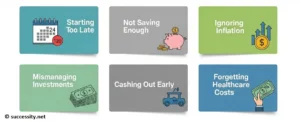
Knowing what not to do is just as important as knowing what to do. Avoid these common pitfalls.
- Mistake #1: Cashing Out Your 401(k) When Changing Jobs. It’s tempting to take the cash, but you’ll be hit with taxes and penalties, and you’ll erase years of hard-earned progress. The better move is to do a “rollover” into an IRA or your new employer’s 401(k).
- Mistake #2: Investing Too Conservatively. Being afraid of the stock market’s ups and downs can lead you to invest too heavily in “safe” assets. But with a long time horizon, your biggest risk isn’t market volatility—it’s inflation eroding the value of your savings.
- Mistake #3: Forgetting to Increase Your Contributions. As you get raises and promotions, your savings should grow too. Automate a 1% annual increase or manually increase it every time your income goes up.
- Mistake #4: Paying High Fees on Your Investments. Investment fees may look small (1-2%), but over 30-40 years, they can consume hundreds of thousands of dollars of your returns. Stick with low-cost index funds and ETFs.
Final Thoughts – Your First Step Towards a Secure Retirement
Saving for retirement doesn’t have to be a source of stress. By breaking it down, you can see it for what it is: a series of small, manageable actions that lead to a life of freedom and security.
The plan is simple:
- Start today.
- Automate your savings.
- Capture every dollar of your employer match.
- Use the right accounts (401k, IRA).
- Invest simply in low-cost funds.
- Stay consistent.
You have the knowledge and the tools. Your future self is counting on the decisions you make today. Your journey starts now—take 15 minutes to log into your 401(k) account or open an IRA. It’s the best investment you’ll ever make.
Frequently Asked Questions (FAQ)
How much of my income should I save for retirement?
A popular rule of thumb is to aim to save 15% of your pre-tax income. If that’s not possible right now, start where you can (at least enough to get your 401k match) and work your way up over time.
Can I save for retirement if I have debt?
Yes. It’s a balancing act. The standard advice is to always contribute enough to get your employer’s 401(k) match (since it’s a 100% return). After that, aggressively pay down high-interest debt (like credit cards) before increasing retirement contributions further.
What happens if I’m behind on my retirement savings?
Don’t panic. It’s never too late to start making a difference. Your path will be more aggressive, but you can still build a substantial nest egg. Focus on cutting expenses, maximizing your savings rate, and taking full advantage of catch-up contributions once you’re over 50.
Should I use a financial advisor?
For many, a good financial advisor can provide a personalized plan and peace of mind. They are especially helpful when your financial life becomes more complex. Alternatively, low-cost robo-advisors are a great, accessible option for managing your investments automatically.
About the Author