Sophia
Do you ever get that feeling? A quiet, persistent nudge that tells you you’re capable of more? More focus, more happiness, more success, more… you.
If so, you’re in the right place. That feeling is the starting point of a self-development journey, and this guide is your roadmap.
Self-development, at its core, is the conscious and deliberate pursuit of personal growth. It’s not about becoming a different person, but about becoming the best possible version of yourself. It’s about shedding the habits that hold you back and actively building the skills and mindset that will propel you forward.
Forget the idea of a single, life-altering epiphany. True, lasting change is a process of small, consistent steps. In this guide, we’ll break down that process, giving you a clear, actionable framework to start unlocking your full potential today.
Why is Self-Development a Non-Negotiable for Success?
In a world that’s constantly changing, standing still means falling behind. Investing in your own growth isn’t just a nice-to-have; it’s a fundamental requirement for a fulfilling life and career. The importance of self-development goes far beyond just learning a new skill.
Here are the core benefits of making personal growth a priority:
- It Boosts Your Self-Awareness and Confidence: The first step to improvement is understanding yourself. Self-development forces you to look inward, identify your strengths, acknowledge your weaknesses, and understand your values. This clarity is the foundation of genuine self-confidence.
- It Dramatically Improves Your Career Prospects: Whether you’re aiming for a promotion, starting a business, or switching fields, personal growth is your competitive edge. New skills, better communication, and a proactive mindset make you an invaluable asset in any professional environment.
- It Enhances Your Relationships: Personal growth isn’t a solo mission. By developing your emotional intelligence, empathy, and communication skills, you become a better partner, friend, family member, and colleague. You learn to listen actively, manage conflict constructively, and build deeper, more meaningful connections.
- It Increases Your Resilience and Mental Strength: Life will inevitably throw challenges your way. A commitment to self-development equips you with the mental and emotional tools to navigate adversity, bounce back from setbacks, and see obstacles as opportunities for growth rather than roadblocks.
- It Fosters a Deep Sense of Purpose and Fulfillment: When you align your daily actions with your core values and long-term goals, you create a life of purpose. Self-development helps you find that alignment, leading to a profound sense of satisfaction that external achievements alone can’t provide.
The 5 Core Areas of Self-Development
Self-development isn’t a single, monolithic concept. To make it manageable, it helps to break it down into five interconnected areas. Think of them as the pillars supporting your best life. You don’t have to tackle them all at once, but being aware of them helps you create a more balanced growth plan.
1. Mental Development (Mindset, Learning & Creativity)
This is all about the health and capacity of your mind. It’s about shifting from a fixed mindset (“I am what I am”) to a growth mindset (“I can learn and improve”). It involves challenging limiting beliefs, staying curious, and continuously learning.
- Examples: Reading 10 pages of a non-fiction book daily, learning a new language with an app like Duolingo, solving puzzles, taking an online course on a topic you’re passionate about.
2. Physical Development (Health, Fitness & Nutrition)
Your body is the vehicle for your entire life experience. Neglecting it makes everything else harder. Physical development focuses on energy, vitality, and longevity. When you feel physically strong and healthy, your mental clarity and emotional resilience improve dramatically.
- Examples: Committing to 30 minutes of exercise three times a week, learning to cook a few healthy meals, prioritizing 7-8 hours of sleep per night, drinking more water.
3. Social & Emotional Development (Communication, Empathy & Relationships)
This area governs how you understand and manage your own emotions and how you interact with others. It’s about building strong emotional intelligence (EQ), which is often a greater predictor of success than IQ. Strong social and emotional skills are the bedrock of all successful relationships, both personal and professional.
- Examples: Practicing active listening in conversations (listening to understand, not just to reply), making an effort to connect with a new colleague, learning to set healthy boundaries, journaling to understand your emotional triggers.
4. Spiritual Development (Purpose, Values & Mindfulness)
This has nothing to do with religion (unless that’s part of your personal journey). Spiritual development is about connecting with your inner self, defining your core values, and understanding your “why.” It’s about finding meaning beyond the day-to-day grind and fostering a sense of inner peace.
- Examples: Practicing 5-10 minutes of daily meditation, spending time in nature without distractions, volunteering for a cause you care about, journaling about what truly matters to you.
5. Financial & Career Development (Skills, Finances & Productivity)
This practical pillar focuses on building a secure and fulfilling professional life. It covers everything from mastering new job skills and managing your money wisely to optimizing your productivity and setting clear career goals. Financial health reduces stress, and career growth provides a sense of contribution and achievement.
- Examples: Creating a monthly budget, automating your savings, taking a course to get a professional certification, updating your resume, learning a high-demand skill like project management or digital marketing.
How to Start Your Self-Development Journey – A 5-Step Blueprint
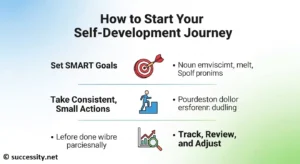
Feeling inspired is great, but inspiration without action is just a dream. Here’s a simple, proven blueprint to turn your desire for growth into a concrete plan.
Step 1 – Conduct a Brutally Honest Self-Assessment
You can’t get to where you’re going if you don’t know where you are. Take some time for honest reflection. A simple SWOT analysis (Strengths, Weaknesses, Opportunities, Threats) can be a powerful tool. Ask yourself:
- Strengths: What am I naturally good at? What do people compliment me on?
- Weaknesses: Where do I consistently struggle? What feedback have I received for improvement?
- Opportunities: What trends or skills could I leverage for growth?
- Threats: What habits or external factors are holding me back?
Step 2 – Set SMART Goals
Vague goals lead to vague results. “Get better at communication” is a wish, not a goal. Use the SMART framework to create clarity and direction.
- Specific: What exactly do you want to achieve?
- Measurable: How will you track progress and know when you’ve succeeded?
- Achievable: Is this goal realistic given your current resources and constraints?
- Relevant: Does this goal align with your values and overall life direction?
- Time-bound: When will you achieve this goal by?
Example:
- Vague Goal: “I want to get fit.”
- SMART Goal: “I will go to the gym three times per week (Monday, Wednesday, Friday) for 45 minutes each session for the next three months to increase my strength and energy levels.”
Step 3 – Create a Personal Development Plan (PDP)
Your PDP is your battle plan. It’s a living document that turns your goals into actionable steps. For each goal, outline the specific actions you’ll take, the resources you’ll need (books, courses, mentors), and your timeline. We’ll dive deeper into this below.
Step 4 – Take Consistent, Small Actions
This is the most important step. Big goals are achieved through tiny, daily habits. As James Clear famously wrote in Atomic Habits, “You do not rise to the level of your goals. You fall to the level of your systems.” Focus on building a system of small, sustainable habits rather than relying on bursts of motivation. Want to read 50 books a year? Start by reading one page a day.
Step 5 – Track, Review, and Adjust
Schedule a weekly or monthly check-in with yourself.
- What went well?
- What didn’t?
- What did I learn?
- What needs to change in my plan for next week/month?
Self-development is not a straight line. It’s a process of continuous feedback and adjustment. Be flexible and kind to yourself.
10 Essential Self-Development Skills to Master
While your journey is unique, certain skills provide an outsized return on your investment of time and effort. Here are ten skills for personal growth that will benefit you in every area of life.
- Time Management: The art of using your time intentionally to achieve your goals.
- Actionable Tip: Try the Pomodoro Technique: work in focused 25-minute intervals, followed by a 5-minute break.
- Communication: The ability to clearly and effectively convey your ideas and listen to others.
- Actionable Tip: The next time you’re in a conversation, practice repeating back what the other person said (“So what I’m hearing is…”) to ensure you understand before you respond.
- Emotional Intelligence (EQ): The ability to recognize, understand, and manage your own emotions and those of others.
- Actionable Tip: Practice the “pause.” When you feel a strong emotion, take a deep breath and count to ten before you react.
- Resilience: The capacity to recover quickly from difficulties; toughness.
- Actionable Tip: Reframe a recent failure. Instead of seeing it as a loss, write down three lessons you learned from the experience.
- Financial Literacy: Understanding how to manage, save, and invest your money effectively.
- Actionable Tip: Track every single expense for one week. The awareness alone is a powerful first step to better financial habits.
- Critical Thinking: The objective analysis and evaluation of an issue in order to form a judgment.
- Actionable Tip: Before sharing an article or accepting a headline as fact, take two minutes to find a source with an opposing viewpoint.
- Habit Formation: The skill of intentionally building positive habits and breaking negative ones.
- Actionable Tip: Use “habit stacking.” Link a new desired habit to an existing one. For example, “After I brush my teeth in the morning, I will meditate for one minute.”
- Mindfulness: The practice of being present and fully engaged with whatever you’re doing at the moment.
- Actionable Tip: Pick one daily activity (like drinking your morning coffee) and do it with zero distractions. No phone, no TV. Just focus on the taste, smell, and warmth.
- Networking: Building and maintaining relationships that can help you professionally and personally.
- Actionable Tip: Aim to have one “give” conversation per week where you connect two people who could benefit from knowing each other, or offer help with no expectation of return.
- Public Speaking: The ability to speak confidently and persuasively in front of an audience.
- Actionable Tip: Record a one-minute video of yourself on your phone talking about your day. It’s a low-stakes way to get comfortable seeing and hearing yourself present.
Powerful Tools & Resources for Your Journey
You don’t have to reinvent the wheel. Stand on the shoulders of giants by leveraging these world-class resources.
Must-Read Self-Development Books
- The 7 Habits of Highly Effective People by Stephen Covey: A timeless framework for personal and professional effectiveness.
- Atomic Habits by James Clear: The definitive guide to building good habits and breaking bad ones.
- Mindset: The New Psychology of Success by Carol S. Dweck: A groundbreaking book on the power of a growth mindset.
- How to Win Friends and Influence People by Dale Carnegie: The classic manual for improving your social and communication skills.
Top Self-Development Apps
- Headspace / Calm: Guided meditation and mindfulness apps to reduce stress and improve focus.
- Notion / Todoist: Powerful tools for organizing your goals, tasks, and personal development plan.
- Audible / Blinkist: Consume more books via audiobooks or get key insights from non-fiction books in minutes.
- Habitica / Streaks: Gamify your habits and stay motivated to be consistent.
Influential Podcasts & YouTube Channels
- The Tim Ferriss Show (Podcast): Deconstructs the habits and routines of world-class performers.
- The School of Greatness with Lewis Howes (Podcast): Inspiring interviews with brilliant business minds, athletes, and influencers.
- Matt D’Avella (YouTube): A minimalist filmmaker who explores topics like habits, productivity, and intentional living.
Creating Your Personal Development Plan
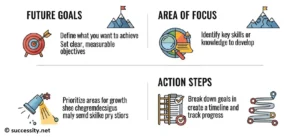
A Personal Development Plan (PDP) is where your intentions become reality. It’s your personalized roadmap that documents your goals and the exact steps you’ll take to achieve them. Writing it down makes it real.
Here are the key sections your PDP should include:
- Current State Assessment: A summary of your self-assessment (your strengths and areas for improvement).
- Future Goals: Your specific SMART goals for the next 3 months, 1 year, and 5 years.
- Area of Focus: For each goal, identify which core area of self-development it falls under (Mental, Physical, etc.).
- Action Steps: The exact, small, daily or weekly actions you will take.
- Required Resources: The books, courses, people, or tools you’ll need.
- Timeline & Milestones: Key dates and smaller milestones to hit along the way.
- Metrics for Success: How will you measure your progress?
To make this easy, we’ve created a simple yet powerful template you can use to build your own plan.
Final Thoughts – The Journey Never Ends
The most important thing to remember is that self-development is a continuous, rewarding journey of becoming, not a one-time destination you arrive at. There is no finish line where you are “fully developed.”
The person you are today is a result of your past choices and habits. The person you will be a year from now will be the result of the choices you make starting today.
Embrace curiosity. Celebrate small wins. Be patient and compassionate with yourself when you stumble. And most importantly, just start. Pick one small action from this guide and do it today.
What is the first step you’ll take on your self-development journey? Share in the comments below
Frequently Asked Questions about Self-Development
What is a good example of self-development?
A great example is someone wanting to become a better public speaker. They might start by reading a book on the topic (Mental), then join a local Toastmasters club to practice (Social), and track their progress by recording their speeches (Action/Review).
How long does it take to see results from self-development?
You can feel small wins almost immediately. The confidence boost from keeping a promise to yourself for one day is a real result. Significant, life-changing results are the product of months and years of consistent effort. It’s a lifelong journey.
What is the difference between self-development and self-help?
They are very similar and often used interchangeably. Self-help can sometimes carry a connotation of fixing something that is “broken.” Self-development is a more proactive term focused on continuous growth and optimization, regardless of your starting point.
How do I stay motivated on my self-development journey?
Motivation is fleeting; systems are reliable. Don’t rely on feeling motivated. Instead, build strong habits, start incredibly small so it’s easy to win, track your progress visually, and connect with a community or an accountability partner who supports your growth. Remind yourself of your “why” regularly.
About the Author