Sophia
Feeling stuck? Ever feel like you’re running on autopilot, repeating the same patterns and getting the same results? If you’ve ever paused and wondered, “How did I even get here?” you’re on the verge of discovering one of the most powerful tools for personal development: self-reflection.
So, what is it, really? Self-reflection is the conscious act of looking inward to examine your thoughts, feelings, decisions, and actions. It’s not about overthinking or harsh self-criticism. Instead, it’s a compassionate and curious exploration of your inner world to gain insight. Think of it as hitting the pause button on life to check your internal map and make sure you’re still heading in the direction you truly want to go.
This guide will explore why a consistent reflective practice is the critical engine for meaningful personal growth. We’ll cover the tangible benefits, powerful techniques you can start today, and actionable prompts to transform self-reflection from a vague idea into a life-changing habit.
Why Self-Reflection is the Cornerstone of Personal Growth
The benefits of dedicating time to self-reflection are not just abstract concepts; they are tangible shifts that can fundamentally improve your quality of life. It’s more than just a wellness buzzword—it’s a foundational skill for anyone committed to genuine self-improvement.
It Fosters Greater Self-Awareness
At its core, self-reflection is the ultimate tool for building self-awareness. It helps you understand your own internal operating system: your core values, your natural strengths, your hidden weaknesses, and your emotional triggers. When you know why you do what you do, you can start living more authentically. You move from being a passenger in your own life to being the driver, making choices that are in true alignment with who you are.
It Improves Decision-Making and Problem-Solving
Your past experiences are a goldmine of data. Self-reflection allows you to analyze past decisions—both the triumphs and the failures—without judgment. By asking, “What went well? What would I do differently next time?” you gather valuable intelligence that informs your future choices. This reflective practice turns mistakes into lessons, preventing you from repeating them and equipping you to navigate future challenges more effectively.
It Enhances Emotional Intelligence (EQ)
Emotional intelligence is the ability to recognize, understand, and manage your own emotions, as well as influence the emotions of others. Self-reflection is the gym where you train this muscle. By regularly checking in with yourself (“Why did that comment make me so angry? What fear is behind my hesitation?”), you gain mastery over your emotional responses. This leads to better communication, stronger relationships, and less reactive behavior.
It Provides Clarity on Goals and Values
It’s easy to get swept up in the day-to-day grind and lose sight of the bigger picture. A consistent self-reflection habit ensures your daily actions are aligned with your long-term goals and deepest values. It acts as a compass, preventing you from drifting aimlessly or chasing goals that society told you to want. This clarity is essential for sustainable motivation and a deep sense of purpose.
It Builds Resilience and Reduces Stress
Life will always present challenges. Resilience isn’t about avoiding difficulty; it’s about how you bounce back from it. Self-reflection helps you process and reframe negative experiences. Instead of seeing a setback as a catastrophe, you can analyze it as a learning opportunity. This mental reframing reduces the emotional weight of stress and builds the mental fortitude needed to face adversity with confidence.
How to Practice Self-Reflection – 5 Powerful Techniques

You don’t need a silent retreat on a mountaintop to start a meaningful reflective practice. It can be woven into your life in simple, accessible ways. The key is finding a method that resonates with you and practicing it with intention.
The Art of Journaling for Insight
Writing is a powerful way to untangle the thoughts swirling in your mind. The act of putting pen to paper (or fingers to keyboard) forces clarity. You can try a “stream of consciousness” approach where you write whatever comes to mind, or you can use structured journaling prompts (like the ones below) to guide your thinking. This creates a personal log of your growth that you can look back on for years to come.
Mindful Meditation and Quiet Contemplation
Sometimes, the best way to hear your own inner voice is to quiet all the external noise. Mindfulness meditation isn’t about emptying your mind, but rather about observing your thoughts without judgment. Just 5-10 minutes of sitting in silence, focusing on your breath, can create the mental space needed for profound insights to surface.
Asking Yourself Powerful Questions
The quality of your reflection is determined by the quality of your questions. Instead of generic questions like “How was my day?”, ask more potent, open-ended questions. A great technique is “The 5 Whys,” where you take a problem or feeling and ask “Why?” five times to drill down to the root cause. This moves you from surface-level observation to deep understanding.
Seeking Feedback and External Perspectives
Self-reflection doesn’t have to be a solo activity. Discussing your thoughts with a trusted friend, mentor, or therapist can provide an invaluable external perspective. They might see patterns you’ve missed or offer a different interpretation of a situation, amplifying your own self-awareness and accelerating your personal development.
Scheduling “Reflection Appointments” with Yourself
What gets scheduled gets done. If you treat self-reflection as an optional “if I have time” activity, it will always get pushed aside. Block out 15 minutes in your calendar—daily, weekly, or bi-weekly—and treat it as a non-negotiable meeting with your most important business partner: yourself.
The Impact of Self-Reflection on Key Areas of Your Life
So, what does this all look like in the real world? The practice of self-reflection isn’t an abstract exercise; its benefits ripple out into the most practical and important parts of your daily life, creating tangible self-improvement.
In Your Career and Professional Development
In the workplace, reflection is a superpower. It helps you identify your professional goals with precision, recognize your unique strengths to leverage for a promotion, and, crucially, learn from professional setbacks without letting them derail your confidence. Regularly asking, “What skills do I need to develop?” or “How could I have handled that meeting better?” is a hallmark of effective leadership and a key driver of career advancement.
In Your Relationships (Romantic, Familial, and Social)
Have you ever reacted poorly in an argument and later wished you could take it back? Self-reflection helps you understand why you reacted that way. By understanding your emotional triggers and communication patterns, you can approach conflicts with more empathy and less defensiveness. This leads to healthier conflict resolution, deeper connections, and more fulfilling relationships with everyone in your life.
In Your Physical and Mental Well-being
Your mind and body are deeply connected. Self-reflection can help you uncover the root causes of stress, anxiety, or unhealthy habits. By asking questions like, “Why do I reach for junk food when I feel overwhelmed?” or “What activity truly recharges my energy?” you can move beyond treating symptoms and start addressing the source, empowering you to build sustainable self-care routines that genuinely support your well-being.
The Science of Self-Reflection – What’s Happening in Your Brain?
The transformative power of self-reflection isn’t just self-help wisdom; it’s backed by neuroscience. When you turn your attention inward, you are actively reshaping your brain for the better.
Engaging Your Brain’s Default Mode Network (DMN)
Scientists have identified a brain system called the Default Mode Network, which becomes active when your mind is at rest and not focused on an external task. This is your brain’s “introspective” or “daydreaming” network. Engaging in self-reflection purposefully activates the DMN, allowing you to consolidate memories, make sense of your experiences, envision the future, and form a coherent sense of self.
Strengthening Metacognition (Thinking About Thinking)
Self-reflection is a prime example of metacognition—the ability to think about your own thinking. This higher-order skill, largely managed by the prefrontal cortex, is what separates conscious thought from automatic reaction. The more you practice it, the stronger this “mental muscle” becomes, giving you the incredible power to observe your thought patterns and consciously choose to change them.
Promoting Neuroplasticity and Habit Change
Your brain is not fixed; it is constantly changing based on your experiences and thoughts—a concept known as neuroplasticity. When you reflect on a negative habit and consciously choose a different response, you are physically weakening old neural pathways and strengthening new ones. This is the biological mechanism behind breaking bad habits and forming positive ones. Consistent self-reflection literally rewires your brain for personal growth.
Getting Started – Self-Reflection Prompts for Daily, Weekly, and Monthly Growth
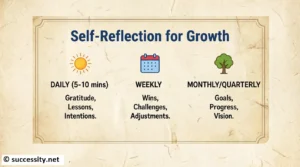
Knowing where to start is often the biggest hurdle. Use these powerful journaling prompts to kickstart your reflective practice.
Daily Self-Reflection Prompts (5-10 minutes)
What one thing brought me a moment of joy or peace today?
What challenged me today, and how did I respond?
What is one thing I learned about myself or the world today?
Weekly Review Questions
What was my biggest win this week, and what made it possible?
Where did I fall short of my values or goals? What can I learn from it for next week?
Who or what am I most grateful for this week? Why?
Monthly and Quarterly Check-ins
Looking back at the last month, am I on track with my larger goals? If not, what adjustments are needed?
Which habits are serving my personal development, and which are holding me back?
- What is one area of my life (career, relationships, health, etc.) that needs more of my attention next month?
Common Challenges in Self-Reflection (And How to Overcome Them)
Even with the best intentions, building a new habit can be tough. Here’s how to navigate the most common roadblocks.
Challenge – “I don’t have time.”
Solution: Start small. You don’t need an hour. Begin with just five minutes during your morning coffee, on your commute, or before you go to sleep. Consistency is far more important than duration.
Challenge – “It feels uncomfortable or negative.”
Solution: Reframe your mindset from judgment to curiosity. You are an explorer in your own mind, not a critic. Approach your thoughts and feelings with compassion, and focus on what you can learn rather than what you did “wrong.”
Challenge – “I don’t know where to start.”
Solution: Don’t let perfection be the enemy of progress. Use the prompts provided in this article. Pick just one question a day and see where it takes you. The simple act of starting is the most important step.
Conclusion – Make Self-Reflection a Lifelong Habit
In a world that constantly pulls our attention outward, the act of turning inward is a quiet revolution. Self-reflection is the essential, non-negotiable practice for anyone serious about personal growth, self-awareness, and creating a life of purpose and intention. It empowers you to learn from your past, live more fully in the present, and build the future you desire.
Remember, this is a practice, not a destination. It’s about small, consistent efforts that compound over time into profound transformation. Start today. Start small. The person you’ll become will thank you for it.
What is one self-reflection technique you will try this week? Share your thoughts in the comments below!
Frequently Asked Questions about Self-Reflection
What is the Main Goal of Self-Reflection?
The primary goal is to gain deeper self-awareness and understanding. It helps you recognize your values and patterns, forming the foundation for intentional personal growth. This clarity leads to better decisions and a more authentic life.
What Are Some Practical Examples of Self-Reflection?
Practical examples include journaling, meditating, or taking a quiet walk to process your thoughts. You can also talk through challenges with a trusted friend or answer a single reflective question. The method matters less than the consistent, intentional practice.
How Does Self-Reflection Help with Anxiety and Stress?
Self-reflection helps by identifying the specific root causes and triggers of your stress. This awareness allows you to interrupt negative thought cycles before they spiral. It builds emotional resilience by helping you process and reframe challenging situations.
Can I Practice Self-Reflection Without Writing?
Yes, absolutely. You can reflect by meditating, taking a walk, or using voice memos to record your thoughts. Even a structured conversation with a mentor serves as a powerful reflective practice. The specific tool is less important than the intentional act of introspection.
What is the Easiest Way to Start a Self-Reflection Habit?
The easiest method is to “start small and stack it” onto an existing routine. Ask yourself one simple question for just a few minutes while your coffee brews or during your commute. Making it small and linking it to a current habit ensures consistency.
About the Author