Sophia
❝ Two years ago on a random Tuesday morning, I sat in my car in the office parking lot, completely exhausted. I had just spilled scalding coffee down my only clean work shirt. ❞
❝ Instead of just wiping it off, I put my head on the steering wheel and completely broke down in tears. ❞
It wasn’t about the coffee. It was the crushing realization that despite working 50-hour weeks, I was completely stagnant, broke, and angry at everyone around me.
That was the exact moment I realized a brutal truth: Working hard isn’t a skill—working on yourself is. That breakdown forced me to build the skills I am about to share with you.
But wait, before I show you the exact framework that pulled me out of that dark place, we need to clarify what we are actually talking about.
What Are Personal Development Skills, Anyway? (The Quick Answer)
Before we can build the house, we need to pour the foundation. If you are wondering what these skills actually mean in the real world, here is the short version.
Personal development skills are the fundamental abilities that help you grow, adapt, and succeed in life. Key examples include emotional intelligence, resilience, active listening, and adaptability. Mastering these qualities allows you to overcome obstacles, build stronger relationships, and unlock your true potential.
But here is where it gets interesting…
Most articles give you a list of 20 random habits. That is overwhelming and useless.
Instead, I am going to show you the 5 “Domino Skills”—master these, and everything else naturally falls into place. Let’s start with the hardest one.
Domino Skill #1 – Radical Adaptability (Pivoting When My “Perfect” Plan Failed)
Building on what we just mentioned in the introduction, the absolute biggest trap I fell into was believing my “life plan” was set in stone. When things inevitably went wrong, I completely panicked.
I used to map out my entire year on a giant whiteboard. I thought that if I just planned hard enough, I could avoid failure.
But here is a brutal reality check…
The universe does not care about your whiteboard. Things will break, clients will leave, and economies will shift.
Think of your life and career like navigating a sailboat across the ocean. You absolutely cannot control the weather, the waves, or the wind.
If a storm hits, radical adaptability is the ability to adjust your sails quickly without losing your mind.
People often think being adaptable means being passive, like a leaf blowing in the wind. That is a massive misconception.
It is actually the exact opposite. It is about making aggressive, smart, and calculated pivots the second the data changes.
When you refuse to adapt, you sink. When you embrace adaptability, you use the storm to push you forward faster.
The crucial difference between reacting and responding
Most people fail at adaptability because they don’t understand the difference between a reaction and a response.
❌ Reacting is purely emotional and instant. It is shouting at the wind when the boat tips. It is sending an angry email right after receiving bad news.
✅ Responding is logical and deliberate. It is taking a breath, calmly grabbing the ropes to steady the ship, and plotting a new course.
So, how do you actually practice this when you are incredibly stressed out?
Here are three quick ways to build your adaptability muscle starting today:
- The 24-Hour Rule: When a major plan fails, give yourself exactly 24 hours to be frustrated. After that, you are no longer allowed to complain; you must pivot.
- Run “Pre-Mortems”: Before starting a big project, ask yourself, “If this completely fails in six months, what went wrong?” Planning for failure reduces the shock.
- Seek Micro-Discomfort: Take a new route to work, try a completely new hobby, or read a book outside your industry. Train your brain to be comfortable with the unfamiliar.
But you might be asking: how do you stop yourself from reacting emotionally when things go wrong? The secret lies in our next core skill.
Domino Skill #2 – Emotional Intelligence (Stopping the Blame Game)

After I finally learned that I needed to adapt to my circumstances, I had to face a much uglier, more painful truth about myself.
Whenever a plan failed, I instantly blamed my boss, my partner, the algorithm, or the economy. Nothing was ever my fault.
You might be wondering – how do you stop playing the victim when it genuinely feels like the world is against you?
The ultimate answer is Emotional Intelligence (EQ).
EQ is the ultimate professional and personal superpower. It forces you to stop looking out the window at everyone else, and start looking at your own internal dashboard.
❝ The exact day I stopped saying ‘He made me so angry’ and started saying ‘I am allowing myself to feel angry right now’ changed the entire trajectory of my career. ❞
Taking extreme ownership of your emotions gives you your power back. If someone else “makes” you angry, they control you. If you own your reaction, you control the situation.
Self-awareness – Learning to read your internal dashboard
Imagine driving a car down the highway with black tape over the dashboard. You have no idea if you are out of gas or if the engine is overheating.
That is what living without self-awareness looks like.
You cannot fix an engine if you don’t know what the warning lights mean. Self-awareness is the ability to recognize your own emotional triggers before they explode and ruin a relationship.
If you notice your chest tightening or your breathing getting shallow during a meeting, that is your dashboard blinking red. Step back, breathe, and detach.
Empathy – The ultimate cheat code
Once you figure out your own emotions, you can start understanding others.
💡 Pro Tip: Empathy is not about agreeing with everyone or being a pushover. It is simply the ability to understand the “why” behind someone else’s actions.
When you practice empathy, you realize your annoying coworker isn’t trying to sabotage you; they are just deeply insecure about their own job.
This completely diffuses office drama. It turns enemies into allies.
Now that we have our emotions properly in check and we stop blaming others, we face the ultimate boss fight in personal development – time.
Domino Skill #3 – Ruthless Prioritization (Escaping the 50-Hour Trap)
So, your emotions are stable, you are practicing empathy, and you are ready to adapt to anything. You are feeling unstoppable.
But listen closely… if you spend your entire day doing the completely wrong things, absolutely none of that matters.
Here is a tough pill to swallow: Being perpetually busy is actually the ultimate form of laziness.
It means you are avoiding the hard, uncomfortable work of deciding what actually matters.
I used to have a daily to-do list with 30 items on it. I ran around the office feeling incredibly productive, but I was just drowning in shallow work.
I was answering emails, organizing folders, and attending pointless meetings. I was moving fast, but I was running on a treadmill. I wasn’t moving forward.
Why traditional time management is completely dead
The self-help industry has lied to us about how to manage our days.
■ Time management says: “Try to cram more tasks into less time. Optimize every single second of your day.”
■ Energy management says: “Identify your most critical task, and do it during the hours when you have the most mental energy.”
You do not need more time. You need more focus. You need to protect your peak hours like your life depends on it.
The Eisenhower Matrix – My daily lifesaver
To escape the trap of “fake work,” I started dividing my tasks ruthlessly using the Eisenhower Matrix. Everything falls into four categories:
- Urgent and Important: Do this right now (e.g., a website crash, a major client crisis).
- Important but Not Urgent: Schedule this (e.g., long-term strategy, building skills, exercising). This is where true growth happens.
- Urgent but Not Important: Delegate this (e.g., most emails, phone calls, administrative requests).
- Not Urgent and Not Important: Delete this entirely (e.g., doom-scrolling social media, gossiping).
If a task did not move the needle on my biggest life goal, I simply looked the person in the eye and said “no.”
But wait, saying “no” and protecting your time requires you to communicate incredibly well with others. This brings us to the quietest, yet deadliest skill on our list.
Domino Skill #4 – Active Listening (How Shutting Up Saved My Best Relationship)
With my schedule finally clear and my priorities in order, I suddenly had the mental space to notice something genuinely horrifying about myself.
Because I had spent years always rushing from one task to another, I never actually listened to people. I just faked it.
While my friends or coworkers were talking, I was just waiting for them to pause so I could take my turn to speak.
❝ I almost lost my business partner because I kept interrupting his deep concerns with my ‘brilliant’ rapid-fire solutions. I wasn’t hearing him at all. ❞
He didn’t need me to fix his problem; he needed me to understand his perspective.
Here is the absolute magic trick to building deep human connections…
Active listening means listening entirely to understand, not to reply. It requires your eyes, your ears, and your full, undivided presence.
Most people walk around completely starved for attention. When you actually stop, look them in the eye, and truly listen, they feel valued.
When people feel truly heard, they trust you on a biological level. And make no mistake: Trust is the ultimate currency of both business and friendship.
If you want to become a master listener, follow these three rules:
- The 3-Second Pause: When someone finishes speaking, count to three in your head before you reply. It proves you are absorbing their words.
- Mirroring: Repeat the last three words of their sentence back to them as a question. (e.g., “It’s been a stressful week.” -> “A stressful week?”) It encourages them to open up further.
- Silence the Internal Monologue: Stop formulating your clever response while they are still talking. Just listen to the words.
But what happens when you do absolutely everything right—you listen, you prioritize, you adapt—and things still fall apart?
Domino Skill #5 – True Resilience (Bouncing Back After the Fall)
You can be deeply adaptable, emotionally brilliant, incredibly focused, and a phenomenal listener.
But I promise you, life will still punch you directly in the mouth sometimes.
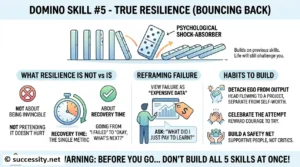
Building on all the previous domino skills we just established, true resilience is your psychological shock-absorber.
Resilience is not about being invincible. It is not about pretending that getting knocked down doesn’t hurt. It absolutely hurts.
Resilience is measured by one metric and one metric only: Your recovery time.
How fast can you go from “I completely failed” to “Okay, what is our next move?”
When I first started my career, a major rejection would ruin my entire month. I would sulk, complain, and lose all my momentum.
Today, a massive rejection might ruin my afternoon, but by the next morning, I am back to work. That shortening of recovery time is the essence of growth.
Reframing failure as “data collection”
The most successful, happiest people on earth do not view failure as a reflection of their personal worth.
They view failure simply as expensive data.
Every single time I launch a project that flops, or try a new habit that doesn’t stick, I ask myself one empowering question: “What did I just pay to learn?”
To build this shock absorber, you need to practice a few habits:
- Detach your ego from your output: You are not your job. You are not your failed project.
- Celebrate the attempt, not just the win: Reward yourself for having the courage to try something difficult, regardless of the outcome.
- Build a safety net: Surround yourself with people who will support you when you fall, not people who will say “I told you so.”
But before you run off, totally hyped up to build all five of these skills at the exact same time, I need to issue a massive, critical warning.
The “Toxic Productivity” Trap – What Personal Growth is NOT
Since we are friends here, and we are going on this journey together, I need to be brutally honest with you about something.
The modern self-help industry often pushes a very dark, very dangerous lie.
If you open social media, gurus will tell you that to be successful, you need to wake up at 4 AM, take freezing ice baths, skip vacations, and hustle until your eyes bleed.
Listen to me very carefully: That is not personal growth; that is a fast track to a hospital bed.
We have completely confused self-abuse with self-improvement.
Toxic productivity is the nagging, guilty feeling that you should always be “doing something.” It is the inability to watch a movie without feeling like you are wasting time.
If you fall into this trap, you will eventually experience severe burnout. Your body will literally force you to stop by making you sick.
Real, sustainable personal growth includes knowing exactly when it is time to rest.
Setting firm boundaries, taking a nap, and staring at the ceiling are elite-level skills.
Do not let internet billionaires with massive support staffs shame you into destroying your mental health. Growth is a marathon, not a sprint.
Here are a few signs that you are on the right track:
- You prioritize sleep just as much as your career goals.
- You have hobbies that you do just for fun, with zero intention of monetizing them.
- You don’t tie your daily self-worth to how many items you crossed off your to-do list.
So, how do we actually apply everything we’ve learned today safely and effectively?
Your Blueprint – How to Start Building These Habits Today
We have covered a massive amount of ground today. You now deeply understand the five Domino Skills, and you know how to avoid the burnout trap.
Right now, you might be sitting there asking yourself: “This is great, but where do I actually begin without getting overwhelmed?”
The answer is embarrassingly simple, and it takes away all the pressure.
The 1% Improvement Rule (My secret weapon)
Do not try to overhaul your entire personality by tomorrow morning. If you try to fix your listening, your emotional intelligence, and your time management all at once, you will fail.
Instead, rely on the math of compounding interest. Just pick one single skill—like active listening—and try to be just 1% better at it today.
If you improve by just 1% every day, you will be 37 times better by the end of the year. Small, invisible daily actions create massive, visible transformations.
Find a growth-minded accountability partner
Do not attempt to do this entirely alone. Motivation is a fickle emotion; it comes and goes.
Find one trusted friend or colleague who also desperately wants to level up their life. You don’t need a massive group, just one person.
Set a rule: Text each other your “small wins” every single Friday afternoon. Knowing that someone is going to ask about your progress is the ultimate hack for consistency.
Are you ready to take that first step? Let’s wrap this up.
Final Thoughts on Your Journey
❝ Today, my mornings look very different. I still spill coffee on my shirts sometimes, but instead of crying in my car, I just laugh, grab a napkin, and get to work. ❞
The skills we talked about today will never make your life completely perfect. Problems will still arise.
But mastering these Domino Skills makes you incredibly, powerfully equipped to handle those imperfections with grace and strength.
Remember, the goal isn’t to become a flawless, highly optimized robot. The goal is simply to be a slightly kinder, stronger, and more resilient version of yourself than you were yesterday.
Start small, give yourself plenty of grace on the bad days, and keep building. You’ve got this, and I am actively cheering for you.
FAQs: Answering Your Unspoken Questions
What is the single most important skill to learn first?
The absolute foundation is self-awareness (part of Emotional Intelligence). You simply cannot fix a flaw or change a habit if you refuse to acknowledge it exists.
How do I showcase these skills on a resume without sounding cliché?
Stop using buzzwords like “good communicator.” Instead, tell a one-sentence story: “Used active listening to resolve a client dispute, saving a $10k account.” Prove it with action.
Are these exactly the same thing as “soft skills”?
Not quite. Personal development is your internal growth (how you manage yourself). Soft skills are how you apply that growth externally (how you interact with your coworkers).
Can I improve if I naturally lack motivation?
Absolutely. Motivation is a myth; discipline is a system. Build tiny micro-habits that take 2 minutes a day so you don’t need to rely on feeling “inspired” to take action.
How long does it actually take to see real results?
You will feel an internal mindset shift within a week. However, seeing external, tangible results in your career or relationships usually takes 3 to 6 months of consistent practice. Keep going!
About the Author