Sophia
Let’s be honest for a second. Have you ever woken up after a full night of sleep, stared at your ceiling, and felt completely drained before the day even began? You drag yourself out of bed, pour a massive cup of coffee, and dive into your to-do list – but no matter how hard you push, it feels like you are running on an empty tank.
If this sounds familiar, you aren’t just tired. You are likely staring down the barrel of burnout.
In today’s hustle-driven culture, we are often celebrated for pushing our limits, working late, and saying “yes” to everything. But living in a constant state of overdrive isn’t a badge of honor; it’s a one-way ticket to complete physical and emotional exhaustion.
True self-development isn’t about grinding until you break. It’s about learning how to avoid burnout so you can achieve your goals while actually having the energy to enjoy them.
In this guide, we are going to break down exactly what burnout is, how to spot the red flags before it’s too late, and give you seven practical burnout prevention strategies you can start using today.
What is Burnout (And How is it Different from Stress)?
To fight an enemy, you first need to understand it. A lot of people use the words “stress” and “burnout” interchangeably, but they are very different animals.
The World Health Organization (WHO) officially recognizes burnout as an occupational phenomenon. They define it as a syndrome resulting from chronic workplace stress that hasn’t been successfully managed. But let’s take it a step further: burnout doesn’t just happen at work. Parents, caregivers, and students can absolutely experience it, too.
Stress vs. Burnout – The Key Differences
Think of stress as being over-engaged. When you are stressed, you feel like you have too much on your plate. Your emotions are heightened, you might feel anxious, and you are operating in a frantic state of hyperactivity. But usually, if you can just get through the current project or crisis, you know you’ll feel better.
Burnout, on the other hand, is about disengagement. It’s the feeling of having not enough—not enough energy, not enough motivation, not enough care left to give. If stress is drowning under a massive wave, burnout is the feeling that the ocean has dried up completely. It is characterized by severe emotional exhaustion, cynicism, and a sharp drop in your personal effectiveness.
The Hidden Types of Burnout (It’s Not Just About Your Job)
When we talk about learning how to avoid burnout, the conversation almost always centers around office life, endless meetings, and demanding bosses. But emotional exhaustion doesn’t discriminate. You can burn out from any role that requires sustained emotional, physical, or mental output without adequate recovery.
Understanding the specific type of burnout you are facing is crucial for figuring out how to heal from it.
- Occupational Burnout: This is the classic type. It stems from a toxic workplace, unmanageable workloads, or a drastic lack of work-life balance.
- Parental Burnout: Raising children is a 24/7 job with zero vacation days. Parental burnout happens when the immense pressure of raising kids—coupled with sleep deprivation and a loss of personal identity—leaves moms and dads feeling completely drained and detached.
- Caregiver Burnout: Often affecting those looking after aging parents or a chronically ill family member, caregiver burnout is a state of physical and emotional exhaustion. It frequently comes with feelings of guilt, as the caregiver gives everything to their loved one and leaves nothing for themselves.
- Relationship Burnout: Yes, you can burn out on people. If you are constantly the “fixer” in your friend group, or if you are navigating a highly draining romantic relationship, the emotional toll can lead to severe mental fatigue.
The Root Causes of Burnout (Why We Hit the Wall)

It is a common myth that burnout is purely the result of working too many hours. While overwork is certainly a trigger, research shows that emotional exhaustion is usually caused by a deeper mismatch between the individual and their environment.
If you want to master burnout prevention strategies, you need to understand these underlying causes:
- Lack of Control: Feeling like you have no say in your schedule, your assignments, or how you manage your day-to-day life is incredibly demoralizing. Micro-management is a fast track to burnout.
- Unclear Expectations: If you never know exactly what is expected of you—whether from a boss, a partner, or even yourself—you will constantly overwork out of fear of falling short.
- Dysfunctional Dynamics: Dealing with the “office bully,” navigating a passive-aggressive boss, or feeling undermined by peers drains your mental energy long before the actual work does.
- Mismatched Values: If you deeply value creativity and autonomy, but your life forces you into rigid, monotonous routines, the friction between your core values and your daily reality will eventually burn you out.
- The Perfectionism Trap: Burnout is often an inside job. High-achievers who set impossibly high standards for themselves are rarely satisfied, meaning their brain never receives the “reward” signal needed to rest.
The 5 Stages of Burnout – Where Are You on the Scale?
Burnout doesn’t happen overnight. It is a slow, creeping process. Psychologists often break burnout down into five distinct stages. Identifying which stage you are currently in can help you choose the right stress management techniques before you hit rock bottom.
Stage 1: The Honeymoon Phase
When you start a new job, launch a new project, or take on a new role, your energy is high. You feel highly productive, committed, and optimistic. The danger here is that you often ignore your boundaries because you are so fueled by the initial excitement.
Stage 2: The Onset of Stress
The honeymoon is over. You start noticing some days are harder than others. Your optimism wanes, and you begin to experience mild physical symptoms like occasional headaches, trouble sleeping, or relying a little too heavily on caffeine to get through the afternoon.
Stage 3: Chronic Stress
Stress is no longer an occasional visitor; it’s your roommate. You feel consistently pressured, your motivation plummets, and feelings of resentment start to bubble up. You might begin snapping at loved ones, procrastinating on important tasks, and neglecting your self-care habits.
Stage 4: Burnout
This is the critical breaking point. The symptoms from Stage 3 become so severe that you can no longer function normally. You feel entirely empty, deeply pessimistic, and completely disconnected from your goals. Simply getting out of bed feels like moving a mountain.
Stage 5: Habitual Burnout
If Stage 4 is ignored, burnout becomes a chronic, habitual state. At this point, the emotional exhaustion is deeply embedded in your life, often leading to ongoing depression, chronic anxiety, and severe physical health issues. Recovery at this stage usually requires professional intervention and major life changes.
The Early Warning Signs of Burnout
Your body and mind are incredibly smart. They will always whisper to you before they scream. The trick to avoiding a complete crash is learning to listen to those whispers.
Here are the most common signs of burnout to watch out for:
Physical Signs:
- Chronic fatigue: Feeling physically heavy and drained, even after resting.
- Weakened immune system: Catching every cold that goes around the office.
- Unexplained aches: Frequent tension headaches, stomach issues, or muscle pain.
- Changes in habits: Struggling to fall asleep, waking up constantly, or a sudden change in your appetite.
Emotional Signs:
- Cynicism and detachment: Feeling irritable, impatient, or entirely disconnected from your work and the people around you.
- Loss of motivation: Dreading the start of the day and struggling to find joy in things you used to love.
- A sense of failure: Intense self-doubt and feeling like nothing you do makes a difference.
Behavioral Signs:
- Procrastination: Taking three hours to do a task that should take thirty minutes.
- Isolation: Skipping social events, ignoring text messages, and withdrawing from friends and family.
- Unhealthy coping mechanisms: Pouring that extra glass of wine every night, binge-eating, or endlessly doomscrolling on social media to numb out.
How to Avoid Burnout – 7 Actionable Strategies
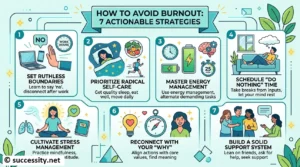
If you recognized yourself in the signs above, don’t panic. You can turn the ship around. Here are seven powerful burnout prevention strategies to protect your peace and rebuild your energy.
1. Set Ruthless Boundaries
A healthy work-life balance doesn’t happen by accident; it happens by design. In a world where our smartphones keep us tethered to our jobs 24/7, you have to become ruthless about your boundaries.
Learn to embrace the word “no.” You do not have to attend every meeting, take on every extra project, or respond to emails at 9 PM. Create clear physical and digital boundaries. When the workday is over, close your laptop, mute your notifications, and mentally clock out. Protect your personal time as fiercely as you protect your work deadlines.
2. Prioritize Radical Self-Care
Forget what Instagram tells you—self-care isn’t just about expensive bubble baths, spa days, or treating yourself to a new outfit. Radical self-care is about fiercely protecting your basic biological needs.
You cannot outwork a bad diet and sleep deprivation. Aim for 7 to 9 hours of quality sleep every single night. Fuel your body with nutritious food that gives you sustained energy, and move your body daily, even if it’s just a 20-minute walk around the block.
When you treat your body like a machine that requires premium fuel and regular maintenance, your mental resilience skyrockets.
3. Master Energy Management (Not Just Time Management)
We often think the cure to feeling overwhelmed is a better to-do list app. But avoiding burnout is less about managing your time and more about managing your energy.
Try using techniques that prevent cognitive overload. The Pomodoro Technique (working in 25-minute sprints followed by 5-minute breaks) is brilliant for keeping your brain fresh.
You can also use the Eisenhower Matrix to sort your tasks into what is actually urgent and important, versus what can be delegated or deleted. Don’t schedule back-to-back demanding tasks; alternate them with easier, low-focus work.
4. Schedule “Do Nothing” Time
When was the last time you sat on the couch and just stared out the window? No podcasts playing in the background, no TV, no scrolling on your phone.
Our brains have a resting state called the Default Mode Network (DMN), which activates when we are daydreaming or letting our minds wander. This network is crucial for creativity, problem-solving, and mental recovery.
If you are constantly consuming information, your brain never gets to rest. Intentionally schedule pockets of unstructured “do nothing” time into your week. A weekend digital detox can do wonders for a fried nervous system.
5. Cultivate Stress Management Techniques
Because you can’t eliminate stress entirely, you need a toolkit to process it so it doesn’t build up and morph into burnout.
Weave daily stress management techniques into your routine. This doesn’t require an hour of chanting on a mountain top. It can look like five minutes of mindfulness meditation before you open your laptop.
It can be practicing “box breathing” (inhale for 4 seconds, hold for 4, exhale for 4, hold for 4) before a stressful meeting. Or, it could be taking ten minutes before bed to write down three things you are grateful for in a journal.
6. Reconnect with Your “Why”
One of the biggest hidden causes of burnout is a lack of alignment. Pushing yourself hard for a goal you deeply care about feels exhausting, but fulfilling. Pushing yourself hard for a goal you don’t care about just feels like torture.
Take a step back and do a life audit. Why are you working this hard? What is the end goal? Does your current day-to-day life align with your core values? If you realize you are climbing a ladder that is leaning against the wrong wall, it might be time to pivot. Reconnecting with your personal “why” restores the passion that burnout steals.
7. Build a Rock-Solid Support System
Being fiercely independent is great, but independence shouldn’t mean isolation. Humans are wired for connection.
When you are feeling overwhelmed, talk about it. Lean on your friends, vent to your partner, or seek out a mentor who has navigated similar pressures. If you feel like you are sinking, do not hesitate to hire a therapist or a life coach. Asking for help is not a sign of weakness; it is a profound sign of self-awareness and strength.
What to Do If You Are Already Burned Out
Let’s say you are reading this and thinking, “Well, prevention is great, but I’m already completely toasted.”
If you are already in the depths of burnout, you need to shift your focus from prevention to recovery. Learning how to recover from burnout requires a heavier intervention.
- Hit the Brakes: You cannot heal in the same environment that made you sick. You need to take actual time off. Use your vacation days or look into a short-term leave of absence.
- Seek Professional Help: Burnout often brings depression and anxiety along for the ride. A licensed therapist can help you untangle your relationship with work and self-worth.
- Re-evaluate Everything: Recovery isn’t about resting just long enough so you can return to the exact same toxic habits. You have to make structural changes to your life, whether that means setting brutal boundaries, changing roles, or even leaving a toxic career entirely.
Final Thoughts – Choose Sustainable Growth
Understanding how to avoid burnout isn’t a one-and-done lesson; it is a lifelong practice of self-awareness. It’s about checking in with yourself daily, honoring your limits, and realizing that your energy is your most valuable currency.
Remember, you are running a marathon, not a sprint. Sustainable success comes from knowing when to push forward and knowing when to rest.
Now we want to hear from you! What is your favorite way to destress after a chaotic week? Let us know in the comments below.
Want to improve your productivity without sacrificing your mental health? Check out our complete guide on Mastering the Art of Saying No. And don’t forget to subscribe to our newsletter for weekly self-development tips delivered straight to your inbox!
Frequently Asked Questions About Burnout
How long does it take to recover from burnout?
There is no set timeline. Depending on how severe your emotional exhaustion is, recovery can take anywhere from a few weeks to a couple of years. It requires patience and a sustained commitment to changing your lifestyle and habits.
Can you avoid burnout by just taking a vacation?
No. A vacation is a fantastic, temporary pause, but it won’t cure burnout. If you spend a week on a beach but return to the same crushing workload, zero boundaries, and toxic environment, you will be burned out again by Tuesday. True prevention requires daily, systemic changes.
Who is most at risk for burnout?
While anyone can experience it, high-achievers, perfectionists, people-pleasers, and caregivers are at a much higher risk. People who tie their self-worth directly to their productivity often struggle the most with setting boundaries.
About the Author