Sophia
Let’s be radically honest for a second. When most of us hear the phrase “self-care,” we instinctively picture weekend spa retreats, expensive face masks, or a luxurious two-hour morning yoga routine. But what happens when it is a chaotic Tuesday afternoon, your inbox is exploding, your Slack is pinging every three seconds, and you cannot even find five minutes to drink a single glass of water?
That is where the real challenge begins. Mastering self-care at work isn’t about expensive bubble baths or taking a six-month sabbatical to find yourself. It is about gritty, realistic, on-the-clock survival tactics that protect your mental health and physical energy while you are still hitting your deadlines, managing client expectations, and paying your bills.
If you are currently feeling completely overwhelmed, teetering on the edge of burnout, and suffocating under a pile of professional guilt, you are in the right place. Let me show you how to take your workday back.
💡 The Quick Answer – What is self-care at work?
Self-care at work means taking small, intentional actions to protect your mental, emotional, and physical health during your actual working hours. Instead of waiting for the weekend to recover, you practice this in real-time by setting clear professional boundaries, taking strategic micro-breaks away from screens, staying physically hydrated, and learning to decline unrealistic tasks without feeling guilty.
The Tuesday Bathroom Breakdown – Why Waiting for the Weekend is a Trap
It was a Tuesday at 2 – 15 PM, and I was hiding in the third stall of the office bathroom. My phone was vibrating in my pocket with relentless Microsoft Teams notifications, my chest felt like it was in a vice, and I just needed to cry in private.
In that moment of panic, a harsh truth became blindingly clear – waiting until Friday at 5 – 00 PM to “recharge” is a total scam. Yet, this is the exact system most of us rely on. We spend our entire workweek completely depleting our energetic reserves, running our bodies on cortisol and caffeine, only to collapse on the couch the moment the weekend starts. This broken cycle is what organizational psychologists call presenteeism – being physically present at your desk but mentally checked out due to sheer exhaustion.
Think about how fundamentally broken that cycle is. When you live solely for the weekend, you fall directly into the Weekend Recovery Trap:
- Saturday – The Physical Crash: Your body finally exits high-cortisol survival mode, leaving you with exhaustion, tension headaches, or unexplained muscle pain.
- Sunday – Anticipatory Anxiety: The notorious “Sunday Scaries” set in by late afternoon as your mind begins pre-processing Monday’s upcoming stress.
- Monday to Friday – Survival Mode: You run your body on adrenaline and caffeine, starving your brain of oxygen for five days and expecting to breathe normally just because it is Saturday.
If you do not build micro-survival tactics into your daily 9-to-5, the system will eventually break you down. Self-care cannot be treated as an after-hours luxury. It must be practiced in real-time, right in the thick of the chaos, while you are still on the clock.
What Real Self-Care at Work Actually Looks Like (Hint – It’s Not Free Office Pizza)
Let’s get one thing straight – corporate “wellness programs” rarely solve the root causes of workplace stress. A ping-pong table in the breakroom, a colorful meditation app subscription, or free pizza on a Friday does not fix a structurally toxic workload or a manager who expects immediate replies at midnight.
True self-care is not about luxury or indulgence; it is an act of pure self-preservation. It requires you to treat your personal energy like a smartphone battery that you simply refuse to let drop below a critical 20% threshold. Think of it as changing the oil in your car while you are driving down the highway at 70 miles per hour. You must learn to manage your energy reserves, not just your calendar.
Traditional time management tells you to cram fifteen tasks into an eight-hour shift. Energy management, however, reminds you that if you do not pace your cognitive load, those same fifteen tasks will take twice as long because your brain is completely fried. Real self-care on the clock is built on quiet, daily boundaries –
- Refusing to check or reply to emails during your designated lunch break.
- Stepping away from your screen the moment your physical vision begins to blur.
- Consciously unclenched your jaw and dropping your shoulders when you feel stress rising.
- Taking your full vacation days without apologizing to your team for your absence.
Ultimately, these are tiny, rebellious acts of self-preservation that protect your humanity in a sterile corporate environment. But how do you actually implement this when you feel like you are constantly being watched?
“Covert” Micro-Breaks – How I Recharge While Looking Completely Busy

Since you cannot exactly unroll a yoga mat in the middle of a bustling open-plan office or during an intense Zoom presentation, you have to get highly tactical. This is where “covert” micro-breaks come in. These are invisible, highly effective habits designed to reset your autonomic nervous system in less than sixty seconds, without drawing any unwanted attention from your peers or managers.
The 20-20-20 Rule for Screen Fatigue
Your eyes do an incredible amount of heavy physical labor during the workday, and optical strain is a primary driver of afternoon brain fog and tension headaches. When we stare at screens, our natural blink rate drops by half, causing dry eyes and mental fatigue. To combat this, apply the 20-20-20 rule –
- Every 20 minutes: Look away from your glowing computer screen.
- Focus your eyes: Focus on any physical object at least 20 feet away.
- Hold your gaze: Keep your eyes fixed on that object for at least 20 seconds.
This simple visual shift instantly relaxes the focusing muscles inside your eyes and gives your brain a literal micro-pause to process information and reset.
Desk Stretches That Won’t Make Your Coworkers Stare
You do not need a gym or a yoga studio to release the physical anxiety trapped in your muscles. When our sympathetic nervous system (the fight-or-flight response) is activated, we subconsciously freeze our posture, raise our shoulders, and hold our breath.
To deactivate this stress response instantly, perform the Stealth Shoulder Drop Protocol right at your desk:
- Inhale Deeply: Breathe in through your nose for 4 seconds, feeling your chest expand.
- Hold & Tense: Hold your breath for 3 seconds while gently shrugging your shoulders toward your ears.
- The Drop: Forcefully drop your shoulders all at once as you exhale slowly through your mouth.
- Repeat: Do this 3 times to send a neurological signal to your brain that you are safe.
Another option is the “under-desk ankle roll,” which stimulates blood circulation and prevents lower-body stiffness during prolonged sitting.
Setting Boundaries – My Journey from Office “Yes-Person” to Protecting My Peace
Now that your body is getting physical micro-breaks, it is time to face the ultimate challenge of corporate life – protecting your time and attention. I spent the early years of my career as a chronic people-pleaser. I was terrified that saying “no” or asking for clarification would make me look lazy, incompetent, or like a bad team player. So, I accepted every project, answered emails late at night, and slowly grew to deeply resent my job.
But here is the paradox of workplace psychology – protecting your time actually increases your professional respect. When you are always available, your time loses its perceived value. People instinctively respect colleagues who respect their own limits and treat their attention as a premium resource.
How to Say “No” Professionally (With Scripts)
You do not have to be confrontational to set a boundary. In fact, you should rarely use the actual word “no.” Instead, master the “priority pivot.” This technique politely transfers the responsibility of workload management back to the person making the request.
💡 Try this script: “I can absolutely take this new task on, but doing so will delay Project X until Thursday afternoon. Which of these two tasks is the priority for you today?”
This force-multiplies your professional boundaries because it presents your capacity limits as a mathematical reality rather than a lack of motivation.
Taming the Pings – Managing Slack and Email Anxiety
Every notification sound or flashing light is a tiny, artificial shot of cortisol injected directly into your nervous system. We have been conditioned to react to work chat pings with the same urgency as a true physical emergency. To protect your limited mental bandwidth, adopt this digital hygiene checklist –
- Mute the Noise: Turn off all auditory and vibration alerts on Slack, Teams, and email clients.
- Batch, Don’t React: Block out 10-minute windows every hour to process incoming messages, rather than responding to every ping in real-time.
- Set Your Status: Use your status updates to normalize asynchronous communication (e.g., “Focus Mode – checking messages at the top of the hour”).
This allows you to work in a state of deep focus rather than constant, stressful interruption.
Nourishing the Machine (When You Can Barely Leave Your Desk)
Even with strong boundaries, you cannot expect your brain to perform at a high level if you are fueling it with nothing but black coffee and adrenaline. When you are stuck in your chair for hours, the physical inputs you give your body directly dictate your cognitive output, your mood, and your patience with challenging colleagues.
Upgrading Your Desk Water Strategy
Mild dehydration is one of the most common, yet overlooked, causes of afternoon fatigue, brain fog, and low motivation. If you rely on walking to the breakroom to fill up a tiny paper cup, you simply won’t drink enough water because the friction of leaving your desk is too high when you are busy.
Invest in a large, insulated water bottle with a built-in straw and keep it on your desk. Having a straw dramatically increases your water intake because it removes the physical friction of unscrewing a cap while you are typing or reading.
Brain-Boosting Snacks vs. The Afternoon Sugar Crash
When the 3 – 00 PM energy slump hits, your brain cries out for quick glucose. However, your food choices determine whether you recover or crash further –
- ❌ Avoid (The High-Glycemic Crash): Soda, vending machine candy, and energy drinks. They cause a massive insulin spike followed by severe mental fatigue and brain fog.
- ✅ Choose (Sustained Cognitive Fuel): Walnuts (rich in Omega-3s), raw almonds (healthy fats and protein), or dark chocolate containing at least 70% cocoa (antioxidants to reduce stress).
Organizing the Chaos – How Clearing My Desk Cleared My Mind
Once your physical energy is stabilized, look at your immediate physical environment. A chaotic, messy desk acts exactly like having thirty open tabs running in the background of your computer. It silently drains your cognitive processing power and creates a constant visual hum of anxiety.
Every scattered piece of paper, half-empty coffee mug, and random sticky note is a visual cue of an unfinished task or an unmade decision. To fix this, build a five-minute “shutdown ritual” into the end of your workday –
- Purge the Trash: Throw away or recycle garbage and empty dishes.
- Clear the Visual Field: File away physical papers completely out of sight.
- Wipe Down: Quickly wipe down your desk surface to keep it fresh.
- Plan Ahead: Write down your top three priorities for tomorrow on a single sticky note.
This simple habit ensures that when you sit down at your desk the next morning, you are greeted by a calm, clean slate rather than yesterday’s leftover chaos.
Finding Your Office “Safe Person” (And Avoiding the Energy Vampires)
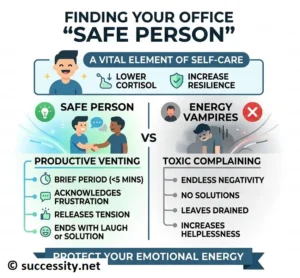
Navigating workplace politics and interpersonal dynamics is incredibly taxing. This is why having at least one trusted ally in your office is a vital element of self-care. You need a safe person who understands the specific pressures of your company culture and can offer a sympathetic ear when needed.
Having a workplace confidant has been scientifically shown to lower workplace cortisol levels and increase resilience. However, you must be select about who you bring into your inner circle.
The Difference Between Productive Venting and Toxic Complaining
It is important to distinguish between supportive relationships and those that leave you feeling worse –
- 💡 Productive Venting: Lasts for a brief, defined period (under five minutes), acknowledges a frustrating situation, releases the tension, and ends with a laugh, a shared sigh of relief, or a constructive solution.
- ❌ Toxic Complaining: Is an endless, cynical cycle of negativity that offers no solutions. It leaves both participants feeling heavier, more drained, and increasingly helpless. Protect your limited emotional energy from these office pessimists.
Rewiring Your Brain – How to Stop Feeling Guilty for Taking a Breath
The greatest obstacle to practicing self-care is not a lack of time; it is the deep, persistent guilt that arises the moment we decide to pause. Modern corporate culture has conditioned us to link our personal self-worth directly to our constant productivity.
We must actively reframe how we view rest. Professional athletes do not train at maximum intensity for 24 hours a day because they know their muscles would tear and their performance would plummet. They understand that structured rest is not “wasted time” – it is the exact phase where muscle recovery and growth actually happen.
Your brain works exactly the same way. Taking a mindful breath, stepping away for a walk, or closing your eyes for a minute is not a sign of laziness; it is a vital professional tool. You cannot consistently produce high-quality work if you refuse to let your cognitive battery recharge.
The Hardest Lesson I Learned – Leaving Work AT Work
All of these strategies are ultimately useless if you pack your daily workplace stress into your bag and bring it home to your loved ones. For years, I would physically leave my office, but mentally, I was still sitting at my desk, anxiously checking emails during dinner and mentally drafting replies in bed.
To protect your personal life, you must establish a clear Psychological Commute using this 4-step end-of-day shutdown ritual:
- The Digital Cleanse: Close all non-essential browser tabs, save your progress, and shut down your work laptop completely.
- The Physical Shift: If you work from home, place your laptop in a drawer or cabinet out of sight to remove the visual cue of “work.”
- The Wardrobe Transition: Change into comfortable, non-work clothing immediately to signal a physical boundary to your brain.
- The Sensory Break: Spend 10 minutes walking, listening to music, or sitting in silence before engaging with family or personal tasks.
Create a firm boundary between your professional responsibilities and your personal life. When you close your laptop, let that be a true, uninterrupted end to your day.
Final Thoughts – You Are So Much More Than Your Job Title
When you finally close your laptop tonight, take a moment to remember why you are putting these boundaries in place. You are a complex human being with relationships, hobbies, passions, and a life outside of your employment. You are not simply a resource on a spreadsheet or a machine built for endless productivity.
Learning to prioritize self-care at work is not about being a perfect, stress-free employee. It is about taking back ownership of your mental and physical health, ensuring that your career pays your bills without costing you your sanity.
FAQs – The Unspoken Questions About Office Survival
Is it okay to tell my boss I need a mental health day, or should I fake a physical illness?
It depends entirely on your company culture. If your manager is empathetic, honesty builds trust. If the environment is toxic, simply state you are taking a “sick day” to attend to a personal health matter.
How do I practice this if I work in a highly monitored environment (like retail or a call center)?
Focus on internal grounding techniques that no camera can see. Practice deep belly breathing while dealing with a customer, and fiercely protect every single second of your mandated 15-minute breaks.
Does taking breaks at work actually lower my productivity?
Absolutely not. Data shows that micro-breaks prevent decision fatigue and actually increase your net output. You end up working much smarter, making fewer mistakes, rather than just working longer.
How can remote workers practice self-care when the “office” is their bedroom?
You must create physical and psychological separation. Never work from your bed, and take a 10-minute walk outside before and after your shift to simulate a fake “commute” for your brain.
What’s the difference between everyday work stress and actual professional burnout?
Stress is characterized by over-engagement and anxiety; you care too much. Burnout is when that shifts into cynicism, detachment, and emotional exhaustion; you stop caring altogether.
About the Author