Sophia
Imagine two different scenarios.
In the first, a project manager named Sarah receives critical feedback from her boss. Her face flushes red, she immediately gets defensive, blames her team, and leaves the office fuming. The rest of her day is ruined, and her team walks on eggshells around her.
In the second scenario, David receives the same feedback. He feels that initial sting of disappointment – he’s human, after all – but he takes a deep breath. He pauses. He asks clarifying questions to understand the issue and later brainstorms solutions with his team.
The difference between Sarah and David isn’t IQ. It isn’t technical skill. It’s Emotional Intelligence (EQ).
For a long time, we obsessed over IQ – raw processing power and logic. But as we move further into 2025, the data is clear: while IQ might get you through the door, developing emotional intelligence is what opens up the elevator to the top floor.
Whether you want to be a better leader, a better partner, or just feel less stressed, this guide covers everything you need to know about boosting your EQ.
What Exactly is Emotional Intelligence?
Before we dive into the “how,” let’s clear up the “what.”
Emotional Intelligence (often abbreviated as EI or EQ) is the ability to perceive, control, and evaluate emotions – both your own and those of the people around you. It’s about recognizing that emotions are data. They tell us what matters, where the dangers are, and how to connect with others.
The EQ vs. IQ Debate
Many people ask, “Is EQ more important than IQ?”
Think of IQ as the hardware of a computer (processing speed) and EQ as the software (how well the programs run). You can have a supercomputer, but if the software is glitchy and keeps crashing, the computer isn’t very useful.
The best news? unlike IQ, which is relatively static throughout your life, emotional intelligence is a skill. Thanks to neuroplasticity (the brain’s ability to rewire itself), you can actually train your brain to become more emotionally intelligent at any age.
The 5 Components of Emotional Intelligence
To understand how to improve EQ, we usually look to the framework popularized by psychologist Daniel Goleman. If you want to build a house, you need a blueprint. These are your five pillars.
1. Self-Awareness
This is the foundation. If you don’t know what you are feeling, you can’t manage it. Self-awareness is the ability to recognize your emotions as they happen. It is deeply connected to daily self-reflection, helping you understand your strengths, your weaknesses, and, crucially, your triggers.
2. Self-Regulation
Once you know what you’re feeling, what do you do with it? Self-regulation isn’t about burying your feelings or being a robot. It’s about expressing them appropriately. It’s the difference between screaming at a driver who cut you off and taking a deep breath to realize they might be rushing to the hospital.
3. Internal Motivation
High-EQ individuals are driven by things beyond money and status. They have a passion for what they do, an inner resilience, and a desire to improve just for the sake of getting better. They remain optimistic even when things go sideways.
4. Empathy
This is the ability to understand the emotional makeup of other people. It’s not just feeling for someone (sympathy); it’s feeling with them. Empathy allows you to read a room, understand power dynamics, and sense when someone is saying “I’m fine” but actually means “I’m drowning.”
5. Social Skills
This is where it all comes together. Social skills are about managing relationships to move people in the desired direction. It involves communication, conflict management, and the ability to build a rapport with anyone, from the janitor to the CEO.
Why Developing EQ Matters More Than Ever
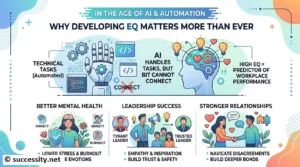
We are living in the age of AI and automation. Algorithms can now write code, analyze spreadsheets, and diagnose diseases. But there is one thing AI cannot do: connect.
As technical tasks become automated, human skills become premium currency. Emotional intelligence in the workplace is now the top predictor of performance.
- Better Mental Health: High EQ is linked to lower levels of anxiety, depression, and burnout. You learn to manage stress rather than letting it manage you.
- Leadership Success: A leader without empathy is a tyrant. The best leaders use EQ to inspire trust and psychological safety.
- Stronger Relationships: In our personal lives, EQ helps us navigate disagreements without destroying bonds.
Common Barriers to Developing Emotional Intelligence
If developing emotional intelligence were easy, everyone would be walking around like a Zen master. But the reality is, biology and habit often work against us. Understanding these barriers is the first step to breaking through them.
The “Stress” Trap
When you are under chronic stress, your brain actually changes. High levels of cortisol (the stress hormone) impair the function of the prefrontal cortex – the part of the brain responsible for executive function and emotional regulation. In simple terms: Stress makes us stupid. It forces us into survival mode, where empathy and patience are seen as luxuries we can’t afford.
The Ego Defense
Your ego’s job is to protect your self-image. When someone gives you feedback, your ego perceives it as a threat, similar to a physical attack. This triggers “cognitive dissonance” – the discomfort of holding two conflicting beliefs (e.g., “I am a kind person” vs. “I just yelled at my team”). To protect yourself, you might reject the feedback entirely. Developing EQ requires the courage to lower the shield and admit, “I messed up.”
Cultural Conditioning
Many of us were raised in environments where emotions were ignored or suppressed. Phrases like “Big boys don’t cry” or “Leave your personal life at the door” conditioned us to view emotions as weaknesses. Unlearning decades of stoicism is one of the hardest parts of the EQ journey.
7 Actionable Steps for Developing Emotional Intelligence
So, how do you actually do it? You can’t just read about pushups to get strong; you have to do the pushups. Here are seven exercises to start building your EQ muscle today.
1. The “Emotional Audit”
Most of us run on autopilot. We move from task to task without checking in with ourselves.
- The Exercise: Set a timer on your phone for three times a day. When it goes off, ask yourself: What am I feeling right now? Where do I feel it in my body?
- Why it works: This builds the neural pathways for self-awareness.
2. Master the “6-Second Pause”
When we get triggered, our amygdala (the primitive “fight or flight” part of the brain) hijacks our prefrontal cortex (the thinking part). This process takes about 6 seconds.
- The Exercise: When you feel a surge of anger or defensiveness, force yourself to wait 6 seconds before speaking or typing that email. Count the tiles on the floor or take two slow breaths.
- Why it works: It gives your “thinking brain” time to catch up to your “feeling brain.”
3. Expand Your Emotional Vocabulary
If the only words you use to describe your feelings are “happy,” “sad,” and “pissed off,” you are limiting your ability to regulate.
- The Exercise: Get specific. Instead of “I feel bad,” try “I feel neglected,” “I feel anxious,” or “I feel overwhelmed.”
- Why it works: Psychologist Dan Siegel coined the phrase “Name it to tame it.” Labeling an emotion specifically actually reduces its intensity in the brain.
4. Practice Active Listening (For Real)
Most people don’t listen to understand; they listen to reply. They are just waiting for their turn to speak.
- The Exercise: In your next conversation, focus entirely on the other person. Look at their body language. When they finish, summarize what they said (“So, what I’m hearing is…”) before you offer your own opinion.
- Why it works: This creates immediate trust and drastically improves your empathy.
5. Ask for the “Brutal” Feedback
Self-awareness is hard because we all have blind spots. You might think you’re assertive, while your team thinks you’re aggressive.
- The Exercise: Ask a trusted friend or mentor: “How do I act when I’m stressed?” or “What is one thing I do that shuts down communication?”
- Why it works: It bridges the gap between how you see yourself and how the world sees you.
6. Journal to Spot Patterns
Triggers are rarely random. They usually point to an unmet need or a past wound.
- The Exercise: When you have a strong emotional reaction, write it down. Who was involved? What was said? What value of yours was violated?
- Why it works: You’ll start to see patterns. Maybe you aren’t angry at your partner for the dishes; you’re angry because you feel your time isn’t being respected.
7. The “Empty Chair” Perspective
It is easy to demonize people we disagree with.
- The Exercise: When you are in a conflict, imagine the other person’s perspective. What are they afraid of? What pressure are they under?
- Why it works: It humanizes the opposition and moves you from judgment to curiosity.
Signs of High vs. Low Emotional Intelligence
How do you know if you (or your boss) have high EQ? Here is a cheat sheet.
| Signs of High EQ | Signs of Low EQ |
|---|---|
| Embraces change and adapts easily. | Fears change and digs heels in. |
| Can let go of mistakes and move on. | Holds grudges and refuses to forgive. |
| curiously listens to other perspectives. | Gets easily offended and defensive. |
| Knows how to say “No” to protect boundaries. | Passive-aggressive or a “people pleaser.” |
| Gives credit to others. | Takes credit for team success. |
| Can identify and name their feelings. | Says “I just feel weird/bad.” |
Developing Emotional Intelligence in the Workplace
Work is where EQ is tested the most. We are thrown together with people we didn’t choose, under high pressure, with money on the line.
If you are a leader (or aspire to be one), focus on psychological safety. This is a shared belief that the team is safe for interpersonal risk-taking. High EQ leaders admit when they are wrong. They ask questions rather than give orders.
When dealing with conflict, switch your language. Instead of saying, “You always turn reports in late,” (which triggers defensiveness), try “When the report is late, I feel anxious because I can’t prepare for the client meeting.” This focuses on the impact of the behavior, not the character of the person.
Applying Emotional Intelligence in Personal Relationships

While workplace EQ gets you promoted, relationship EQ keeps you connected. The skills are similar, but the stakes – love, family, friendship – are often higher.
The Difference Between Complaint and Criticism
Renowned relationship researcher Dr. John Gottman identifies a key distinction that high-EQ partners understand.
- Complaint: Addresses a specific behavior. “I’m upset that the dishes weren’t done last night.”
- Criticism: Attacks the person’s character. “You are so lazy; you never help around the house.” People with high emotional intelligence know that criticism triggers defensiveness, while complaints invite cooperation.
Validating vs. Fixing
When a partner or friend comes to you with a problem, the logical brain wants to fix it immediately. But often, the other person just wants to be heard. High EQ in relationships looks like pausing to ask: “Do you want comfort or solutions right now?” simply validating their feelings (“That sounds really frustrating, I can see why you’re upset”) is often the most powerful way to de-escalate tension.
Recognizing “Bids” for Connection
In every relationship, people make small “bids” for attention. It might be a sigh, a comment about the weather, or a text meme. A low-EQ response is ignoring it (turning away). A high-EQ response is engaging with it (turning toward). Recognizing these small moments is the secret sauce to long-term intimacy.
Top Tools and Resources to Measure Your EQ
While self-reflection is great, sometimes you need external data to really see where you stand. Here are the top frameworks and resources to help you measure and improve your emotional quotient.
Professional Assessments
- EQ-i 2.0: One of the most scientifically validated assessments used by corporations. It breaks your EQ down into 15 sub-scales, showing you exactly where you thrive (e.g., independence) and where you struggle (e.g., impulse control).
- MSCEIT (Mayer-Salovey-Caruso Emotional Intelligence Test): Unlike self-report surveys where you say how great you are, this is an ability-based test. It asks you to solve emotional problems, much like an IQ test asks you to solve math problems.
Must-Read Books
- “Emotional Intelligence 2.0” by Travis Bradberry & Jean Greaves: This is the practical handbook. It focuses less on theory and more on 66 specific strategies to boost your score.
- “Primal Leadership” by Daniel Goleman: Essential reading if you manage people. It explains how a leader’s mood is “contagious” and sets the tone for the entire organization.
Digital Tools
- Mood Meter App: Developed by the Yale Center for Emotional Intelligence, this app helps you expand your emotional vocabulary and track patterns in your mood over time.
- Headspace or Calm: Meditation is a backdoor to EQ. By training your brain to focus and observe thoughts without judgment, you are directly training the skill of self-regulation.
Final Thoughts
Developing emotional intelligence isn’t about becoming a softy. It’s not about holding hands and singing Kumbaya. It is about being smart with your feelings.
It is the ability to walk into a tense room and lower the temperature. It is the ability to navigate a difficult conversation with grace. It is the ability to pick yourself up after a failure.
In a world that is becoming increasingly artificial, your ability to be authentically human is your greatest superpower. Start with one of the steps above today. Pause. Breathe. Listen. Your future self will thank you.
Frequently Asked Questions (FAQ)
Can emotional intelligence be taught to adults?
Absolutely. While children soak up social cues naturally, adults can build EQ through conscious practice and cognitive behavioral techniques. It requires effort, but the brain remains plastic throughout life.
How long does it take to improve EQ?
There is no finish line. It is a lifelong practice. However, if you diligently practice the “pause” and active listening, you will likely see changes in your relationships within a few weeks.
Is it possible to have too much emotional intelligence?
Interestingly, yes. Being overly empathetic can lead to “compassion fatigue,” where you take on everyone else’s burdens to your own detriment. The goal is balance – understanding others’ emotions without being consumed by them.
About the Author