Sophia
You find yourself staring at the tiled floor of an office bathroom stall, listening to the hum of the ventilation fan as cold panic tightens in your chest over an impending strategic decision. This paralyzing mental freeze is not a reflection of your intelligence, but a predictable biological reaction to cognitive overload that can be systematically bypassed.
By understanding how to activate your critical thinking skills, you can quiet this neurological noise and make high-stakes choices with absolute composure and clarity.
💡 The Quick Answer – What are Critical Thinking Skills?
Critical thinking skills are the objective mental processes used to analyze information, identify cognitive biases, and make reasoned judgments. By utilizing systematic analysis, metacognition, and logical reasoning, you can bypass emotional reactivity to make optimal, high-stakes decisions under intense personal or professional pressure.
The Bathroom Breakdown – When Cognitive Overload Mimics Incompetence
The project launch is in twenty-four hours, and your inbox is a cascade of conflicting data points and urgent demands. Your hands are slightly damp, your heart rate is elevated, and your ability to process simple emails has completely evaporated.
This state of acute mental paralysis often feels like personal incompetence or a sudden loss of professional capability. In reality, your brain is simply experiencing executive dysfunction, a state where your working memory becomes completely saturated by perceived threats.
To find your way back to clarity, you must first understand the physical emergency taking place inside your head. It is not a lack of talent; it is a temporary biological takeover.
The Neurobiology of the Amygdala Hijack
When you face intense professional pressure, your emotional brain perceives the threat of a bad decision in the same way it views a physical predator. This triggers an immediate amygdala hijack, flooding your system with cortisol and adrenaline.
This hormonal surge effectively deprives your prefrontal cortex of glucose and oxygen, shutting down your brain’s executive function. Because your prefrontal cortex is the seat of logical processing, you are temporarily rendered incapable of complex analysis.
To break this chemical cycle, you can implement proven breathing exercises for stress relief alongside a rapid physical reset protocol:
- The Box Breath – Inhale deeply through your nose for four seconds, hold for four seconds, exhale for four seconds, and hold empty for four seconds.
- The Sensory Grounding – Acknowledge five physical objects in your immediate surroundings to bring your focus back to the present moment.
- The Cognitive Labeling – Silently state the exact emotion you are feeling, such as “I am feeling overwhelmed by this budget projection.”
💡 By shifting your physiological state, you allow oxygenated blood to return to your logical brain, preparing it for deeper analytical tasks.
Defining the Mechanics – What are Critical Thinking Skills in the Modern Age?
In a world saturated with algorithmic content and instant notifications, traditional logic must adapt to a faster pace of life. Modern critical thinking is not just about memorizing facts or spotting logical fallacies in academic papers.
Instead, it is a highly active, daily defense system designed to filter noise from signal and protect your limited mental energy. It requires you to treat your initial reactions as mere hypotheses rather than objective truths.
To build this defense system, you must cultivate a specific set of foundational habits:
- Intellectual Humility – Embracing a growth mindset by accepting that your current knowledge is limited and actively seeking out alternative perspectives.
- Active Observation – Noticing subtle details and patterns in data that others might overlook due to haste.
- Systematic Analysis – Breaking down complex problems into smaller, manageable components before attempting a solution.
- Constructive Skepticism – Questioning the source, intent, and context of any piece of incoming information.
Deconstructing Information – The Power of Metacognition
At the core of all advanced analytical reasoning lies a powerful cognitive tool known as metacognition. Metacognition is the practice of stepping back to observe your own thoughts, prejudices, and emotional reactions as they happen.
This self-reflective awareness is foundational when developing emotional intelligence, ensuring that subconscious triggers do not dictate your professional judgment. Without this buffer, your brain relies entirely on fast, automatic thinking patterns to save energy. While these quick mental pathways are efficient, they are highly prone to errors and subconscious biases.
❌ When you react instantly to a critical email, you are operating on autopilot.
✅ When you pause to ask yourself why a specific piece of news made you feel defensive, you are practicing active metacognition.
This simple mental pause creates a vital gap between stimulus and response, allowing your logical mind to take control of the narrative.
The Anatomy of Cognitive Bias – How Our Brains Deceive Us

Our brains are evolutionary preservation machines designed to conserve metabolic energy. To do this, the brain constructs mental shortcuts that bypass rigorous, energy-intensive thinking.
While these shortcuts kept our ancestors alive in wild environments, they often fail us in modern, data-dense work settings. Recognizing these systemic mental glitches is the first step toward reclaiming objective clarity.
Overcoming Heuristics and the Confirmation Bias Trap
Confirmation bias is perhaps the most pervasive cognitive trap in professional environments today. It acts as a selective filter, actively searching for data that proves you right while quietly discarding evidence that proves you wrong.
This distortion is amplified by heuristics, which are quick mental rules-of-thumb that prioritize speed over accuracy.
To actively challenge these built-in cognitive distortions, you can use the following systematic checklist:
- The Red Team Exercise – Assign a colleague or use your own mind to build the strongest possible case against your current decision.
- The Data Sieve – Categorize your evidence into objective, verifiable facts versus subjective opinions and assumptions.
- The Alternative Matrix – Force yourself to write down three realistic, alternative explanations for the current situation.
💡 By actively hunting for disconfirming evidence, you break the cycle of self-justification and protect your projects from catastrophic assumptions.
The Socratic Method – A Practical Blueprint for Deeper Inquiry
Centuries before modern neuroscience, the philosopher Socrates developed a rigorous method of disciplined questioning. This dialectic approach remains one of the most effective tools for exposing weak logic and finding core truths.
Instead of accepting assertions at face value, the Socratic method forces you to peel back the layers of any statement. This practice prevents you from building strategic plans on a foundation of unstable assumptions.
Asking the Right Questions to Uncover Hidden Assumptions
To apply this method in your daily workflow, you do not need to be a classical philosopher. You simply need a reliable, repeatable sequence of questions to run whenever a major decision rests on a specific claim.
Here is a practical sequence of inquiry you can run during your next strategic review:
- Clarify the Claim – Ask yourself or your team to explain the core idea using simpler, non-technical terms.
- Challenge the Foundation – Ask what underlying evidence or data supports this specific claim.
- Examine the Implications – Ask what would happen if this assumption turns out to be entirely incorrect.
- Explore Alternative Paths – Ask if there are other equally plausible interpretations of the same data.
❌ Accepting a proposal because “it feels right” or “we have always done it this way” is a fast track to strategic failure.
✅ Actively pressure-testing the core assumptions of that proposal ensures your strategy is built on solid, verifiable ground.
Neuroscience-Backed Protocols to Enhance Daily Mental Clarity
Your brain is a biological organ that requires physical care to perform complex cognitive tasks. No amount of mental training can compensate for a brain that is sleep-deprived, chronically stressed, or chemically unbalanced.
To sustain high-level analytical performance, you must establish predictable daily protocols that protect your biological machinery. By doing so, you build a resilient foundation that resists cognitive fatigue and decision paralysis.
System 1 versus System 2 Thinking in High-Stress Environments
Nobel laureate Daniel Kahneman identified two distinct modes of cognitive processing: System 1 (fast, automatic, emotional) and System 2 (slow, effortful, logical).
When stress levels run high, your brain naturally defaults to System 1 to save precious energy, even when the situation demands the analytical precision of System 2.
To actively engage your System 2 thinking when the stakes are high, try incorporating these biological protocols into your daily routine:
- The 90-Minute Focus Block – Structure your deep work using deliberate time-blocking intervals, followed by a complete mental disconnect to prevent cognitive fatigue.
- The Hydration Check – Drink a full glass of water before starting any major analytical task, as even mild dehydration degrades executive function.
- The Choice Minimizer – Automate low-stakes morning decisions, such as your outfit or meal, to preserve your prefrontal cortex’s energy for critical tasks.
💡 By respecting the physical limits of your brain, you ensure that your System 2 logic is fully charged and ready when a critical crisis lands on your desk.
Building Your Personal Decision-Making Framework
Without a structured framework, every new problem forces you to reinvent the wheel, draining your precious mental stamina. Having a personalized cognitive toolkit turns chaotic situations into a step-by-step process.
This repeatable blueprint helps you bypass emotional triggers and approach challenges with a sense of methodical calm.
Implementing First Principles Thinking to Solve Complex Problems
First principles thinking is the practice of breaking a problem down to its most basic, undeniable truths, and then building a solution up from there. This approach prevents you from copying existing solutions that may not fit your specific context.
By stripping away analogies and assumptions, you expose the raw components of any challenge.
Here is how you can apply this physics-based reasoning to your daily operational bottlenecks:
- Identify the Objective – Define exactly what you are trying to achieve, removing any unnecessary constraints.
- Deconstruct the Problem – List all the current facts of the situation, separating undeniable verities from common assumptions.
- Rebuild the Solution – Design a brand new path forward using only the verified, foundational truths you have uncovered.
💡 This process keeps you from saying “we can’t do this because it has never been done before,” opening the door to genuine innovation.
Developing Lateral Thinking – Expanding Beyond Binary Choices
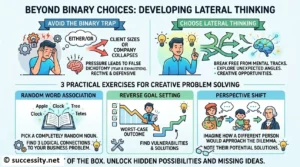
When under pressure, the brain naturally simplifies complex situations into binary choices, such as “either we sign this client or our company goes under.” This false dichotomy is a cognitive trap born out of fear and exhaustion.
Lateral thinking allows you to break free from these mental tracks, encouraging you to look at problems from entirely unexpected angles.
Practical Exercises for Creative Problem Solving
Cultivating lateral thinking requires conscious, playful effort to stretch your mental boundaries. It forces your brain to build new synaptic connections outside of your usual professional habits.
To stimulate this cognitive flexibility when you find yourself stuck, try these brief exercises:
- The Random Word Association – Pick a completely random noun from a book and force yourself to find three logical connections between that word and your current business problem.
- The Reverse Goal Setting – Spend five minutes planning exactly how to achieve the absolute worst possible outcome for your current project, then reverse those steps to find hidden vulnerabilities.
- The Perspective Shift – Imagine how a historic figure, an artist, or a child would approach your current dilemma, and write down their potential solutions.
❌ Succumbing to a binary trap keeps you locked in reactive, defensive thinking patterns.
✅ Actively exploring lateral paths reveals creative, cost-effective opportunities that others completely miss.
From Theory to Action – Measuring Your Analytical Growth
Acquiring theoretical knowledge is only half the battle; true cognitive mastery requires ongoing reflection and measurement. You must actively track how your analytical habits evolve as you face new, real-world crises.
To do this, maintain a consistent practice of journaling for self-reflection with a dedicated decision log where you record major choices, your emotional state at the time, your underlying assumptions, and the ultimate outcomes.
Reviewing this log every quarter allows you to spot recurring logical blind spots, monitor your emotional regulation, and celebrate your gradual mental growth.
Reclaiming Your Mental Space – Final Thoughts
At the end of the day, your cognitive capacity is not a measure of your worth as a human being. The anxiety you feel in moments of high pressure is simply a sign that you care deeply about the impact of your actions.
By mastering these analytical patterns, you are not trying to turn yourself into a cold, unfeeling machine. You are simply learning to build a quiet sanctuary inside your mind where reason can safely sit with emotion.
As you step out of the bathroom stall and back into the fast-paced demands of your day, take a deep breath. You now possess the scientific tools and human perspective needed to sharpen your critical thinking skills and lead with quiet, steady confidence.
Frequently Asked Questions
What are the five core critical thinking skills?
The five core critical thinking skills are observation, analysis, inference, communication, and problem-solving. Together, these cognitive processes allow you to evaluate information objectively and make well-reasoned decisions.
How can I improve my critical thinking skills daily?
You can improve your critical thinking skills daily by practicing active metacognition, questioning your first impressions, and keeping a daily decision journal. Additionally, regularly exposing yourself to diverse viewpoints helps break down subconscious cognitive biases.
What should I do if I am too emotionally exhausted to think critically?
When emotional fatigue strikes, step away from the problem entirely and focus on physical recovery, such as deep breathing or a short walk. Attempting to make complex choices while cognitively depleted only triggers an amygdala hijack, leading to flawed decisions.
Will thinking too critically make me slow and indecisive?
No, systematic critical thinking actually speeds up your decision-making over time by eliminating repetitive worrying and mental loops. By using reliable cognitive frameworks, you can quickly filter out irrelevant data and make choices with quiet confidence.
About the Author