Sophia
We’ve all been there. You walk into the kitchen, expecting to see a clean counter because obviously your partner knows you’ve had a stressful day. Instead, you’re greeted by a mountain of dirty dishes.
Instant frustration kicks in. You feel unseen. You feel undervalued.
But let’s hit the pause button for a second. Did you actually ask them to do the dishes? Or did you just expect them to “just know”?
This is the classic trap of managing relationship expectations. There is a famous saying often attributed to Shakespeare (or sometimes Buddhism) that goes: “Expectations are the root of all heartache.” While that might be a bit dramatic, in the world of modern romance, it’s not far off.
The gap between what we expect and the reality of our daily lives is where resentment grows. If you find yourself constantly feeling let down, it might not be a partner problem – it might be an expectation problem.
In this guide, we’re going to dig deep into how to cultivate realistic relationship expectations, how to stop expecting your partner to be a mind reader, and how to communicate your needs without starting a fight.
What Are Relationship Expectations?
Before we can manage them, we have to define them. Relationship expectations are the internal standards, beliefs, and assumptions we hold about how a partner should behave and how a relationship should look.
These aren’t random. They are usually built on a foundation of:
- Family History: If your dad always mowed the lawn, you might subconsciously expect your husband to do the same.
- Past Relationships: If an ex cheated, you might expect betrayal.
- Media and Culture: Rom-coms have convinced many of us that love means never having to say you’re sorry (which, for the record, is terrible advice).
Implicit vs. Explicit Expectations
The biggest trouble spots usually come from unspoken expectations (implicit). These are the rules you have in your head that you haven’t actually shared with your partner.
- Implicit: “He should know I want flowers on our anniversary.”
- Explicit: “I really love celebrating our anniversary with gifts; let’s agree to exchange presents this year.”
When expectations remain unspoken, you are essentially setting a trap that your partner is guaranteed to fall into.
Healthy vs. Unrealistic Expectations – the Difference
This is the tricky part. Managing relationship expectations doesn’t mean lowering your standards to the floor. You absolutely should have standards! The key is distinguishing between healthy standards regarding how you deserve to be treated versus unrealistic fantasies about human perfection.
Examples of Healthy Expectations (Standards)
These are the non-negotiables that form the bedrock of a safe, functioning partnership. You should absolutely expect:
- Mutual Respect: Kindness, even during arguments.
- Trust and Loyalty: Knowing your partner has your back.
- Effort: A willingness to work on the relationship.
- Interest: A partner who cares about your feelings and life goals.
Examples of Unrealistic Expectations (Fantasies)
These are the silent killers of relationship satisfaction. If you hold these beliefs, you are setting yourself up for chronic relationship disappointment:
- “My partner should complete me.” No one person can be your best friend, financial advisor, therapist, lover, and travel buddy all at once. That’s too much pressure.
- “We should never fight.” Disagreement is natural. The goal isn’t to avoid conflict, but to navigate it respectfully.
- “The spark should never fade.” The chemical rush of new love (the honeymoon phase) always evolves into a calmer, deeper attachment. Expecting butterflies 24/7 is biological nonsense.
- “They should know what I need without me asking.” Unless you are dating a psychic, this is impossible.
Signs Your Relationship Expectations Are Unmanaged
How do you know if your “expectation meter” is broken? Here are a few red flags that suggest you might be projecting unfair demands onto your partner:
- The Comparison Trap: You spend time scrolling through Instagram, looking at “perfect” couples, and wondering why your partner doesn’t plan elaborate surprise trips or write sonnets about you.
- Scorekeeping: You have a mental tally of every time they’ve messed up, and you use it as ammunition.
- Chronic Resentment: You feel annoyed by them more often than you feel affectionate. Resentment is almost always a symptom of an unmet (and often unspoken) need.
- Trying to “Fix” Them: You aren’t dating the person in front of you; you’re dating the potential version of them you’ve created in your head.
The “Instagram Effect” – How Social Media Warps Our Standards
One of the biggest modern enemies of managing relationship expectations is the device in your pocket. We are constantly bombarded with curated highlight reels of other couples: influencers receiving car-sized bouquets, surprise proposals in Paris, or partners who seem to spend 24/7 gazing adoringly at each other.
This creates a phenomenon known as comparative suffering. When you look at your partner – who is currently asleep on the couch with their mouth open – and compare them to a curated 15-second TikTok clip, you are setting yourself up for misery.
How to combat this:
- Remember the 1% Rule: Social media shows the top 1% of a relationship’s best moments. It rarely shows the arguments about money, the silent treatments, or the boring Tuesday nights.
- Check Your Feed: If following certain “couple goals” accounts makes you feel resentful toward your own partner, unfollow them. Protect your mental space.
- Focus on Your Reality: Remind yourself that a “boring” night of watching movies together is actually a sign of safety and stability, even if it doesn’t get a thousand likes.
5 Steps to Managing Relationship Expectations Effectively
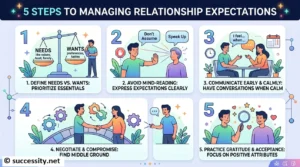
So, you’ve realized your expectations might be a little out of whack. Now what? Here is a step-by-step approach to realigning your view and communicating needs effectively.
1. Identify Your Core Needs vs. Wants
Sit down and separate your “Deal-Breakers” from your “Preferences.”
- Deal-Breakers (Needs): Values, children, financial honesty, religious beliefs. These are hills worth dying on.
- Preferences (Wants): How they squeeze the toothpaste, their taste in movies, or how often they post about you online.
If you are fighting a war over preferences, you’re wasting energy. Learn to be flexible with the wants so you can stand firm on the needs.
2. The “Mind-Reading” Detox
Repeat this mantra: Uncommunicated expectations are just premeditated resentments.
If you catch yourself thinking, “I shouldn’t have to tell them,” stop immediately. Yes, you do have to tell them. People have different love languages and different upbringings. Assuming they view the world exactly as you do is the quickest route to misery.
3. Communicate Early and Often
Don’t wait until you are screaming to discuss expectations. Have the conversation when you are calm.
Try this script:
“Hey, I realized I had an expectation in my head that we would spend every Sunday together. When you made plans with your friends, I felt disappointed. Can we talk about how we balance our weekends so we both get what we need?”
Notice the use of “I” statements. This isn’t an attack; it’s an invitation to solve a problem.
4. Bridge the Gap (Negotiation)
Sometimes, you will express an expectation, and your partner will say, “I can’t do that.”
Maybe you expect a clean house daily, and they are naturally messy. This is where negotiation happens.
Can you meet in the middle? perhaps you agree to a “messy zone” in the house, or you hire a cleaner twice a month. Healthy expectations in a relationship often look like compromise.
5. Practice Acceptance and Gratitude
The antidote to disappointment is gratitude. Instead of hyper-focusing on the 20% your partner doesn’t do, look at the 80% they do right.
Maybe they aren’t romantic poets, but they change the oil in your car because they want you to be safe. Maybe they don’t like cooking, but they are amazing at soothing you when you’re anxious. Appreciate who they are rather than punishing them for who they aren’t.
Common Areas Where Expectations Clash
When managing relationship expectations, specific triggers tend to come up repeatedly.
- Finances: One sees money as security (saving), the other sees it as enjoyment (spending). Discussing financial goals explicitly is crucial to avoid “financial infidelity.”
- Household Chores: Who does the dishes? Who remembers to buy birthday cards? The “mental load” often falls on one person. Explicitly dividing labor prevents this resentment.
- Intimacy: Differences in libido are normal. Expecting your drives to always match up is unrealistic; communicating about how to stay connected during dry spells is healthy.
- Time: The balance between “Us Time” and “Me Time.” One partner’s need for solitude can look like rejection to a partner who expects constant togetherness.
How Expectations Must Evolve Over Time
A common mistake is thinking that once you set expectations, they are set in stone forever. But healthy expectations in a relationship are fluid; they change as you move through different life stages.
What you needed from a partner at six months (excitement, constant texting, novelty) is very different from what you need at six years (stability, shared financial goals, parenting support).
- The Honeymoon Phase: Expectations usually revolve around chemistry and fun. It is easy to overlook flaws here.
- The Deepening Phase: As lives merge, expectations shift toward reliability. “Will they show up when I’m sick?” becomes more important than “Are they a good dancer?”
- The Stressor Phases (Kids/Career/Loss): During high-stress times, you may need to temporarily lower expectations for romance to prioritize survival and partnership.
If you don’t update your “contracts,” you’ll be judging your partner by outdated standards. Make it a habit to have an annual “State of the Union” chat to discuss how your needs have shifted over the last year.
Handling the “Let Down” – What to Do When Expectations Fail
Even with the best communication, your partner will eventually disappoint you. They are human, and they will forget the one thing you asked them to do, or say the wrong thing when you are crying. How you handle this moment defines the health of your bond.
When you feel that sting of relationship disappointment, try the “Pause and Pivot” method before reacting:
- The Pause: Do not lash out immediately. That initial anger is usually a defense mechanism for feeling hurt. Take twenty minutes to cool down so your prefrontal cortex (the logic part of your brain) can come back online.
- The Fact-Check: Ask yourself, “Did I actually communicate this expectation clearly, or did I assume they knew?” Be honest. If you didn’t say it, you can’t be mad they didn’t do it.
- The Attribution: Are they malicious, or just oblivious? Most of the time, our partners aren’t trying to hurt us; they are just distracted or wired differently. Attributing “good intent” can stop a fight before it starts.
- The Repair: When you address it, focus on the future. Instead of “You failed,” try “Next time, this is what I need to feel supported.”
When to Re-evaluate – Are Your Expectations Too Low?

A quick, important warning: This guide is about managing expectations for normal human flaws. It is not a permission slip for your partner to mistreat you.
If you find yourself “managing your expectations” to accept:
- Verbal or physical abuse.
- Chronic lying or cheating.
- Complete lack of emotional support.
…then your expectations aren’t too high; they are too low. You cannot “manage” away toxic behavior. In those cases, the expectation should be safety and respect, and if those aren’t met, it may be time to leave.
Final Thoughts
Managing relationship expectations is not a one-time task; it’s a lifelong practice. We change, our partners change, and our lives change. The expectations that worked when you were dating might not work when you have a mortgage or children.
By bringing your unspoken needs into the light, distinguishing between standards and fantasies, and practicing a little bit of grace, you can protect your relationship from the corrosive effects of disappointment.
Remember: Real love isn’t about finding a partner who meets every single one of your expectations automatically. It’s about finding a partner who cares enough to try when you tell them what you need.
Frequently Asked Questions
Is it wrong to have high expectations in a relationship?
Not at all. High standards for how you are treated, such as respect, loyalty, and kindness, are healthy and necessary. It is only “wrong” when you have high expectations for perfection or demand things that are impossible for a human being to deliver constantly.
How do I tell my partner my expectations aren’t being met without nagging?
Focus on your feelings and the solution rather than the criticism or the failure. Instead of saying “You never take me out anymore,” try using an “I” statement like, “I really miss our date nights and I’d feel so loved if we planned one this week.”
Can relationship counseling help with mismatched expectations?
Absolutely. A therapist acts as a neutral translator who can help you identify where your standards clash and why. They provide a safe space to uncover the root of your needs and help you negotiate a middle ground that feels fair to both parties.
What happens if I don’t voice my relationship expectations?
Unspoken expectations are the fastest route to resentment because they rely on your partner reading your mind. If you do not articulate your needs clearly, you are essentially setting your partner up for failure and guaranteeing your own disappointment.
Is it okay to change my expectations later in the relationship?
Yes, expectations should evolve as you grow individually and as a couple. Major life stages like career changes, parenthood, or aging often require you to renegotiate the “terms” of your partnership to ensure it remains sustainable and supportive.
About the Author