Sophia

A strong relationship is not built on romantic gestures alone. It grows through trust, honest communication, mutual respect, shared values, and the everyday choices that help two people feel connected and supported.
Think of a relationship like a house. Attractive decorations may make it look beautiful, but the foundation determines how well it withstands pressure. In the same way, romantic dinners, vacations, and thoughtful gifts can make a relationship enjoyable, but they cannot replace the qualities that help couples navigate disagreements, financial stress, family responsibilities, and changes in life.
Whether you are starting a new relationship or hoping to strengthen a long-term partnership, understanding the strong relationship foundation you need can help you build a healthier connection.
In this guide, you will discover the seven essential pillars of a healthy relationship, practical ways to strengthen each one, and steps you can take together to build a more secure and fulfilling partnership.
What Makes a Strong Relationship Foundation?
A strong relationship foundation is the combination of trust, communication, respect, emotional connection, and shared effort that allows two people to maintain a healthy partnership.
It does not mean that partners always agree, never feel insecure, or understand each other perfectly. Every relationship encounters challenges. What matters is how both people respond to those challenges and whether they can address problems without consistently undermining each other’s well-being.
A healthy foundation allows both partners to feel that they can express their needs, discuss difficult subjects, maintain their individuality, and work toward solutions together.
It also develops over time. Small, consistent actions often matter more than occasional grand gestures because they demonstrate reliability and care in everyday life.
The 7 Essential Pillars of a Healthy Relationship
These seven pillars provide a practical framework for understanding what makes a relationship stronger. Each contributes something different, and couples can work on them together as their needs change.
1. Trust and Honesty
Trust allows partners to feel secure in their relationship. It develops when words and actions consistently align, promises are taken seriously, and both people can communicate honestly without deliberately misleading each other.
Building trust in a relationship involves more than remaining faithful. It also means being dependable, admitting mistakes, respecting privacy, and following through on commitments.
For example, if you promise to discuss an important decision with your partner, make time for that conversation rather than repeatedly postponing it. If you make a mistake, acknowledge it instead of hiding it or shifting the blame.
How to strengthen trust:
- Keep your promises and communicate when circumstances change.
- Be honest about important concerns, expectations, and decisions.
- Take responsibility for mistakes without making excuses.
- Respect each other’s privacy and personal boundaries.
- Discuss broken commitments and agree on how to rebuild reliability.
Trust may take time to establish, especially when previous experiences have made one or both partners cautious. It can also be damaged by repeated dishonesty or broken agreements.
If trust is already a concern, explore these practical strategies for building trust in a relationship.
2. Open and Respectful Communication
Good communication helps partners understand each other’s thoughts, feelings, and expectations. It is not simply about talking frequently. It is about sharing information clearly and listening with the intention of understanding.
Communication problems often arise when partners expect each other to guess what they need, interrupt before the other person finishes, or interpret every disagreement as a personal attack.
Instead of saying, “You never listen to me,” try explaining the specific situation and its effect on you: “I felt overlooked when I was explaining something important and we changed the subject before I finished.”
This approach gives your partner a clearer understanding of the concern and makes it easier to discuss a practical solution.
How to improve communication:
- Give each other time to speak without unnecessary interruptions.
- Ask questions when something is unclear instead of making assumptions.
- Express your needs directly and respectfully.
- Acknowledge your partner’s feelings even when your perspective differs.
- Choose an appropriate time to discuss sensitive subjects.
You do not need to agree on everything to communicate effectively. The goal is to understand each other well enough to address differences constructively.
When communication breaks down during disagreements, use this guide to resolve conflicts in your relationship.
3. Shared Values and Future Goals

Partners do not need identical personalities, hobbies, or opinions to build a strong relationship. However, they benefit from understanding each other’s priorities and discussing important decisions before those differences become persistent sources of conflict.
Core values influence how people approach family, money, work, personal freedom, parenting, and long-term commitments.
For example, one partner may prioritize saving for a home, while the other values spending money on travel and experiences. Neither preference is automatically wrong. The important question is whether both people can discuss their priorities and develop an arrangement that feels reasonable.
Important topics to discuss include:
- Financial priorities, spending habits, and saving goals.
- Whether to have children and expectations about parenting.
- Career ambitions, lifestyle preferences, and future plans.
- Family responsibilities and the role of extended relatives.
- Personal beliefs, traditions, and individual independence.
Shared values do not require complete agreement. They require enough mutual understanding to make important decisions without consistently sacrificing one person’s needs.
Try discussing what matters most to each of you and identifying the areas where compromise is possible. Some differences may be manageable, while others may require honest conversations about long-term compatibility.
Financial disagreements deserve particular attention because they can affect everyday decisions and future plans. Learn how to talk about money with your partner to approach these conversations more constructively.
4. Mutual Respect and Healthy Boundaries
Respect means treating your partner as an individual whose feelings, opinions, choices, and personal limits matter.
In a healthy relationship, both people can express disagreement without being mocked, threatened, or deliberately humiliated. Neither partner should have to give up their identity or independence to prove their commitment.
Boundaries help put this respect into practice. They clarify what each person is comfortable with, what they need, and how they expect to be treated.
For example, a partner may need time alone after a demanding workday, prefer to keep certain conversations private, or want both people to agree before making significant financial commitments.
Healthy boundaries are not a way to control another person. They are a way to communicate personal limits and establish respectful expectations.
How to build mutual respect:
- Listen to each other’s opinions without ridicule.
- Respect personal space, friendships, and individual interests.
- Discuss disagreements without insults or intimidation.
- Make important decisions through mutual discussion.
- Accept that partners can have different needs and preferences.
Respect also means taking concerns seriously when your partner tells you that a behavior is hurtful. You may not always agree with their interpretation, but you can still listen and consider how your actions affect them.
For more practical guidance, read how to communicate boundaries in relationships.
5. Emotional and Physical Intimacy
Intimacy helps partners feel connected, understood, and valued. It can involve emotional openness, affectionate gestures, meaningful conversations, and physical closeness that both people welcome.
Emotional intimacy develops when partners feel comfortable sharing their experiences, hopes, worries, and vulnerabilities. It also grows when they respond to each other with interest rather than dismissing difficult feelings.
Physical intimacy varies from couple to couple. It may include holding hands, hugging, kissing, sexual intimacy, or other forms of mutually comfortable affection. Neither partner should feel pressured to provide physical affection to prove their love.
How to strengthen intimacy:
- Ask about each other’s feelings and experiences.
- Make time for conversations without unnecessary distractions.
- Express appreciation and affection in ways your partner welcomes.
- Share personal concerns when you feel ready.
- Discuss changing needs and expectations with sensitivity.
Intimacy is not about knowing everything about your partner or eliminating every moment of distance. It is about continuing to learn about each other and making room for honest connection.
If emotional distance has become a concern, explore why emotional availability matters in a relationship.
6. Constructive Conflict Resolution
Disagreements are a normal part of relationships. Two people can care deeply about each other and still have different opinions, emotional reactions, or expectations.
The goal is not to eliminate every disagreement. It is to address problems without creating unnecessary harm or turning each conversation into a contest.
Constructive conflict resolution involves listening, explaining concerns clearly, taking responsibility where appropriate, and looking for solutions that address the underlying issue.
For example, if you disagree about household responsibilities, focus on the specific tasks and expectations rather than attacking your partner’s character. You might agree to divide responsibilities differently or establish a schedule that works better for both people.
The Gottman Institute discusses the value of repair attempts, which are words or actions intended to reduce tension and help partners reconnect during conflict. You can learn more in its guide to making repair attempts in a relationship.
How to handle disagreements more constructively:
- Address the specific issue instead of bringing up every past mistake.
- Use clear statements about your feelings and needs.
- Avoid insults, threats, and deliberately hurtful language.
- Take a break when emotions become too intense, and agree on when to resume the conversation.
- Acknowledge your part in the problem when appropriate.
- Follow up to determine whether the agreed solution is working.
A sincere apology can help repair hurt, but meaningful change also requires different behavior afterward.
If the same disagreement keeps returning, consider whether the underlying expectations have been clearly discussed. Recurring conflicts may need a different solution rather than another repetition of the same argument.
It is also important to recognize that abuse, intimidation, and coercive control are not ordinary disagreements. In those situations, safety and appropriate professional support take priority over trying to resolve the issue together.
7. Friendship, Affection, and Playfulness

Romantic relationships benefit from friendship as well as attraction. Enjoying each other’s company creates opportunities for connection outside the responsibilities and problems of everyday life.
Friendship can be expressed through shared humor, thoughtful conversations, common interests, and small moments of appreciation. It also involves remaining curious about your partner as they grow and change.
You do not need to share every hobby. Having separate interests can be healthy, provided both partners make time to connect and respect each other’s activities.
How to strengthen friendship in your relationship:
- Spend time together without making every activity about responsibilities.
- Ask questions about your partner’s interests and experiences.
- Express appreciation for everyday acts of kindness.
- Try new activities or revisit something you both enjoy.
- Create small routines that give you opportunities to reconnect.
For example, you might take an evening walk together, cook a meal, play a game, or spend time discussing something other than work and household responsibilities.
These activities do not need to be expensive or elaborate. Their value comes from the attention and enjoyment you share.
Friendship also supports the other pillars. When partners feel appreciated and understood, it can become easier to approach difficult conversations with patience and goodwill.
How to Strengthen Your Relationship Foundation in Everyday Life
Understanding the seven pillars is a useful starting point, but applying them consistently is what makes the difference.
You do not need to change everything at once. Begin with a few practical habits that address your relationship’s current needs.
Make Time for Regular Check-Ins
Set aside time each week to discuss how things are going. Choose a moment when neither person is rushed or distracted.
You might ask:
- What has gone well between us this week?
- Is there anything you have been wanting to discuss?
- What could I do to help you feel more supported?
- Is there something we should approach differently next week?
The purpose is to understand each other, not to create a list of complaints or judge who is doing more.
Express Appreciation Regularly
People can become so focused on responsibilities that they stop acknowledging the small things their partners do.
Notice and express appreciation for helpful actions, thoughtful gestures, and qualities you value. Be specific when possible.
For example, instead of saying only “Thanks for everything,” you could say, “I appreciated that you took care of dinner when I was exhausted.”
Genuine appreciation helps make care visible rather than leaving it assumed.
Discuss Problems Before Resentment Builds
Small frustrations can become more difficult when they remain unspoken for long periods.
If something is bothering you, consider raising it respectfully before it develops into a larger conflict. Explain what happened, how it affected you, and what change would help.
At the same time, recognize that not every irritation requires a serious discussion. Consider whether the issue is important, whether it is part of a recurring pattern, and whether a simple adjustment would be enough.
Protect Time for Your Relationship
Work, family obligations, and daily responsibilities can leave couples with little time for meaningful connection.
Consider establishing simple routines, such as eating together without phones, taking a short walk, or setting aside time for a shared activity.
These routines should fit your circumstances rather than create another obligation that causes stress.
Support Each Other’s Individual Growth
A healthy partnership leaves room for personal interests, friendships, learning, and individual goals.
Encourage each other’s development without assuming that every activity must be shared. Maintaining a sense of identity can help both partners contribute to the relationship without expecting the other person to meet every emotional or social need.
The aim is to balance individual independence with mutual care and commitment.
How to Recognize When Your Relationship Foundation Needs Attention
Every relationship experiences difficult periods, and a single disagreement does not necessarily indicate a serious problem. However, recurring patterns may suggest that certain parts of the relationship need attention.
Consider whether you have noticed any of the following:
- Repeated broken commitments: Promises are regularly made but not followed through, making it difficult to rely on each other.
- Communication avoidance: Important concerns remain unspoken because conversations frequently become dismissive or hostile.
- Growing emotional distance: You rarely share meaningful experiences or feel interested in each other’s inner lives.
- Persistent resentment: Past disagreements remain unresolved and repeatedly surface during new arguments.
- Lack of mutual respect: One or both partners regularly dismiss the other’s feelings, needs, or boundaries.
- Unequal effort: One person consistently carries the responsibility for communication, planning, or repairing disagreements.
These signs are reasons to examine what is happening, not automatic proof that a relationship cannot improve.
Start by identifying the specific pattern that concerns you. Discuss it when possible and consider what realistic change would make a difference.
If you are unsure whether your relationship patterns are healthy, read Signs of a Healthy vs. Unhealthy Relationships.
If you feel afraid of your partner, experience threats or coercion, or cannot safely express your needs, prioritize your safety and seek appropriate support rather than treating the situation as an ordinary communication problem.
Can You Rebuild a Weak Relationship Foundation?
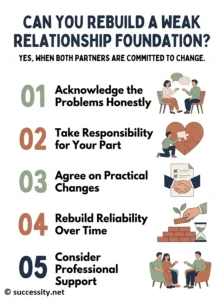
Yes, some relationships can become healthier when both partners acknowledge problems and consistently work toward change. However, improvement is not guaranteed, and rebuilding a relationship requires more than promising to do better.
The appropriate next steps depend on what has damaged the relationship, whether both people want to work on it, and whether the relationship is safe.
Step 1: Acknowledge the Problems Honestly
Identify what is not working without immediately turning the conversation into a search for blame.
Be specific about recurring behaviors, unmet expectations, and unresolved concerns. Each person should have an opportunity to describe their perspective.
Step 2: Take Responsibility for Your Part
Focus on what you can change rather than trying to control your partner’s reactions.
This might involve keeping commitments, communicating more clearly, listening without interrupting, or acknowledging the impact of a hurtful action.
Taking responsibility does not mean accepting blame for everything that happens in the relationship.
Step 3: Agree on Practical Changes
Choose one or two specific changes you can both work toward.
For example, you might agree to discuss financial decisions before making large purchases or to pause difficult conversations when either person becomes overwhelmed.
Make the agreement clear enough that both partners understand what they are committing to do.
Step 4: Rebuild Reliability Over Time
Trust and emotional security are strengthened through consistent behavior, not promises alone.
Check whether the changes are helping, acknowledge progress, and address setbacks honestly. Some problems may take considerable time to resolve.
Step 5: Consider Professional Support When Needed
A qualified couples therapist may help partners understand recurring conflict, improve communication, and explore difficult relationship patterns.
Professional support is particularly worth considering when repeated attempts to resolve problems have not worked. Where there is abuse, coercion, or fear, seek specialized support and prioritize safety rather than assuming joint therapy is appropriate.
Rebuilding is not always the right outcome. Both partners have the right to decide whether they want to continue the relationship.
A Simple Relationship Foundation Check-In
You can begin strengthening your relationship without waiting for a major problem or planning a complicated activity.
Set aside 15 to 20 minutes together this week. Each partner should have time to answer the following questions without interruption.
1. What is working well in our relationship?
Identify the habits, experiences, and behaviors that make you feel connected or supported.
2. Where could we understand or support each other better?
Choose one area that would benefit from attention. Focus on a specific situation rather than making broad accusations.
3. What is one action we can each take this week?
Agree on a realistic step that you can follow through on. One person might make more time for conversation, while the other might communicate plans more clearly.
4. When should we check in again?
Choose a time to discuss how the changes are working. This keeps the conversation practical and helps you adjust your approach when necessary.
The goal is not to solve every relationship issue in one sitting. It is to build a habit of honest communication, shared responsibility, and continued improvement.
Final Thoughts
Building a strong relationship foundation is an ongoing process shaped by everyday decisions. Trust, communication, shared values, respect, intimacy, constructive conflict resolution, and friendship all contribute to a healthier partnership.
You do not need to master all seven pillars immediately. Begin by identifying one area where your relationship is already strong and another where a small change could make a meaningful difference.
Then discuss those observations with your partner and agree on one practical action you can take together.
A stronger relationship is built through consistent effort, mutual respect, and the willingness to understand each other. Start with one conversation, one thoughtful action, and one commitment you can follow through on.
Frequently Asked Questions
What Is the Most Important Foundation of a Relationship?
There is no single quality that guarantees a healthy relationship. Trust, respect, communication, emotional safety, and shared effort work together. The most important starting point depends on the couple’s circumstances and the areas that need attention.
How Do You Build a Strong Relationship From the Beginning?
Start by communicating openly, learning about each other’s values and expectations, respecting boundaries, and following through on commitments. Allow trust and intimacy to develop over time rather than rushing important decisions or ignoring concerns.
Can You Rebuild a Relationship After Trust Has Been Broken?
Some couples can rebuild trust when the person who caused the harm takes responsibility, both partners willingly participate, and behavior changes consistently over time. The process can be difficult, and reconciliation is not always possible or appropriate.
How Can Couples Strengthen Their Relationship Over Time?
Make time for meaningful conversations, express appreciation, address recurring problems respectfully, and continue learning about each other’s needs. Regular check-ins and shared activities can help couples maintain their connection as their circumstances change.
About the Author