Sophia

Negotiating your salary can feel uncomfortable, especially when you are worried about making the wrong impression or losing a job opportunity. You might wonder whether asking for more money will make an employer reconsider their offer or affect your relationship with your manager.
But salary negotiation is a normal part of professional life. Whether you are considering a new job, responding to a lower-than-expected offer, or asking for a raise in your current position, you have the opportunity to discuss compensation that reflects your experience, responsibilities, and the value you bring.
The key is preparation. When you understand your market value, know what you want, and can explain why your request is reasonable, the conversation becomes easier to manage.
This guide explains how to negotiate salary confidently, from researching compensation and preparing your arguments to responding to objections and reviewing your final offer. You will also find practical examples and scripts you can adapt to your situation.
Understand Your Total Compensation Before Negotiating
Before discussing a higher salary, understand what your employer is offering. Your base salary is important, but it is only one part of your overall compensation.
A job with a slightly lower salary may offer better benefits, retirement contributions, paid time off, or flexibility. Another position may offer a higher base salary but fewer benefits or less predictable bonuses.
Looking at the complete package helps you make a more informed decision.
Base Salary vs. Total Compensation
Base salary is the fixed amount you receive for performing your job, usually expressed as an annual or hourly rate.
Total compensation includes your base salary and other financial or employment benefits provided by your employer.
Depending on the company and position, it may include:
- Performance bonuses: Additional payments based on individual, team, or company performance.
- Commission: Earnings linked to sales or other measurable results.
- Equity and stock options: A potential ownership interest in the company, subject to specific conditions.
- Retirement contributions: Employer contributions to retirement savings plans.
- Health insurance: Medical, dental, and vision coverage where applicable.
- Paid time off: Vacation days, holidays, and other paid leave.
- Professional development: Training, certifications, and education assistance.
- Flexible working arrangements: Remote work, hybrid schedules, or flexible hours.
When comparing two offers, look beyond the headline salary. Consider the value, conditions, and long-term implications of each benefit.
Which Benefits and Perks Should You Consider?
Think about what matters most to your financial situation and lifestyle.
For example, an additional $3,000 in annual salary might be less valuable to you than an employer-paid certification, additional paid leave, or a flexible schedule that reduces commuting expenses.
However, avoid treating every benefit as equivalent to cash. Stock options may never become valuable, bonuses may depend on performance, and some benefits may have restrictions.
Your goal is to understand the complete package before deciding what to negotiate.
Research Your Market Value Before Negotiating

Confidence during salary negotiations comes from knowing what similar positions pay.
Before suggesting a number, research the typical compensation for your role, experience level, industry, and location. Without this information, you risk asking for too little or making a request that is difficult to justify.
Compare Salaries for Similar Roles
Start by identifying positions that closely match your responsibilities.
A job title alone is not enough. Two employees with the same title may have very different responsibilities, experience requirements, and levels of authority.
Compare the following factors:
- Job responsibilities: What tasks, projects, and decisions does the position involve?
- Experience: How many years of relevant experience do employers typically expect?
- Location: Are you comparing salaries in the same city, state, or geographic market?
- Industry: Does your industry generally pay more or less than others?
- Company size: Are you comparing a small business with a large corporation?
- Specialized skills: Do you have technical knowledge, certifications, or experience that is difficult to replace?
For example, a senior marketing manager responsible for an international team may command a different salary from someone managing a small local marketing department.
The more closely your comparisons match the position, the more useful your research becomes.
Use Reliable Salary Research Tools
Do not rely on one salary website. Compare information from multiple sources to develop a realistic picture of the market.
Useful resources include:
- Bureau of Labor Statistics (BLS): Provides occupational wage estimates across different industries and geographic areas.
- Glassdoor: Offers employee-reported salary information and company insights.
- Payscale: Provides salary comparisons based on roles, experience, and other factors.
- LinkedIn: Can help you research similar positions and understand the professional backgrounds of people in those roles.
- Levels.fyi: Particularly useful for compensation research in technology companies.
For U.S. salary research, the Bureau of Labor Statistics wage data is a particularly useful starting point. It provides wage estimates by occupation, location, and industry, including median and percentile figures.
Remember that salary websites use different data collection methods. Some rely on employer reports, while others use employee submissions. Treat the figures as benchmarks rather than guaranteed salaries.
Check Published Salary Ranges
Some employers publish salary ranges directly in job advertisements.
When available, these ranges can help you understand the company’s expected compensation before entering negotiations.
Compare the advertised range with your research and qualifications. If the employer lists a range of $75,000 to $95,000 and your experience supports the upper portion, you can use that information when preparing your request.
Pay transparency requirements vary by location. Check the applicable rules before relying on salary disclosure requirements in a particular state or country.
Determine Your Target Salary and Negotiation Range
Once you understand the market, decide what you actually want before speaking with the employer.
Going into a negotiation without a clear financial target makes it easier to accept an offer that does not meet your expectations.
A useful approach is to establish three important numbers.
Establish Three Important Numbers
1. Your ideal salary
This is the amount you would be happiest to receive. It should reflect your experience, responsibilities, and market research.
2. Your target salary
This is the realistic amount you want to achieve through negotiation.
3. Your minimum acceptable salary
This is the lowest compensation you would genuinely consider accepting, taking the complete package and your circumstances into account.
For example, imagine that your research suggests a reasonable salary range of $85,000 to $95,000.
You might establish the following targets:
- Ideal salary: $95,000
- Target salary: $90,000
- Minimum acceptable salary: $85,000
These numbers are personal decision-making tools. You do not need to reveal your minimum to the employer.
Establishing your boundaries beforehand helps you negotiate without making decisions based entirely on pressure or emotion.
Decide Whether to Give a Salary Range or a Specific Number
Employers may ask for your salary expectations before making an offer.
You can respond with a researched range rather than immediately committing to one number.
For example:
“Based on my experience and the responsibilities of this position, I would be comfortable discussing a base salary in the range of $90,000 to $100,000, depending on the overall compensation package.”
Only provide a range if its lower end is genuinely acceptable to you.
Alternatively, you can ask the recruiter about the budgeted range first. This may give you a better understanding of the employer’s expectations before sharing your own figure.
There is no single strategy that works in every negotiation. Your approach should depend on how much information you have and how flexible the employer appears to be.
Consider Your Alternatives Before Negotiating
Think about what you will do if the employer cannot meet your target.
Do you have another job offer? Are you currently employed? Would you be willing to decline the position?
Understanding your alternatives helps you evaluate the negotiation realistically.
It is also worth considering whether the position supports your longer-term ambitions. If you are still deciding which direction to take professionally, this guide to identifying your career goals can help you think through what you want from your next career move.
You should never make an offer you are not prepared to follow through on simply to create pressure.
Build a Strong Case for Higher Compensation

Knowing the market rate explains what similar positions pay. Your next task is to demonstrate why your experience and contributions justify your requested compensation.
Employers need a clear reason to consider increasing an offer or adjusting an existing salary.
Prepare Your Case for a New Job
If you are negotiating a new position, connect your previous achievements to the employer’s needs.
Review the job description and identify the most important responsibilities.
Then prepare examples showing how you have handled similar challenges.
For example:
- You managed a project that finished ahead of schedule.
- You improved a process that reduced operating costs.
- You helped increase sales or customer retention.
- You developed a skill that is particularly valuable for the position.
- You led a team or managed responsibilities beyond your previous job title.
Instead of simply saying that you are an experienced professional, explain what your experience allows you to accomplish.
Prepare Your Case When Asking for a Raise
If you already work for the company, focus on your contributions since your last compensation review.
Consider the following questions:
- Have your responsibilities increased?
- Have you delivered measurable results?
- Have you taken responsibility for important projects?
- Have you helped generate revenue or reduce costs?
- Have you developed skills that benefit the organization?
- Have you consistently performed above the expectations of your position?
Prepare specific examples rather than relying on general statements.
For example:
“Over the past year, I have taken responsibility for three major client accounts, improved our reporting process, and helped reduce project delays. I would like to discuss adjusting my compensation to reflect these contributions and the current market rate for my responsibilities.”
This approach connects your request to professional value rather than personal financial needs.
Create a Simple Salary Negotiation Preparation Sheet
Before the conversation, write down:
- Your current salary or job offer.
- The market salary range for similar positions.
- Your ideal salary and target salary.
- Your minimum acceptable compensation.
- Three measurable professional achievements.
- Your preferred benefits or alternative compensation.
- Questions you want to ask the employer.
A short preparation sheet helps you stay focused and avoid forgetting important points during the discussion.
Choose the Right Time to Negotiate Your Salary
Timing can influence how smoothly a salary conversation develops.
The best opportunity depends on whether you are negotiating a new position or discussing compensation with your current employer.
When Negotiating a New Job Offer
Receiving a formal job offer is generally a suitable time to discuss compensation.
At this stage, the employer has identified you as a preferred candidate, and you can review the proposed salary before making a commitment.
Thank the employer for the offer, express your interest, and explain that you would like to discuss the compensation package.
Avoid accepting an offer immediately if you need time to review the details.
When a Recruiter Asks About Salary Expectations
Recruiters sometimes ask about salary expectations during an initial screening conversation.
You do not have to provide an arbitrary number without understanding the position.
You could respond:
“I would like to learn more about the responsibilities and expectations of the role before settling on a specific figure. Could you share the salary range budgeted for this position?”
If the recruiter insists on an answer, provide a researched range that reflects your expectations.
When Asking Your Current Employer for a Raise
For an existing job, arrange a dedicated meeting with your manager.
A performance review may be an appropriate opportunity, especially if you can demonstrate achievements since your previous review.
You can also request a separate discussion if your responsibilities have increased significantly or your compensation no longer reflects your role.
Prepare your evidence beforehand and give your manager enough time to consider the request.
What to Say When Negotiating Your Salary

Knowing what to say can make salary negotiations much less intimidating.
The following examples provide practical starting points. Adapt them to your experience, communication style, and the circumstances of the conversation.
When Asked About Your Salary Expectations
If a recruiter asks about your expectations before discussing an offer, you can say:
“I’m primarily focused on finding a position that matches my experience and professional goals. Based on what I understand about the role so far, I would be interested in learning more about the compensation range budgeted for this position. Could you share that information?”
This response keeps the conversation open while giving you more information.
How to Counter a Low Job Offer
If you receive an offer below your target, respond with appreciation and a clear explanation.
For example:
“Thank you for the offer. I’m genuinely excited about the opportunity and the possibility of joining your team.
After reviewing the responsibilities and comparing the compensation with similar positions, I was hoping for a base salary closer to $95,000.
Given my experience in project management and the results I’ve delivered in previous roles, I believe this would be a reasonable figure.
Is there flexibility in the budget to bring the offer closer to that amount?”
This approach is professional and direct without making the employer feel personally criticized.
For another perspective on preparing and presenting a counteroffer, see Harvard Law School’s guide to negotiating a higher salary after a job offer.
How to Ask Your Current Employer for a Raise
If you are requesting a salary increase, focus on your contributions and the responsibilities you have taken on.
You could say:
“I’ve really enjoyed contributing to the team over the past year. Since my last salary review, I’ve taken on additional responsibilities, improved our project delivery process, and helped the team achieve several important targets.
Based on these contributions and my research into current market compensation, I would like to discuss adjusting my salary to better reflect my role and responsibilities.
Could we discuss what would be possible?”
The strongest conversations connect measurable achievements with a reasonable compensation request.
How to Negotiate Salary by Email
Email can be useful when you want to organize your thoughts, provide supporting information, or respond to a written job offer.
Here is a practical example:
Subject: Discussion About the Compensation Package
Hi [Recruiter’s Name],
Thank you for extending the offer for the [Job Title] position. I’m excited about the opportunity to join [Company Name] and contribute to the team.
After reviewing the responsibilities and researching compensation for similar positions, I was hoping we could discuss a base salary closer to [Target Salary].
I believe this figure reflects my experience, relevant skills, and the value I can bring to the role.
Is there any flexibility in the compensation package?
Thank you for your time and consideration. I look forward to hearing from you.
Best regards,
[Your Name]
Keep your email concise, professional, and focused on the request.
How to Request More Time to Consider an Offer
You do not have to make a decision immediately.
If you need time to review the salary, benefits, and employment conditions, say:
“Thank you for the offer. I’m very interested in the position and appreciate the opportunity. I would like a little time to review the complete compensation package before making a decision. Would it be possible to provide my response by [Date]?”
This gives you time to make a thoughtful decision without creating unnecessary tension.
How to Respond to Salary Negotiation Objections

Even a well-prepared negotiation may not produce the answer you want immediately.
An employer might have budget restrictions, internal salary policies, or concerns about compensation differences between employees.
The important thing is to remain professional and understand what options are available.
“We Don’t Have the Budget”
If the employer says there is no room in the budget, ask whether a future review is possible.
You could respond:
“I understand that budgets can be limited. If an adjustment isn’t possible right now, could we agree on a compensation review in six months based on specific performance objectives?”
If the employer agrees, ask for clear expectations and a realistic review date.
A vague promise of a future raise is not the same as a confirmed agreement.
“This Is Our Best and Final Offer”
If the employer says the offer cannot be increased, consider whether other parts of the package can be improved.
You could say:
“Thank you for clarifying. I understand the base salary may be fixed. Would there be flexibility in other areas of the compensation package, such as a signing bonus, additional paid time off, or professional development support?”
If no changes are possible, evaluate whether the existing offer still meets your expectations.
“You’re Already at the Top of the Salary Range”
This response may indicate that the employer has limited flexibility within the current job level.
You can ask whether additional responsibilities, a different position level, or a future salary review could provide another path.
For example:
“I appreciate that explanation. Given the responsibilities and experience I bring, would it be possible to discuss whether the position could be evaluated at a different level?”
Do not assume that the employer can change the salary band. Focus on understanding the available options.
“We Need More Time to Decide”
Give the employer reasonable time to review your request.
You can respond:
“Of course. I appreciate you taking the time to consider it. Would it be helpful if I followed up later this week?”
A polite follow-up is usually more productive than repeatedly asking for an immediate decision.
What to Do If the Employer Says No
Sometimes the employer will not change the offer.
You have several options:
- Accept the offer if the overall package meets your expectations.
- Ask whether alternative benefits or working arrangements are available.
- Request a future compensation review with clear objectives.
- Decline the offer if it does not meet your minimum requirements.
A refusal does not necessarily mean the conversation was unsuccessful. You may have gained important information about the employer’s flexibility and compensation practices.
Negotiate Benefits When the Base Salary Cannot Increase
Salary is only one part of compensation. If the employer cannot increase your base pay, you may still be able to negotiate other valuable benefits.
The key is to identify which alternatives would genuinely improve your employment arrangement.
Negotiate a Signing Bonus or Performance Bonus
A signing bonus is a one-time payment offered when you join a company.
If the employer cannot change the annual salary, you could ask whether a signing bonus is available.
Performance bonuses are another possibility, although you should understand the targets, eligibility conditions, and payment schedule before assigning them a value.
Discuss Equity and Stock Options
Some companies offer stock options or other forms of equity compensation.
These can provide potential financial benefits, but their value depends on the company’s performance, ownership structure, vesting schedule, and other conditions.
Before accepting equity as a substitute for salary, understand what you are receiving and what restrictions apply.
Do not treat uncertain future equity as guaranteed income.
Request More Paid Time Off or Flexible Working Arrangements
Additional vacation days, flexible working hours, and remote work may improve your quality of life.
For example, if the employer cannot increase your salary, you could ask for an additional week of paid leave or a hybrid working arrangement.
Consider which changes would provide the greatest practical value to you.
Negotiate Professional Development Opportunities
Training and education benefits can support your long-term career growth.
You might ask the employer to cover:
- Industry certifications.
- Professional courses.
- Conference attendance.
- Relevant training programs.
- Continuing education expenses.
These opportunities can help you develop skills that benefit both your career and your employer.
Request a Future Salary Review
If the employer cannot meet your target immediately, ask whether a future review can be arranged.
For example:
“If the starting salary cannot be adjusted at this stage, could we schedule a formal compensation review after six months, based on agreed performance goals?”
Ask for the review date and expectations to be documented.
A scheduled review provides a clearer next step than an informal promise.
Common Salary Negotiation Mistakes to Avoid
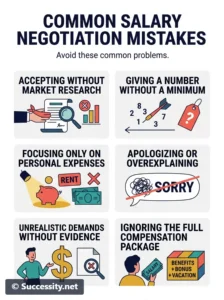
Even with good preparation, certain mistakes can make salary discussions more difficult.
Avoid these common problems.
Accepting an Offer Without Researching Market Rates
Without researching similar positions, you may accept compensation below what the role and your experience justify.
Compare multiple salary sources and understand the employer’s advertised range before making a decision.
Giving a Number Without Understanding Your Minimum
It is easy to become focused on the highest possible salary and forget what you would realistically accept.
Establish your ideal, target, and minimum acceptable figures before the conversation.
Focusing Only on Personal Expenses
Your rent, personal debts, and household expenses may influence how much income you need, but they are not usually the strongest reasons for an employer to increase your compensation.
Focus your argument on relevant market information, experience, responsibilities, and measurable contributions.
Apologizing Excessively or Overexplaining
You do not need to apologize for having a professional compensation discussion.
Avoid phrases such as “I’m sorry for asking” or repeatedly explaining why you feel uncomfortable.
State your request politely and allow the employer to respond.
Making Unrealistic Demands Without Evidence
A high salary request needs a reasonable explanation.
Research the market, understand the role, and connect your expectations to your qualifications and professional value.
Ignoring the Full Compensation Package
A higher base salary is not always the best overall offer.
Review benefits, working conditions, bonuses, retirement contributions, and other employment terms before making your final decision.
How to Practice Salary Negotiation Before the Conversation
Reading advice is useful, but practicing what you want to say can make a real difference.
The first time you explain your salary expectations should not be during an important meeting with a recruiter or manager.
Rehearse Your Main Request
Write down your preferred salary and the reasons supporting it.
Practice saying your request in a natural, confident voice.
For example:
“Based on my experience and the responsibilities of this position, I would be looking for a salary closer to $95,000.”
Keep your statement simple and avoid adding unnecessary explanations.
Practice Responding to Difficult Questions
Ask a friend, mentor, or colleague to role-play the employer.
Have them ask questions such as:
- Why do you believe you deserve a higher salary?
- What if we cannot increase the offer?
- Do you have another offer?
- What is your minimum acceptable salary?
- Why should we pay more for your experience?
Practice responding honestly and professionally.
A mentor or experienced colleague can also help you prepare. Building professional relationships with people who understand your industry can make it easier to find guidance and learn about career opportunities. See this step-by-step guide to building a career network for practical ideas.
Record Yourself and Review Your Delivery
Record a short practice conversation on your phone.
Listen for unclear explanations, excessive apologies, or statements that sound uncertain.
Your goal is not to sound aggressive or overly rehearsed. It is to communicate your request clearly.
Prepare for Silence and Follow-Up Questions
After stating your salary request, allow the employer time to respond.
You do not need to fill every pause with additional explanations or immediately lower your expectations.
Listen carefully, answer questions directly, and ask for clarification when necessary.
Review the Final Offer Before Accepting
Reaching an agreement is an important step, but you should still review the complete employment offer before accepting.
Verbal discussions are not a substitute for written confirmation.
Compare the Revised Offer With Your Original Expectations
Check whether the revised compensation matches what you discussed.
Review:
- Base salary.
- Bonus eligibility.
- Commission structure.
- Equity or stock options.
- Benefits.
- Paid time off.
- Working arrangements.
- Start date.
Make sure you understand any changes to the original package.
Confirm Salary, Bonuses and Benefits in Writing
Request an updated offer letter or written agreement that clearly reflects the negotiated terms.
If the employer has agreed to a signing bonus, additional leave, or another benefit, make sure it is documented.
Do not rely solely on verbal promises for important compensation arrangements.
Check Important Employment Conditions
Read the employment documents carefully.
Depending on the role and location, pay attention to:
- Working hours and overtime arrangements.
- Bonus conditions.
- Equity vesting schedules.
- Probationary periods.
- Notice requirements.
- Confidentiality obligations.
- Other contractual conditions.
If something is unclear, ask the employer to explain it before signing.
Confirm the Final Agreement Before Resigning From Your Current Job
If you are changing employers, do not resign based solely on a verbal promise.
Wait until you have received and reviewed the formal written offer and understand any conditions that must be satisfied before employment begins.
A careful final review protects you from misunderstandings and helps you start your new position with clear expectations.
Final Thoughts
Learning how to negotiate salary confidently is about more than asking for a higher number. It involves understanding your market value, recognizing your professional contributions, and communicating your expectations clearly.
Before your next salary conversation, research comparable positions, establish your target, and prepare examples that demonstrate the value you bring. Think beyond base salary and consider the complete compensation package.
Most importantly, remember that negotiation is a professional discussion, not a personal confrontation. You can be respectful, appreciative, and confident while advocating for fair compensation.
Prepare your case, make a reasonable request, and take the time to review the final agreement. The better prepared you are, the easier it becomes to make a decision that supports both your career and your financial goals.
For more practical advice on professional growth, explore the Career & Purpose section.
Frequently Asked Questions About Salary Negotiation
Is It Okay to Negotiate Salary After Receiving a Job Offer?
Yes. Receiving a formal job offer is generally a suitable opportunity to discuss compensation before accepting. Thank the employer, explain your expectations, and support your request with relevant market research and experience.
How Much More Should I Ask for When Negotiating Salary?
There is no universal percentage that works for every position. Your request should reflect comparable salaries, your qualifications, the responsibilities of the role, and the employer’s compensation range. Establish a realistic target before making a counteroffer.
Should I Give a Salary Range or a Specific Number?
Both approaches can work. A researched range communicates flexibility, while a specific number provides a clear target. If you give a range, make sure its lower end is an amount you would genuinely consider accepting.
Can I Negotiate Salary Without Another Job Offer?
Yes. You do not need a competing offer to negotiate. You can support your request with market salary research, relevant experience, specialized skills, and evidence of the value you bring to the position.
Should I Negotiate Salary Over Email or in Person?
A phone or video conversation can make it easier to discuss compensation and respond to questions. Email is useful when you need to present your request clearly or document an offer. Whichever method you choose, confirm the final agreement in writing.
What Happens If an Employer Refuses to Negotiate?
If the employer refuses, ask whether other benefits or a future compensation review are possible. If no changes are available, evaluate the complete package and decide whether it meets your expectations.
Can I Negotiate My Salary After Accepting a Job Offer?
You can ask, but your negotiating position may be different after accepting. The employer may already consider the agreed terms final. If circumstances have changed or an important detail was misunderstood, approach the conversation professionally and review any relevant contractual obligations.
About the Author