Sophia

Public speaking can feel intimidating, whether you are presenting an idea at work, speaking in a meeting, delivering a class presentation, or giving a toast at a special event. You might worry about forgetting your words, speaking too quickly, or standing in front of an audience that seems to be judging every move.
The good news is that you can improve public speaking skills through preparation, deliberate practice, and feedback. You do not need to become an extrovert or memorize every sentence to communicate effectively. You need to organize your ideas, practice your delivery, and learn how to recover when something does not go as planned.
Public speaking also involves several valuable communication abilities that apply to everyday conversations, teamwork, and professional relationships. These are part of the broader importance of soft skills in personal and professional development.
In this guide, you will discover five practical strategies to help you prepare better speeches, speak more confidently, engage your audience, and develop skills you can use in professional and personal situations.
1. Prepare a Clear and Audience-Focused Speech
One of the most effective ways to improve public speaking is to prepare a message your audience can easily follow. When you know what you want to communicate and why it matters, it becomes easier to organize your thoughts and deliver them with confidence.
Identify Your Audience, Purpose, and Main Message
Before writing your speech, answer three questions:
- Who is your audience? Consider their knowledge, interests, expectations, and familiarity with the subject.
- What do they need to understand? Focus on the information, explanation, or solution that will be most useful to them.
- What should they remember? Identify the single main message you want listeners to take away.
For example, if you are presenting a new project to your manager, you might focus on the problem, your proposed solution, and the expected benefits. If you are explaining the same project to a new team member, you may need to provide more background information.
Adapting your message to your audience helps you avoid unnecessary details and makes your presentation more relevant.
Structure Your Speech With a Strong Opening, Clear Main Points, and Conclusion
A well-organized speech helps listeners understand how your ideas connect. A simple structure is often enough.
1. Opening: Capture attention with a relevant question, a brief story, a useful observation, or a problem your audience recognizes.
2. Main points: Organize your central ideas into two or three sections when appropriate. Explain each point with an example, fact, or practical illustration.
3. Conclusion: Summarize the main message and finish with a clear takeaway, recommendation, or next step.
For instance, a presentation about improving workplace productivity could begin by describing a common problem, explain three practical ways to address it, and end with one action the team can implement.
For additional guidance on organizing your message and delivering it effectively, read Toastmasters International’s guide to writing and delivering a speech.
Use Examples and Stories to Explain Your Ideas
Facts and explanations are important, but a relevant example can make an abstract idea easier to understand.
Suppose you are explaining why preparation matters. Instead of simply saying that preparation improves performance, describe how rehearsing a presentation helped you identify an unclear explanation, simplify a slide, or prepare for an unexpected question.
Keep stories brief and connected to your main point. Avoid adding personal anecdotes simply to make a speech longer. Every example should help the audience understand, remember, or apply the message.
2. Practice Deliberately Before You Speak

Preparation gives your speech structure, but practice helps you deliver it naturally. Reading your notes silently is not enough. You need to rehearse out loud so you can identify problems with timing, clarity, and delivery before facing an audience.
Rehearse Your Main Points Instead of Memorizing Every Word
Memorizing an entire speech can make it difficult to recover when you forget a sentence. Instead, become familiar with the main ideas, supporting examples, and transitions between sections.
Create a short outline with keywords rather than writing every sentence you plan to say. Practice explaining each point in your own words while keeping the overall structure consistent.
It can help to memorize your opening and closing if doing so makes you more comfortable. However, allow the middle of your speech to sound natural rather than forcing yourself to reproduce a script word for word.
Record Yourself and Review Your Delivery
Recording a practice session is one of the simplest ways to identify habits you might not notice while speaking.
Use your phone to record a short presentation, then review it for the following:
- Pace: Are you speaking so quickly that listeners might struggle to follow?
- Clarity: Are your words easy to understand?
- Filler words: Do you frequently say “um,” “uh,” or “like”?
- Pauses: Do you give listeners enough time to process important points?
- Body language: Are your gestures natural, or do you repeatedly fidget?
- Structure: Can someone understand your main message without additional explanation?
Do not try to correct everything at once. Choose one or two improvements, record another attempt, and compare the results.
For example, if you notice that you rush through the conclusion, practice delivering just that section at a slower pace. Once it feels comfortable, rehearse the entire speech again.
Practice With Realistic Feedback
Speaking alone is useful, but practicing in front of another person helps you experience the pressure of having an audience.
Ask a friend, colleague, or family member to listen to your presentation. Rather than asking whether they liked it, ask specific questions:
- Was my main message clear?
- Which part was hardest to follow?
- Did I speak too quickly at any point?
- What is one thing I could improve?
Feedback is especially valuable when you are trying to improve communication in professional settings. If your goal is to take on more responsibility at work, these same habits can complement efforts to develop leadership skills.
The goal is not to deliver a perfect speech every time. It is to identify specific weaknesses and gradually improve them.
3. Improve Your Voice and Body Language
Your words communicate the main message, while your voice and body language help listeners follow your ideas and understand which points deserve attention.
You do not need dramatic gestures or a theatrical speaking style. Focus on being clear, natural, and easy to follow.
Control Your Pace, Volume, and Pauses
Speaking at a steady, understandable pace helps your audience process information. When people feel nervous, they often rush through sentences without realizing it.
Try these techniques:
- Slow down for important points. Give listeners time to understand information that requires thought.
- Vary your tone. Use natural changes in emphasis rather than delivering every sentence in the same way.
- Speak loudly enough to be heard. Adjust your volume to the size of the room without shouting.
- Use pauses intentionally. A short pause after an important statement can make the message clearer and give you time to think.
For example, instead of rushing through a sentence such as, “The most important thing is to understand the problem before choosing a solution,” pause briefly after “the most important thing.” Then complete the thought.
If you tend to use filler words, practice replacing them with silence. A short pause is usually less distracting than repeatedly saying “um” while searching for your next thought.
Use Eye Contact, Gestures, and Natural Posture
Body language can support your message when it feels comfortable and appropriate for the situation.
Eye contact: Look at different people in the audience for a few seconds at a time rather than staring at one person or continuously scanning the room. If direct eye contact feels uncomfortable, begin with brief glances and build gradually.
Hand gestures: Use gestures to emphasize a point or illustrate an idea. For example, you might use your hands to compare two options or show how a process develops from one stage to another.
Posture: Stand comfortably, keep your shoulders relaxed, and avoid positions that make breathing or movement difficult. You do not need to hold a rigid pose throughout the presentation.
Movement: Move when it supports a transition or helps you connect with another part of the audience. Avoid pacing continuously simply because you feel nervous.
For practical examples of how gestures can support a presentation, consult Toastmasters International’s guide to gestures and body language.
The objective is not to perform a set of perfect movements. It is to ensure that your delivery supports the message instead of distracting from it.
4. Manage Public Speaking Anxiety

Feeling nervous before a speech does not mean you are a poor speaker. Even when you understand your subject well, being observed by others can make you feel tense, speak too quickly, or lose your train of thought.
The goal is not necessarily to eliminate every sign of nervousness. It is to learn how to manage it well enough to communicate effectively.
Use a Simple Pre-Speech Routine
A predictable routine can help you feel more prepared before speaking.
Try the following steps:
- Arrive early enough to become familiar with the room or meeting setup.
- Check your notes, microphone, slides, or other equipment.
- Review your main points rather than trying to memorize the entire speech at the last minute.
- Take a few slow, comfortable breaths and relax your shoulders.
- Remind yourself of the main message you want to communicate.
You can also practice reframing your thoughts. Instead of telling yourself, “Everyone will notice that I am nervous,” try, “I have prepared my message, and I can focus on helping the audience understand it.”
This does not guarantee that anxiety will disappear, but it can help redirect your attention toward the task rather than your fears.
Recover Calmly When You Lose Your Place
Forgetting a word or losing your place can happen to any speaker. What matters is how you respond.
If your mind goes blank:
- Pause instead of rushing to fill the silence.
- Take a comfortable breath.
- Look at your notes if you need a reminder.
- Restate your last point or move to the next idea.
- Continue without repeatedly apologizing for a minor mistake.
If someone asks a question you cannot answer, be honest. You might say, “I don’t have that information with me, but I can check and follow up.”
If your slides stop working, explain the issue briefly and continue without them if possible. Your slides are there to support your message, not replace your knowledge.
Regular practice can also make these situations feel more manageable because you have already rehearsed speaking under less-than-perfect conditions.
5. Engage Your Audience and Adapt to the Situation
Effective public speaking is not just about delivering information. It also involves understanding your audience and making it easier for people to follow your message.
Encourage Audience Participation and Respond to Questions
For longer presentations, consider simple ways to involve listeners.
You could ask a relevant question, invite the audience to consider a short example, or pause briefly to check whether people have understood an important point.
For instance, during a presentation about time management, you might ask, “Which task takes up more of your time than you would like?” This encourages listeners to connect the topic to their own experience.
When answering questions, listen to the full question before responding. If you need clarification, ask for it. If you do not know the answer, acknowledge that rather than guessing.
Practicing active listening can help you respond more thoughtfully to questions and understand what your audience actually wants to know. You can learn more in this guide to how to practice active listening in conversations.
Not every presentation needs audience participation. A formal announcement or a short prepared speech may work better with uninterrupted delivery. Choose the approach that fits your purpose, audience, and available time.
Adapt Your Presentation for Virtual Meetings
Speaking through a camera introduces challenges that do not always occur in a physical room. You may need to adjust your setup so people can see, hear, and follow you comfortably.
Use these practical guidelines:
- Camera placement: Position your camera near eye level when possible.
- Lighting: Use light that illuminates your face, avoiding a bright window directly behind you.
- Audio: Test your microphone and reduce background noise before the meeting.
- Eye contact: Look toward the camera at key moments, while still checking your notes and participants when necessary.
- Slides: Keep text readable and focus each slide on one main idea where practical.
- Pacing: Speak clearly and allow time for participants to respond, particularly when connection delays are possible.
You do not need to exaggerate your gestures or constantly maintain eye contact with the camera. Aim for a natural, attentive delivery that suits the meeting.
A Simple Practice Plan to Improve Your Public Speaking
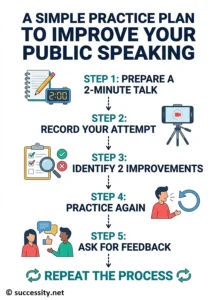
You can begin improving your public speaking skills without waiting for a major presentation. Start with a short exercise and use the results to decide what to practice next.
Step 1: Prepare a Two-Minute Talk
Choose a familiar subject, such as a skill you have learned, a work project, or a hobby. Write down your main message and two or three supporting points.
Step 2: Record Your First Attempt
Deliver the talk without stopping every time you make a mistake. The purpose is to understand your current habits, not to produce a perfect recording.
Step 3: Identify Two Improvements
Review the recording and choose one improvement related to your content and one related to your delivery.
For example:
- Content: Make the opening more direct.
- Delivery: Slow down when explaining the second main point.
Step 4: Practice Again
Deliver the same talk a second time, focusing on the two improvements you selected. Avoid changing everything at once.
Step 5: Ask for Feedback
Share the recording with someone you trust, if you feel comfortable doing so. Ask what was clear, what could be improved, and whether the main message came across.
Repeat this process with different topics and speaking situations. Over time, you will have a clearer understanding of your strengths and the skills that still need work.
Final Thoughts: Your Public Speaking Skills Can Improve
Learning how to improve public speaking is a process of preparation, practice, feedback, and gradual improvement. You do not need to eliminate every nervous feeling or become a naturally charismatic speaker to communicate effectively.
Start by organizing your message, rehearsing out loud, and making one deliberate improvement each time you practice. Learn to pause when you need a moment, adapt your delivery to your audience, and treat mistakes as opportunities to improve.
Your next step is simple: Prepare a two-minute talk today, record yourself, and choose one thing to improve in your next attempt. Small, consistent changes can help you become a clearer and more confident speaker over time.
Frequently Asked Questions
How can I improve my public speaking quickly?
Start by preparing a short speech, recording yourself, and identifying one or two habits to improve. Practice speaking at a comfortable pace, organizing your ideas clearly, and using pauses instead of rushing. A focused rehearsal can help you identify immediate improvements, although building lasting confidence takes continued practice.
What are the most effective ways to improve public speaking skills?
Three useful starting points are preparing a clear message, practicing out loud with feedback, and improving your delivery. Recording yourself can help you identify specific habits, while practicing with other people gives you experience speaking to an audience.
How can I stop saying “um” and “ah” when speaking?
Notice when filler words appear, especially when you are transitioning between ideas. Practice pausing silently instead of filling every gap with a sound. Recording yourself and rehearsing at a slightly slower pace can help you identify when these words occur and reduce them gradually.
How can I overcome the fear of public speaking?
Prepare your message, rehearse it out loud, and begin with manageable speaking situations. Before speaking, take a few comfortable breaths and focus on what your audience needs to understand. If anxiety remains intense or significantly interferes with your life, consider seeking support from a qualified mental health professional.
What is the 10-20-30 rule in presentations?
The 10-20-30 rule is a presentation guideline commonly associated with Guy Kawasaki. It recommends using no more than 10 slides, presenting for no longer than 20 minutes, and using a font size of at least 30 points. These are guidelines rather than universal requirements. The best presentation length, slide count, and font size depend on the topic, audience, and setting.
About the Author