Sophia

Building credit from scratch can feel frustrating. You apply for a credit card, try to rent an apartment, or prepare for a future car loan, only to discover that you need a credit history first. But how can you establish that history if lenders are reluctant to approve you?
The good news is that you do not need to borrow large amounts of money or pay interest just to establish credit. You need an appropriate credit-building method, a manageable budget, and consistent payment habits.
If you are new to credit in the United States, this guide explains how to build credit from scratch, compares the main options, and shows you how to get started without taking on unnecessary debt. You will also learn how credit scores work, which mistakes to avoid, and how long it may take before a credit score becomes available.
What Does It Mean to Have No Credit History?
Having no credit history means that lenders and credit scoring companies may not have enough information about your borrowing and repayment activity to generate a credit score. This is sometimes called being credit invisible.
You might be in this situation if you have never had a credit card, loan, or another account that reports eligible payment information to the major credit bureaus.
Having no credit history is not the same as having bad credit. Bad credit generally means that your credit report contains negative information, such as missed payments or accounts in collections. With no history, there may simply be too little information to evaluate.
This distinction matters because your first step depends on your situation. Someone with no credit history may need to establish an account, while someone with existing negative information may need to review their reports and address specific problems.
Credit Report vs. Credit Score
A credit report contains information about your credit accounts and borrowing history. Depending on your circumstances, it may include account balances, payment history, credit limits, inquiries, and certain public-record or collection information.
A credit score is a number calculated from information in a credit report using a particular scoring model. Lenders use scores alongside other details, such as income and existing debts, when evaluating applications.
The three major US credit reporting companies are Equifax, Experian, and TransUnion. Your reports may differ because not every lender reports information to all three companies.
You may also see different credit scores from different providers. FICO and VantageScore use different scoring models, and a lender may use a particular version designed for a specific lending decision. Therefore, do not assume that one score is the only score that matters.
Why Building Credit Matters
A credit history can influence whether you qualify for certain financial products and the terms a lender offers. Depending on the lender and the situation, your credit information may also be considered when you apply to rent a home or establish certain utility services.
A stronger credit profile may help you qualify for more favorable borrowing terms. However, a credit score does not guarantee approval, and lenders may consider income, debt obligations, employment information, and other factors.
If you expect to apply for a car loan or mortgage in the future, starting early gives you more time to establish a record of responsible credit use. If buying a home is one of your goals, Successity’s first-time home buyer’s guide can help you understand other parts of the preparation process.
How Credit Scores Work

Credit scoring models evaluate information in your credit report to estimate how you manage credit. The exact factors and their importance depend on the model being used.
For example, commonly cited FICO scoring factors include payment history, amounts owed, length of credit history, credit mix, and new credit. The familiar percentages often associated with these factors describe a particular general FICO model, not every score used by every lender.
Payment History
Payment history is one of the most important factors in many credit scoring models. It shows whether you have paid your credit obligations on time.
A late payment can hurt your credit profile, particularly when it becomes significantly overdue and is reported to the credit bureaus. Negative information may remain on a credit report for years, depending on the type of information and applicable reporting rules.
The simplest way to protect your payment history is to pay every bill by its due date. Set up payment reminders or automatic payments when appropriate, and make sure your bank account has enough money to cover scheduled withdrawals.
If you are using a credit card, consider paying the full statement balance by the due date. You do not need to carry debt from month to month to establish a positive payment history.
Credit Utilization
Credit utilization measures how much of your available revolving credit you are using. It is particularly relevant to credit card balances.
For example, if your credit card has a $1,000 limit and a reported balance of $300, your utilization on that card is 30%.
In general, lower utilization is better for many scoring models. Keeping your balances well below your limits can help, although there is no single percentage that guarantees a particular score.
You do not need to spend a certain amount every month to build credit. A small purchase that fits your budget can be enough to demonstrate responsible account management, provided the issuer reports the account to the credit bureaus.
Length of Credit History, Credit Mix, and New Credit
The length of your credit history reflects how long your accounts have been established and other account-age details. As a beginner, you cannot speed up the passage of time, so focus on keeping suitable accounts in good standing.
Credit mix refers to the types of credit accounts in your report, such as revolving credit cards and installment loans. Having experience with different types of credit may matter to some scoring models, but you should not take out an unnecessary loan just to diversify your credit profile.
New credit activity can also matter. Applying for several accounts within a short period may lead to multiple hard inquiries and could affect your score. Apply selectively rather than opening accounts simply because you want to build credit faster.
5 Ways to Build Credit from Scratch
There is no single best method for everyone. The right option depends on whether you have money available for a security deposit, whether you are a student, and whether you can comfortably manage a monthly payment.
| Method | Main advantage | What to check |
|---|---|---|
| Secured credit card | Lets you establish revolving credit with a refundable security deposit, subject to the card’s terms | Annual fees, deposit requirements, and credit bureau reporting |
| Authorized user | May help you benefit from the history of another person’s eligible account | Issuer reporting policies and the account holder’s payment habits |
| Credit-builder loan | Can establish installment payment history and may help you save | Total fees, interest, payment schedule, and reporting |
| Student credit card | May provide an entry point for eligible students | Eligibility, income requirements, fees, and reporting |
| Rent reporting | May add eligible rent payment information to certain credit files or scoring models | Cost, bureau coverage, and whether relevant lenders use the data |
Before choosing any product, confirm that the provider reports the account or payments to the credit bureaus relevant to your goals. Reporting policies vary, and not every service affects every credit score.
1. Get a Secured Credit Card
A secured credit card is one of the most straightforward options for people who are new to credit or have difficulty qualifying for a traditional card.
You provide a refundable security deposit according to the card’s terms. The issuer generally uses that deposit to secure the account, and your credit limit may be based on the amount deposited. You still have to make your required payments.
For example, suppose you deposit $300 and receive a card with a $300 credit limit. You use the card to pay for a $25 grocery purchase, then pay the statement balance in full by the due date. If the issuer reports the account to the credit bureaus, this responsible use can contribute to your credit history.
The deposit does not pay your monthly bill automatically. You remain responsible for making payments, and the issuer may apply the deposit to unpaid amounts if you default, according to the account agreement.
Before applying, check for:
- Annual fees and application fees.
- Interest rates and late-payment fees.
- The minimum deposit and available credit limit.
- Which credit bureaus receive account information.
- Whether the issuer may review your account for an unsecured upgrade and refund the deposit.
Do not choose a card based only on an advertised low deposit. Compare the full cost and confirm that the account supports your credit-building goal.
2. Become an Authorized User
Another option is to become an authorized user on a trusted person’s credit card account. This might be a parent, partner, or another family member who manages credit responsibly.
Depending on the card issuer and the scoring model, some or all of the account’s history may appear on your credit report. If the account has a strong payment record and low utilization, it may help your credit profile.
However, this is not guaranteed. The effect depends on whether the issuer reports authorized-user information, what information is reported, and how the scoring model evaluates it.
Before being added, discuss the arrangement with the primary account holder. Confirm that the account is in good standing, that the balance is manageable, and that payments are made on time.
You should also agree on whether you will use the card or simply be added to the account. Being an authorized user is different from being a joint account holder, and it generally does not make you responsible for the account in the same way as the primary borrower. Exact rights and responsibilities depend on the arrangement.
Do not rely on this strategy alone. It may help, but establishing an account in your own name can give you more direct control over your credit-building progress.
3. Consider a Credit-Builder Loan
A credit-builder loan is designed to help people establish credit while building savings. It may be offered by a bank, credit union, or another financial institution.
Unlike a conventional loan that provides money upfront, many credit-builder loans hold the loan proceeds in a secured account while you make scheduled payments. After you complete the required payments, the funds are released according to the agreement.
For example, a lender might offer a small loan with monthly payments over a set period. The lender may report those payments to the credit bureaus, helping establish an installment account history.
The important question is whether the total cost is worth it for your circumstances. You may pay interest or fees, and the amount you ultimately receive may be less than the total amount you paid.
Before signing up, ask the lender:
- What is the total cost over the full term?
- Are there setup, administration, or early repayment fees?
- Which credit bureaus receive payment information?
- What happens if you miss a payment?
- When will you receive the saved funds?
A credit-builder loan may be useful if you prefer a structured payment plan, but it is not necessary for everyone. If you already have a suitable credit card that reports to the bureaus, you may be able to build credit without taking on another financial obligation.
4. Consider a Student Credit Card
If you are enrolled in college or another eligible educational program, a student credit card may be an option. Some issuers offer products intended for applicants who have limited credit history.
Eligibility varies by issuer. You may need to provide information about income, expenses, and your ability to make payments. Under US rules, applicants under 21 generally face additional requirements when applying for a credit card, including demonstrating an independent ability to make payments or having an eligible co-signer where the issuer permits one.
Student status does not guarantee approval. Compare the card’s fees, interest rate, credit limit, and reporting policies before applying.
If you qualify, use the card for manageable expenses rather than treating the available credit as extra income. Paying the statement balance in full each month can help you avoid interest while establishing a record of responsible use.
5. Explore Rent Reporting and Alternative Payment Reporting
If you have been paying rent consistently, you may be able to use a rent-reporting service to add eligible payment information to certain credit reports.
However, rent payments are not automatically included in every credit report. A reporting service may charge a fee, and the usefulness of the information depends on which bureaus receive it and which scoring models consider it.
Some services also offer ways to report eligible utility or other recurring payments. Their coverage and effect can differ, so do not assume that every payment will be added to all three credit reports or improve every score.
Before paying for a service, ask which bureaus it reports to, whether past payments can be included, what fees apply, and whether the lenders you expect to work with use scores that consider the reported information.
Alternative reporting can be worth exploring if you want to establish credit without opening a traditional credit card. Still, it is important to confirm the details rather than relying on marketing claims about instant score increases.
How to Build Credit Step by Step

Once you understand the main options, focus on a simple plan you can maintain. Consistency matters more than complicated strategies or frequent account changes.
Step 1: Check Whether You Already Have a Credit Report
Before applying for a new account, check whether you already have a credit history. You may have a report from a previous student loan, authorized-user account, or another credit product that you no longer remember.
You can obtain your credit reports through AnnualCreditReport.com, the federally authorized website for requesting reports from the major nationwide credit reporting companies.
Review the information for unfamiliar accounts, incorrect personal details, and inaccurate payment records. If you find an error, follow the credit reporting company’s dispute process and contact the company that supplied the incorrect information when appropriate.
Checking your own credit report does not count as a hard inquiry that lowers your score.
Step 2: Choose One Suitable Credit-Building Method
Start with one option that fits your budget and circumstances. For many beginners, a secured credit card is a practical starting point. Others may prefer a credit-builder loan, authorized-user account, or eligible rent-reporting service.
Compare the cost, eligibility requirements, and reporting policies before making a decision.
You do not need to open several accounts at once. Applying for multiple products can create unnecessary inquiries, fees, and payment obligations. Choose a method you can manage comfortably and give it time to establish a record.
Step 3: Make Small, Affordable Purchases
If you choose a credit card, use it for an expense you can already afford, such as a grocery purchase or a recurring bill that fits your budget.
For example, you might put a $20 or $30 purchase on a card with a $300 limit. That lets you practice managing credit without relying on it for essential expenses you cannot otherwise cover.
Keep your balance low relative to your limit, and avoid making purchases just to create activity. The goal is not to maximize spending. It is to manage the account responsibly.
Step 4: Pay on Time and in Full
Payment consistency is one of the most important habits you can develop.
Set a reminder before the due date or use automatic payments if your bank balance is reliable enough to support them. If you choose automatic payments, continue checking your account to ensure the payment goes through.
When possible, pay the full statement balance by the due date. This helps you avoid interest on purchases under the card’s applicable terms and prevents a balance from accumulating unnecessarily.
If you cannot pay the full balance, make at least the required minimum payment by the due date and work on reducing the remaining debt. Do not ignore a bill because you cannot pay it in full.
Step 5: Monitor Your Progress and Keep Accounts in Good Standing
Review your credit reports periodically to confirm that your account information is accurate and being reported as expected. You can also check a credit score through a bank, card issuer, or reputable credit monitoring service.
Remember that different providers may show different scores. Focus on the accuracy of your credit information and the habits you control instead of reacting to every small score change.
Keep suitable accounts in good standing. Before closing an account, consider whether it has an annual fee, whether you can manage it safely, and how closing it might affect your available credit.
A closed account does not necessarily disappear from your credit report immediately. Depending on the reporting rules and scoring model, its history may continue to be considered for some time. Closing a card can also reduce your total available credit, potentially increasing utilization if you still have balances elsewhere.
Common Credit-Building Mistakes to Avoid
Building credit is easier when you avoid mistakes that create unnecessary costs or undermine your progress.
Carrying a Balance to Build Credit
You do not need to carry a balance from month to month or pay interest to build credit. Responsible card use and on-time payments are what matter.
Paying your full statement balance by the due date can help you avoid interest on purchases under the card’s terms. Deliberately carrying debt just to improve your score adds cost without providing a necessary credit-building benefit.
Applying for Too Many Accounts at Once
Opening several cards in a short period may create multiple hard inquiries and new payment obligations. It can also make it harder to track due dates and manage balances.
Compare your options first, then apply for an account that matches your needs. You can consider additional products later if there is a genuine reason to do so.
Using Too Much of Your Available Credit
A high balance relative to your limit can hurt some credit scores, even if you have not missed a payment.
For example, a $250 balance on a $300 limit represents about 83% utilization. If the reported balance is lower, utilization is lower too.
The solution is not to spend more or borrow unnecessarily. Keep purchases affordable and pay down balances when you can.
Closing an Old Account Without Considering the Effects
Closing a credit card does not automatically erase its payment history. However, it may reduce the amount of credit available to you and affect utilization.
If a card has no annual fee and is easy to manage, keeping it open may be reasonable. If it has high fees, creates overspending risks, or is difficult to manage, closing it may still be the right decision. Weigh the costs and benefits instead of following a blanket rule.
Assuming Debit Cards Build Credit
Debit cards generally use money in your bank account rather than extending credit. Ordinary debit card purchases therefore do not establish credit history in the same way as a credit card or loan that reports payment information.
If you prefer using a debit card for everyday spending, you can continue doing so while choosing a separate credit-building method that fits your circumstances.
Ignoring Your Credit Reports
Incorrect balances, unfamiliar accounts, or inaccurate late-payment information can cause problems when you apply for credit.
Check your reports periodically and dispute information you believe is inaccurate. Also, take steps to protect your personal information and review unfamiliar activity promptly.
How Long Does It Take to Build Credit?
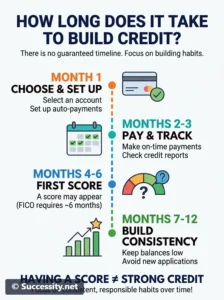
There is no guaranteed timeline for building credit from scratch. The time it takes to generate a score depends on the accounts you open, when the information is reported, the scoring model, and whether enough eligible information is available.
Some scoring models require a minimum amount of credit history before they can produce a score. For example, FICO generally requires an account to have been open for at least six months and reported to a credit bureau within the relevant period for a FICO score to be generated. Other scoring models may have different requirements.
It is important to distinguish between getting a score and building a strong credit profile. Having a score does not automatically mean that every lender will consider it sufficient for approval or offer favorable terms.
Here is a practical way to think about your first year:
- First month: Choose a suitable account or service, review its terms, and set up reminders for payments.
- Months two and three: Continue making payments as agreed and check whether the account is reporting as expected. You may not yet have a score available from every provider.
- Months four to six: Keep the same responsible habits. Depending on the scoring model and reported information, a score may become available during this period or later.
- Months seven to twelve: Continue paying on time, keeping balances manageable, and avoiding unnecessary applications. Your history will gradually contain more information about how you manage credit.
These are planning stages, not promises of a particular score. Your score may develop differently, and a specific number such as 700 is not guaranteed within the first year.
The most useful measure of progress is whether your credit report is becoming more accurate and complete while you maintain responsible payment habits.
Your First Six Months of Building Credit
Use this checklist to keep your plan simple and manageable.
Before you begin
- Check whether you already have a credit report.
- Review your budget and decide what you can afford.
- Compare suitable credit-building products and their fees.
- Confirm which credit bureaus the provider reports to.
- Apply for one appropriate account if you decide you need one.
During the first few months
- Make only purchases you can afford to repay.
- Set payment reminders or reliable automatic payments.
- Pay on time every month.
- Keep your credit card balances low relative to your limits.
- Check that your account information appears correctly on your reports when reporting begins.
As your history develops
- Review your credit reports for errors.
- Dispute inaccurate information when necessary.
- Avoid unnecessary credit applications.
- Compare score information carefully if different providers show different numbers.
- Continue the habits that fit your budget instead of chasing quick score increases.
You do not need to complete every item on the same day. The purpose of the checklist is to help you build a routine that you can maintain.
Final Thoughts
Learning how to build credit from scratch does not require complicated tricks or taking on debt you do not need. It starts with understanding your current credit situation, choosing an appropriate method, and making payments consistently.
For many beginners, a secured credit card is a practical starting point. Others may benefit from an authorized-user account, a credit-builder loan, or an eligible rent-reporting service. Whatever you choose, confirm that the account reports to the relevant credit bureaus and that the costs fit your budget.
Most importantly, pay on time, keep balances manageable, check your reports for errors, and give your credit history time to develop. You cannot control every scoring decision, but you can build habits that support a healthier credit profile over the long term.
Frequently Asked Questions About Building Credit
Can You Build Credit Without a Credit Card?
Yes. Depending on your circumstances, a credit-builder loan, an eligible student loan, or becoming an authorized user may help establish credit. Certain rent-reporting services may also add eligible payment information to credit files. The key is to confirm that the account or service reports information that can be used by the relevant credit bureaus and scoring models.
Do You Need to Carry a Balance to Build Credit?
No. Carrying a balance and paying interest are not required to build credit. If you use a credit card, paying the full statement balance by the due date can help you avoid interest on purchases under the card’s terms while maintaining responsible payment habits.
Does Checking Your Own Credit Score Lower It?
No. Checking your own credit report or score is generally treated as a soft inquiry and does not lower your score. A hard inquiry can occur when a lender checks your credit after you apply for certain credit products.
What Is a Good First Credit Score?
There is no single score that guarantees approval for every product. Credit score ranges and lender requirements vary, and some lenders evaluate applicants who have limited credit history differently from applicants with established records. Focus first on building accurate credit history, paying on time, and keeping balances manageable.
Can You Build Credit in Six Months?
It is possible to establish enough history for some scoring models to generate a score within several months, but it is not guaranteed. FICO generally has minimum credit-history requirements, and other models may work differently. Having a score after six months does not guarantee a high score or approval for a particular loan.
Is a Secured Credit Card Better Than a Credit-Builder Loan?
Neither option is automatically better for everyone. A secured credit card may be useful if you can manage purchases and repay the statement balance. A credit-builder loan may suit someone who prefers scheduled installment payments and wants to build savings. Compare the costs, reporting policies, and payment requirements before choosing.
About the Author