Sophia
Building wealth in your 30s is less about earning a high salary and more about what you do with the money you earn. A higher income can create more opportunities, but expensive debt, rising living costs, and inconsistent saving can prevent your financial position from improving.
You do not need to become wealthy overnight, invest aggressively, or give up everything you enjoy. You need a plan that reflects your income, responsibilities, and goals.
Start by understanding your finances, creating a manageable safety net, and dealing with expensive debt. Then build a savings and investing routine that you can maintain. As your circumstances improve, you can work on increasing your income, diversifying your assets, and protecting the progress you make.
This guide explains how to build wealth in your 30s with practical steps, realistic examples, and a 30-day action plan. Whether you are starting with little savings, paying off debt, or already investing, you can use these steps to decide what to work on first.
What Building Wealth in Your 30s Really Means
Building wealth means increasing the value of what you own relative to what you owe. Your salary matters, but your financial progress also depends on your spending, debt, savings, and investments.
A useful starting point is your net worth.
Net worth = Total assets – Total liabilities
Assets may include cash, savings, investments, retirement accounts, and property. Liabilities include outstanding credit card balances, personal loans, student loans, and a mortgage.
Consider this example:
| Financial item | Amount |
|---|---|
| Cash savings | $8,000 |
| Investments and retirement accounts | $12,000 |
| Car’s estimated market value | $10,000 |
| Outstanding debts | -$15,000 |
| Net worth | $15,000 |
This is an illustrative example, not a target you should have reached by a particular age. Your net worth can also fluctuate as investment prices and property values change.
The most useful question is whether your financial position is improving over time. Someone earning a modest salary who consistently reduces debt and builds savings may be making meaningful progress, even if their net worth is lower than that of a higher earner.
Your priorities will depend on your circumstances. You may be supporting children, paying student loans, renting, buying a home, changing careers, or helping family members. Your financial plan should account for those obligations instead of relying on a universal wealth benchmark.
Step 1: Assess Your Current Financial Situation

Before deciding how much to save or invest, establish a clear picture of your finances. This helps you identify the changes most likely to make a difference.
Calculate Your Net Worth
List your assets and debts in one place. Include your savings, investment accounts, retirement funds, and any property you own. Use realistic estimates for assets that could change in value, and avoid counting the same asset twice.
Subtract your total liabilities from your total assets.
Update this calculation every three to six months. One month’s result may be affected by a large bill or market movement, so focus on the longer-term direction rather than every short-term change.
Track Your Monthly Cash Flow
Calculate your take-home income and subtract your expenses.
Include housing, utilities, groceries, transportation, insurance, childcare, debt payments, subscriptions, and discretionary spending. Remember to account for irregular costs such as car repairs, annual insurance premiums, school expenses, and home maintenance.
If your expenses regularly consume your entire paycheck, identify whether you can reduce a major cost, increase your income, or adjust a combination of expenses.
For practical ideas, see this guide to reducing monthly expenses.
Identify Your Most Important Financial Obstacle
Use your financial review to identify the problem that is holding you back most.
It may be high-interest debt, no emergency savings, irregular income, expensive housing, or spending increases that follow every pay rise.
Avoid trying to fix everything at once. Choose one immediate priority and one secondary goal. For example, you might build a small cash reserve while making required payments on your debts.
Step 2: Build Financial Stability Before Taking More Risk
Investing can help grow wealth over time, but financial stability can make it easier to handle unexpected expenses without taking on more debt or selling investments at an unfavorable time.
Build an Emergency Fund
An emergency fund provides accessible money for unexpected expenses, such as urgent repairs, medical costs, or a temporary loss of income.
Start with a manageable amount if you have little or no savings. Then work toward a reserve based on your essential monthly expenses, income stability, household responsibilities, and available support.
For example, if your essential expenses total $1,800 per month, a reserve covering three months would be $5,400. Six months would be $10,800. These are planning examples, not requirements for everyone.
If your income is irregular or other people depend on you financially, you may need a larger reserve. If you are struggling to pay essential bills, focus first on immediate needs and a realistic initial cushion.
Keep emergency money accessible rather than investing it in assets that could lose value just when you need the cash.
Prioritize Expensive Debt
High-interest credit card balances and similar debts can absorb money that could otherwise support your goals.
List each debt, its outstanding balance, interest rate, and minimum payment. Continue making required payments on all debts while directing extra money toward the highest-interest balance if minimizing interest costs is your priority.
For example, suppose you have a $2,000 credit card balance charging 24% annual interest. A simplified calculation at an unchanged balance suggests approximately $480 in interest over a year. Actual interest depends on the lender’s calculation method, payment timing, and changing balance.
This illustrates why expensive debt deserves attention. Paying it down reduces future interest costs, although you should still consider essential expenses and your need for accessible savings.
The debt avalanche method prioritizes the highest interest rate first. The debt snowball method prioritizes the smallest balance first, which may help some people maintain motivation. Learn more in this guide to debt management strategies.
Review Employer Retirement Benefits
If your employer offers matching retirement contributions, understand how the program works and whether you can contribute enough to receive the available match.
Check eligibility, vesting rules, investment choices, fees, and withdrawal restrictions. If your budget is under pressure, balance retirement contributions against essential bills, required debt payments, and a workable emergency reserve.
The right sequence depends on your circumstances. A financial plan should help you make progress without creating a new shortfall elsewhere.
Step 3: Create a Savings Plan You Can Maintain
Saving works best when it becomes a regular habit rather than a decision you must reconsider every month.
Choose a Realistic Savings Target
There is no single savings percentage that works for everyone. Your target depends on your take-home income, housing costs, debt, dependents, existing savings, and financial goals.
Consider someone who receives $3,000 per month after tax. Their budget might look like this:
| Monthly category | Example amount |
|---|---|
| Housing and utilities | $1,050 |
| Groceries and household needs | $400 |
| Transportation | $250 |
| Insurance and healthcare | $200 |
| Debt payments | $250 |
| Personal and family spending | $400 |
| Irregular-expense savings | $150 |
| Emergency savings or investments | $300 |
| Total | $3,000 |
In this example, the person sets aside $450 each month for savings, including $150 for irregular expenses and $300 for emergency savings or investments. That represents 15% of take-home income.
This is only an illustration. Someone with higher housing costs, dependents, or urgent debt may have less available to save. Another person with lower expenses may be able to save more.
The important point is to build a plan around your actual numbers. If your current budget leaves no room for saving, start by identifying one realistic adjustment instead of choosing a target you cannot sustain.
Automate Contributions
If your cash flow allows it, schedule transfers to savings after payday. Make sure essential bills and required payments are covered before money is moved.
You can start with a small amount and increase it when your income rises or a debt is paid off. Automation reduces the effort required to maintain the habit, but it should not cause overdrafts or force you to borrow for everyday expenses.
Plan for Irregular Expenses
Some costs are not monthly, but they are predictable. Examples include annual insurance, school supplies, holiday travel, and routine vehicle maintenance.
If you expect to spend $600 on an annual bill, setting aside $50 per month can help you prepare for it. Keep this money separate from your emergency fund and long-term investments.
This small adjustment can prevent an ordinary expense from becoming new credit card debt.
Separate Short-Term and Long-Term Goals
Money needed soon should be treated differently from money intended for retirement.
For example, a home deposit you expect to need in two years generally requires more attention to capital preservation and access than retirement money you will not need for decades.
Choose savings accounts or investments based on when you need the money, how much risk you can accept, and what financial products are available in your country.
Step 4: Understand Long-Term Investing and Risk

Saving helps you prepare for expenses and protect your financial stability. Investing provides an opportunity for long-term growth, but returns are not guaranteed and losses are possible.
Understand Diversification
Diversification means spreading investments across different assets rather than relying too heavily on a single company, industry, or investment type.
Some investors use broad mutual funds or exchange-traded funds (ETFs) to access many investments through a single fund. However, a fund is not automatically diversified simply because it is an ETF or mutual fund. A narrowly focused fund may still concentrate risk.
The appropriate mix of stocks, bonds, cash, and other assets depends on your goals, time horizon, and ability to tolerate losses. Diversification can reduce some risks, but it cannot eliminate market losses.
The U.S. Securities and Exchange Commission explains these principles in its guide to asset allocation and diversification.
Compare Investment Fees
Investment costs reduce the amount of money that remains invested. Before choosing a fund or investment account, review ongoing expenses, transaction fees, advisory charges, and any applicable account fees.
A lower-cost investment is not automatically the best choice, but costs deserve attention alongside diversification, risk, and suitability.
Avoid choosing an investment simply because it has recently performed well. Past performance does not guarantee future results.
Match Investments to Your Goals
Consider when you will need the money and how you would respond if its value fell significantly.
Money intended for a near-term purchase may need a different approach from retirement savings intended to remain invested for decades.
Avoid concentrating your savings in a few stocks or speculative assets simply because you want to build wealth faster. Borrowing to invest can magnify losses and create additional financial pressure.
A sensible investment plan is one you understand and can maintain through changing market conditions.
Understand Retirement and Tax-Advantaged Accounts
Depending on your country, retirement accounts may offer tax benefits, employer contributions, or other advantages. They may also have contribution limits, eligibility rules, fees, and restrictions on withdrawals.
In the United States, examples include traditional and Roth IRAs and employer-sponsored 401(k) plans. Their tax treatment and eligibility requirements differ, and some contribution limits depend on income and other circumstances.
Review the current rules before contributing. The official IRS retirement plans resources explain the options available to U.S. taxpayers.
If you live elsewhere, research the equivalent accounts and tax rules in your country rather than assuming U.S. arrangements apply to you.
Step 5: Increase Your Earning Potential Without Inflating Your Expenses
Reducing unnecessary expenses can free up money, but there is a limit to how much you can cut from an already modest budget. Increasing your earning potential can create another route toward financial progress.
Invest in Your Career
Review the skills, qualifications, and experience that could improve your employment opportunities.
Depending on your field, this might mean gaining a professional credential, learning a valuable skill, taking on higher-responsibility projects, or applying for roles with better compensation.
Document your contributions at work and research realistic salary ranges before negotiating a raise or considering another position.
Compare total compensation, benefits, job security, commuting expenses, and other relevant costs before changing jobs. A higher salary does not automatically produce a better financial outcome if the associated expenses also increase.
Evaluate Additional Income Opportunities
Freelancing, consulting, tutoring, and small online businesses can provide additional income, but they also require time and effort. Some involve upfront costs, uncertain demand, or irregular earnings.
Start with a skill you already have and test whether people are willing to pay for it before spending heavily on equipment, advertising, or training.
For example, if you earn an additional $200 per month after business expenses and taxes, directing that money toward a high-interest debt or an emergency fund can make a meaningful difference over time. The result depends on your actual costs and how consistently you earn the extra income.
Explore the potential advantages and trade-offs in this guide to the benefits of a side hustle.
Do not assume a side business will become passive income immediately. Protect your time, understand the costs, and avoid risking money you need for essential expenses.
Avoid Lifestyle Inflation
When your income rises, it can be tempting to upgrade your car, housing, subscriptions, and everyday spending.
Some lifestyle improvements are worthwhile. The problem arises when every raise becomes a permanent increase in expenses, leaving your financial position unchanged.
Consider deciding in advance how to use part of each raise. You might increase debt payments, add to savings, or invest more while still setting aside some money to enjoy your improved income.
This approach allows you to benefit from earning more without allowing your expenses to rise automatically by the same amount.
Step 6: Evaluate Other Wealth-Building Options Carefully

Once your essential financial priorities are under control, you can consider additional ways to build assets. These options should complement your overall plan rather than replace accessible savings or expose you to risks you cannot afford.
Consider Real Estate Carefully
Real estate can provide rental income and potential appreciation, but owning property also involves maintenance, insurance, taxes, vacancy periods, financing costs, and unexpected repairs.
Before buying a rental property, estimate the income left after operating expenses, loan payments, periods without tenants, and a reserve for major repairs. Do not base your decision on rent alone.
For example, a property that brings in $1,500 per month in rent does not generate $1,500 in profit. If operating costs, maintenance reserves, and other expenses total $600, only $900 remains before any mortgage payment and applicable taxes.
This is a simplified illustration. Actual costs vary by property, location, financing, and local regulations.
Real estate investment trusts (REITs) offer another way to invest in certain property markets without directly managing a building. Their prices can fluctuate, and distributions are not guaranteed.
Compare the costs, risks, liquidity, and effect on your overall portfolio before investing in property or REITs.
Be Careful With Promises of Fast Returns
Promises of unusually high returns with little or no risk should raise concerns.
Speculative investments can lose substantial value, and borrowing to invest can magnify losses. Do not commit emergency savings or money needed for essential expenses to volatile investments.
Understand what you are buying, how it may generate returns, what it costs, and how you could lose money. Building wealth is generally a long-term process, not a search for one investment that solves every financial problem.
Step 7: Protect the Progress You Make
Growing assets is only part of a sound financial plan. You also need to consider events that could interrupt your income or create substantial expenses.
Review Your Insurance Needs
Your insurance needs depend on your household, employment benefits, dependents, debts, assets, and local regulations.
If someone depends on your income, life insurance may help protect them financially if you die. Disability coverage may help replace some income if an illness or injury prevents you from working.
Review the coverage you already have before buying additional policies. Compare exclusions, waiting periods, benefit limits, premiums, and coverage conditions.
Avoid assuming that one policy type or a fixed amount of coverage is right for every household.
Organize Essential Financial Documents
Keep important information about your accounts, debts, insurance policies, investments, and beneficiaries organized and secure.
Depending on your circumstances and local laws, you may also need a will, powers of attorney, or other estate-planning documents.
These arrangements can help clarify how financial matters should be handled if you become unable to manage them or die. Seek qualified legal or financial advice when your situation involves substantial assets, dependents, or complex family circumstances.
A Practical 30-Day Plan to Start Building Wealth
You do not need to change every part of your financial life immediately. Use the next month to establish a clear starting point and build a manageable routine.
Week 1: Understand Your Finances
- List your assets and debts.
- Calculate your current net worth.
- Review two or three months of spending where records are available.
- Identify your highest-interest debt and largest recurring expenses.
- Choose one financial priority to address first.
Week 2: Strengthen Your Foundation
- Set an initial emergency savings target that fits your circumstances.
- Make sure essential bills and required debt payments are covered.
- Review debt interest rates and choose a repayment strategy.
- Check whether your employer offers retirement contributions or matching benefits.
- Identify upcoming irregular expenses and estimate how much you need to set aside.
If you are struggling to cover essential bills, address those immediate needs before focusing on investing.
Week 3: Establish a Savings Routine
- Set up an affordable automatic transfer if your cash flow permits.
- Separate emergency savings from money intended for planned expenses.
- Review the accounts available for your short-term and long-term goals.
- Learn the basic costs and risks of any investment you are considering.
- Avoid investing money you may need soon in volatile assets.
If you are not ready to invest, improving your cash flow and building financial stability is still meaningful progress.
Week 4: Review and Improve
- Check whether your budget reflects your actual spending.
- Identify one realistic way to increase income or reduce an unnecessary cost.
- Review your insurance and essential financial documents.
- Decide how you will use part of any future pay raise or additional income.
- Schedule your next financial review.
At the end of the month, measure what has changed. You may have reduced one balance, started an emergency fund, or simply gained a clearer picture of your finances. Each can be a useful first step.
Common Wealth-Building Mistakes to Avoid
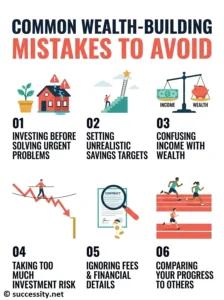
Trying to Invest Before Addressing Urgent Financial Problems
Investing while struggling to cover essential expenses or carrying expensive debt may add financial pressure. Address immediate needs and establish a workable foundation before taking on more investment risk.
Setting an Unrealistic Savings Target
A target that ignores housing costs, dependents, and other obligations can make progress feel impossible. Start with a realistic amount and adjust it as your circumstances change.
Confusing Income With Wealth
A higher salary does not guarantee a higher net worth. Review what you own, what you owe, and how your financial position changes over time.
Taking Too Much Investment Risk
Chasing high returns, concentrating investments, or borrowing to invest can expose you to losses that take years to recover from. Choose investments that match your goals, time horizon, and ability to tolerate risk.
Ignoring Fees and Financial Details
Recurring fees, debt interest, and unfavorable account terms can reduce your financial progress. Review the costs and conditions of financial products before committing money.
Comparing Your Progress With Other People
People in their 30s have different incomes, responsibilities, starting points, and opportunities. Focus on improving your own financial position rather than copying someone else’s spending or investment choices.
Final Thoughts
Building wealth in your 30s does not require a perfect financial history, an unusually high salary, or extreme investment risks.
Start by understanding your finances, managing expensive debt, building accessible savings, and creating a plan that suits your goals. As your circumstances improve, increasing your income and investing appropriately may help you build assets over time.
You do not need to make every change at once. Calculate your net worth, identify your most important financial priority, and take one practical step this month.
Consistent progress and realistic decisions will serve you better than chasing shortcuts or comparing your finances with someone else’s.
Frequently Asked Questions
Is 30 too late to start building wealth?
No. Starting in your 30s can still leave decades for saving and investing before retirement. Your results depend on factors such as contributions, investment performance, fees, income, and time.
How much of my income should I save in my 30s?
There is no universal percentage. Choose an amount that fits your essential expenses, debt, dependents, and goals. Increase it gradually when your financial circumstances allow.
Should I pay off debt or invest first?
The answer depends on the debt’s interest rate, your emergency savings, available employer retirement benefits, and your overall financial situation. Paying down high-interest debt can reduce a relatively predictable cost, while investment returns are uncertain. Lower-interest debt requires an individual comparison.
How can I build wealth while supporting a family?
Start with a budget that accounts for essential household expenses, debt payments, and irregular costs. Build accessible savings, review available employer benefits, and consider suitable protection for dependents. Set goals your household can realistically maintain.
What should I do first if I have little or no savings?
Start by reviewing your income, essential expenses, overdue bills, and outstanding debt. Address urgent obligations and work toward a small emergency reserve. Once your finances are more stable, you can build savings and consider longer-term investments.
Is investing in your 30s risky?
All investments involve some degree of risk, and some can lose substantial value. Your approach should reflect when you need the money, your ability to absorb losses, and your broader financial position. Diversification can reduce certain risks but cannot eliminate them.
About the Author