Sophia
You stare at your screen, exhausted yet wired, feeling like a cognitive shell of your former productive self. True recovery from chronic exhaustion requires shifting away from superficial self-care and addressing the biological shutdown of your nervous system.
This guide offers a scientific blueprint and actionable protocols on how to deal with burnout so you can safely pull your mind and body out of survival mode.
💡 The Quick Answer – How to deal with burnout?
To deal with burnout effectively, you must transition your autonomic nervous system from sympathetic dominance (fight-or-flight) to parasympathetic recovery. This is achieved by reducing your cognitive load, establishing strict energetic boundaries, implementing somatic nervous system resets, and systematically restoring your body’s physiological reserves through deep rest.
The Bathroom Floor Epiphany – Why Willpower Alone Cannot Save You
The cold tile of the bathroom floor felt surprisingly grounding. Just moments earlier, a simple, red notification bubble on a computer screen had triggered a wave of nausea so intense it forced a sudden retreat from the desk.
There were no tears left, only a profound, hollow emptiness that made even holding a phone feel like lifting an impossibly heavy weight. For months, the warning signs were ignored, pushed aside by another cup of coffee and the false belief that one more productive weekend would fix everything.
This is the point where willpower fails completely. When you reach this level of exhaustion, your brain is not merely tired; it has initiated an involuntary emergency shutdown to protect you from yourself.
Understanding this pivot point is crucial because it shifts the entire narrative of recovery. You are not weak, undisciplined, or failing; your biology has simply run out of resources to keep up with the demands.
To understand why this happens, we must look at the key indicators that suggest your system is approaching or has reached a complete shutdown:
- The Wired-Exhausted Loop – Feeling completely drained during the day yet unable to sleep at night due to racing thoughts.
- Emotional Flatlining – Experiencing a total lack of joy or satisfaction from achievements that used to bring excitement.
- Physical Somatization – Developing frequent tension headaches, unexplained digestive issues, or chronic muscle tightness without a physical cause.
- Cognitive Friction – Finding simple tasks like drafting an email or making a basic schedule incredibly difficult and overwhelming.
Understanding the Biology of Exhaustion – What Burnout Does to Your Brain
To truly recover, we must stop treating this condition as a simple attitude problem. It is a measurable physiological state characterized by profound autonomic nervous system dysregulation.
When stress becomes chronic, the body accumulates a heavy allostatic load, which is the wear and tear on tissues and biological systems due to constant activation of the stress response. This prolonged state keeps you locked in sympathetic dominance, preventing your body from entering the restorative parasympathetic state required for healing.
The HPA Axis Under Siege – How Chronic Stress Redefines Your Cortisol Levels
At the heart of this physiological shutdown is the Hypothalamic-Pituitary-Adrenal (HPA) axis, the complex feedback system that regulates your response to stress. Under normal circumstances, this system releases cortisol in a healthy, diurnal rhythm known as the cortisol awakening response (CAR).
However, chronic overwork forces the HPA axis to remain constantly active. Over time, this unrelenting demand can lead to HPA axis dysfunction, where the body’s ability to produce and regulate cortisol becomes compromised.
Instead of a healthy morning spike that gives you energy, your cortisol curve flattens out entirely. This hormonal disruption leaves you feeling deeply fatigued in the morning, followed by unnatural spikes of anxious energy late at night.
Cognitive Depletion – Why Decision Fatigue and Brain Fog Set In
The brain’s prefrontal cortex, which handles executive functions like planning, decision-making, and emotional regulation, requires massive amounts of cellular energy. When your body is stuck in survival mode, energy is diverted away from these high-level cognitive centers.
This redirection of resources leads directly to severe cognitive depletion. The neural pathways associated with focus and memory struggle to function under the weight of constant neuroinflammation and neurochemical imbalances.
This state is not permanent, but it cannot be solved by simply forcing yourself to concentrate harder. Recognizing that brain fog is a biological indicator of depleted resources is the first step toward strategic recovery.
How to Deal with Burnout – A Strategic Three-Phase Protocol
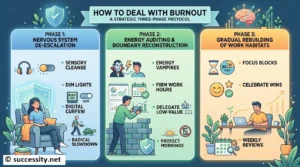
Recovery is not an overnight event, nor is it a random sequence of spa days. It requires a structured, systemic approach that respects your body’s altered biology and gently coaxes your nervous system back to safety.
By treating recovery as a phased medical-grade protocol, you remove the guesswork and decision fatigue that often stall progress. This structured journey allows you to heal systematically while maintaining your professional responsibilities.
Phase 1 – Immediate Nervous System De-escalation
The primary objective of this initial phase is to stop the physiological bleeding. When you are deeply depleted, your system is flooded with inflammatory cytokines and circulating stress hormones that keep you in a state of high alert.
To reverse this, you must initiate an immediate, low-demand incubation period. This phase is designed to minimize external sensory inputs and signal absolute safety to your overactive amygdala.
- The Sensory Cleanse – Reduce auditory and visual stimulation by dimming lights and spending at least two hours in complete silence daily.
- The Digital Sabbatical – Establish a strict digital curfew by turning off all work-related devices by 6:00 PM to protect your evening melatonin production.
- The Radical Slowdown – Intentionally perform daily tasks like walking, eating, and speaking at half your usual speed to mechanically calm your nervous system.
Phase 2 – Structural Energy Auditing and Boundary Reconstruction
Once your nervous system begins to stabilize, you must address the external factors that caused your depletion in the first place. This phase focuses on identifying and plugging your primary energy leaks.
You cannot heal in the same environment that made you sick without changing the dynamics of that environment. This step requires a clinical, objective assessment of your daily energy expenditures.
- Identify Energy Vampires – Pinpoint specific tasks, meetings, or interpersonal dynamics that leave you feeling physically drained.
- Establish Hard Stop times – Set immutable boundaries around your working hours, treating your end-of-day wrap-up as a non-negotiable appointment.
- Delegate Low-Value Tasks – Offload repetitive administrative work that consumes high mental bandwidth but offers minimal professional return.
- Protect Your Mornings – Keep the first hour of your day entirely free from emails, notifications, and external demands to preserve your cognitive reserves.
Phase 3 – Gradual Neuroplastic Rebuilding of Work Habitats
The final phase involves returning to your professional tasks with a completely restructured approach. This is where you leverage neuroplasticity to build healthier work habits and cognitive patterns.
Instead of returning to your old, unsustainable work style, you will establish a sustainable cadence. This ensures that you can perform at a high level without triggering another systemic crash.
- Implement Focus Blocks – Work in highly focused, 90-minute intervals followed by mandatory 15-minute breaks to align with your natural ultradian rhythms.
- Celebrate Micro-Successes – Consciously acknowledge small daily completions to rebuild your brain’s dopamine pathways and restore natural motivation.
- Conduct Weekly Reviews – Assess your energetic levels every Sunday to adjust your upcoming workload before stress accumulates.
The Somatic Toolkit – Instant Resets for Sympathetic Dominance
When you are in the depths of exhaustion, cognitive tools like positive thinking or logical reasoning are often ineffective. This is because a compromised prefrontal cortex cannot easily override a deeply stressed survival brain.
Somatic tools bypass the thinking mind entirely, sending direct, physical signals of safety up the vagus nerve to the brain. These physiological resets can quickly pull you out of an acute stress response.
Physiological Sighing – The Fastest Way to Calm Your Vagus Nerve
Developed by neuroscientists, the physiological sigh is a rapid, autonomous breathing pattern that immediately triggers the parasympathetic nervous system. It is the most efficient real-time tool for reducing autonomic arousal.
By expanding the lung’s alveoli and increasing carbon dioxide elimination, this simple breath pattern lowers your heart rate within seconds.
- Take a Double Inhale – Take a deep, sharp inhalation through your nose, followed immediately by a second, quick sniff to fully inflate your lungs.
- Perform a Slow Exhale – Release the air slowly through your mouth with a long, relaxed sigh, making the exhalation twice as long as the inhalation.
- Repeat Three Times – Cycle through this pattern three times in succession to experience an immediate drop in physical tension.
Non-Sleep Deep Rest (NSDR) – Recharging Cognitive Reserves Without Sleeping
Non-Sleep Deep Rest (NSDR) is a highly effective protocol that guides your brainwaves into deep alpha and theta states. These are the same restorative states experienced during deep sleep, but you remain consciously awake.
This practice allows your brain to rapidly clear out metabolic waste and replenish depleted neuromodulators like dopamine and acetylcholine.
- Find Quiet Space – Lie down in a comfortable, dark room where you will not be interrupted for twenty minutes.
- Listen to Guidance – Play an NSDR or Yoga Nidra audio track to focus your mind on systematic body scanning and breath awareness.
- Allow Complete Release – Focus on letting your muscles feel progressively heavier, allowing your body to drop into a state of deep stillness.
Restructuring Your Professional Environment – Tactical Boundary Templates
Many professionals struggle with recovery because they fear that setting boundaries will damage their careers. However, establishing clear operational limits actually increases your long-term value and professional reliability.
By framing your boundaries around efficiency and quality of work, you protect your health while earning professional respect.
The Out of Office Paradigm – Disconnecting Without Guilt
True recovery requires periods of absolute, uninterrupted disconnection. If you are constantly checking messages during your off-hours, your nervous system remains in a state of low-grade, anticipatory stress.
Setting up clear, automated communications manages external expectations and allows you to disconnect without experiencing professional anxiety.
- Define Specific Windows – Clearly state your response times in your email signature so colleagues know exactly when to expect a reply.
- Identify Emergency Contacts – Provide a clear escalation path for true emergencies so colleagues do not feel tempted to bypass your boundaries.
- Set Automated Triggers – Use automated out-of-office replies during focused work blocks to protect your attention from continuous interruptions.
Saying No Gracefully – Scripts for High-Performers
Saying no is not about being uncooperative; it is about protecting your limited cognitive bandwidth to deliver high-quality work. High-performers must learn to decline low-priority tasks with confidence and professionalism.
You can use these proven, polite communication templates to protect your workload:
- The Priority Re-allocation – “I would love to help with this project, but to maintain the quality of my current deliverables, I would need to deprioritize our main campaign. How should we balance this?”
- The Delayed Execution – “This is a great initiative, but my capacity is fully committed for this week. I can schedule a dedicated slot to look into this next Tuesday.”
- The Strategic Referral – “While I cannot take on this specific task right now, I can share a framework that might help your team complete it independently.”
Dietary and Sleep Hygiene Adjustments for HPA Axis Recovery
Recovering your endocrine system requires providing your body with the exact nutritional building blocks and environmental cues it needs to heal. When your HPA axis is compromised, your body’s cellular metabolism and circadian rhythms require extra support.
By stabilizing your blood sugar and aligning your sleep patterns with natural light cycles, you give your endocrine system the stability it needs to repair.
- Prioritize Morning Light – Step outside within thirty minutes of waking to view natural sunlight, which helps anchor your cortisol awakening response.
- Incorporate Targeted Minerals – Support your adrenal health by consuming foods rich in magnesium, potassium, and high-quality sea salts.
- Avoid Afternoon Caffeine – Stop consuming caffeine after 12:00 PM to prevent it from interfering with your deep sleep architecture.
- Balance Your Macronutrients – Eat balanced meals containing clean proteins, healthy fats, and complex carbohydrates to prevent cortisol-spiking blood sugar drops.
Reclaiming Your Identity Outside of Professional Output

A primary psychological driver of severe overwork is the unconscious belief that your personal value is directly tied to your productivity. When your entire identity is built around professional output, resting can feel like a threat to your self-worth.
To heal fully, you must decouple your self-concept from your achievements. Reclaiming your identity outside of work is a vital step in building long-term psychological resilience.
- Pursue Zero-Utility Hobbies – Engage in activities like painting, gardening, or playing music solely for the joy of it, with no intention of monetizing the outcome.
- Reconnect with Nature – Spend regular, unstructured time in natural environments to remind yourself of the larger world outside your professional circle.
- Nurture Offline Relationships – Dedicate focused energy to deep conversations with loved ones where work and career goals are completely off the table.
The Roadmap to Sustainable Performance – Preventing Future Relapse
True recovery is not a temporary fix; it is a permanent lifestyle transition. Once you have successfully restored your nervous system, your focus should shift to building an early warning system to prevent future relapses.
By treating your energy levels as a finite resource, you can design a sustainable life that supports both high performance and deep personal well-being.
- Track Energetic Baselines – Take a quick mental inventory of your physical and emotional energy levels every morning before checking your phone.
- Schedule Mandatory Rest – Treat your rest periods with the same level of respect and commitment as your most important client meetings.
- Audit Workloads Quarterly – Review your professional commitments every three months to ensure your responsibilities have not slowly crept past your boundaries.
Final Thoughts
Healing from chronic depletion is not a sign of weakness; it is a courageous act of reclaiming your humanity. Your body is not a machine designed for constant, uninterrupted output, and honoring your physiological limits is the ultimate form of self-respect.
As you begin to implement these protocols, remember to be patient with your progress. Real recovery is a gradual journey of small, consistent steps that slowly rebuild your system from the inside out. By prioritizing your physical and mental well-being, you will discover how to deal with burnout while building a deeply fulfilling, balanced, and sustainable life.
Frequently Asked Questions
What are the 5 stages of burnout?
The five stages begin with the honeymoon phase, characterized by high energy and enthusiasm, which gradually transitions into balancing stress. This is followed by chronic stress, actual burnout, and eventually habitual burnout, where physical and mental exhaustion become deeply embedded.
How long does it take to fully recover from burnout?
Recovery timelines vary significantly depending on the depth of nervous system depletion and environmental factors. Mild cases can often resolve within three to twelve weeks, while severe cases may require six months to a year of dedicated physical and psychological recovery.
Am I actually burned out, or am I just being lazy and undisciplined?
Lazy individuals generally do not care about the quality of their work or the impact of their performance on others. If you are feeling deeply frustrated by your lack of focus and desperately want to care but simply lack the energy to do so, you are experiencing genuine physiological depletion.
What if my job does not allow me to take time off or set strict boundaries?
Even in highly demanding environments, you can still implement micro-recovery strategies throughout your day. Practices like taking three physiological sighs between meetings, stepping outside for five minutes of morning light, and using structured scripts to filter minor tasks can protect your nervous system.
About the Author