Sophia

Have you ever agreed to something you didn’t want to do because you were afraid your partner would feel hurt? Maybe you canceled plans with friends to avoid an argument, answered messages while trying to relax, or stayed in an uncomfortable conversation because saying “I need a break” felt selfish.
At first, these small compromises might seem harmless. But when they happen repeatedly, frustration can build. You may start feeling exhausted, overlooked, or resentful, even though you genuinely care about your partner.
This is where healthy relationship boundaries matter. Boundaries help you communicate what you are comfortable with, what you need, and how you expect to be treated. They allow both partners to maintain their individuality while building a relationship based on mutual respect.
Still, knowing you need a boundary and actually setting one are two different things. You might worry about disappointing your partner, creating conflict, or appearing selfish. That discomfort can make it difficult to speak up.
The good news is that you can be considerate without ignoring your own needs. Learning how to set boundaries in a relationship without feeling guilty starts with understanding your limits, communicating them clearly, and remembering that another person’s disappointment does not automatically mean you have done something wrong.
What Are Healthy Boundaries in a Relationship?
Relationship boundaries are personal limits that define what you are comfortable with and how you want to be treated. They help protect your emotional well-being, physical comfort, privacy, time, and personal values.
For example, you might need an hour alone after work, prefer not to share your phone password, or want disagreements to happen without insults or shouting. These are all examples of boundaries that help you feel respected and comfortable.
Boundaries are not about controlling every decision your partner makes. They are about communicating your limits and deciding what you will do when a situation crosses them.
Boundaries vs. Rules, Demands, and Ultimatums
It is important to understand the difference between setting a boundary and trying to control someone else.
A demand tells another person what they must do. A boundary explains what you are comfortable with and what action you will take if a situation continues.
Consider these examples:
- Controlling demand: “You are not allowed to spend time with those friends.”
- Healthy boundary: “I want us to make time for our relationship, but I also respect that we both need friendships outside it.”
Another example:
- Threat: “If you ever raise your voice again, you’ll regret it.”
- Healthy boundary: “I am willing to discuss this, but I will leave the conversation if we start shouting at each other.”
A boundary does not guarantee that another person will agree with you. It gives them a clear understanding of your limits and helps you decide how to respond.
For a useful explanation of how boundaries and expectations work together, read Love Is Respect’s guide to boundaries and expectations.
Why Boundaries Make Relationships Healthier
A healthy relationship needs room for two individuals, not just one shared identity. Both partners should be able to express their needs, maintain personal interests, and disagree without feeling threatened.
Clear boundaries can help you:
- Reduce resentment: You are less likely to agree to things you secretly resent.
- Protect your individuality: You can maintain friendships, hobbies, and personal goals.
- Communicate expectations: Your partner does not have to guess what makes you uncomfortable.
- Build mutual respect: Both people learn to recognize and consider each other’s limits.
- Create emotional safety: Difficult conversations become easier when both partners know that insults, pressure, and disrespect are not acceptable.
Boundaries do not remove every disagreement. They give couples a healthier way to handle differences. You can also explore the foundations of a lasting partnership in our guide to building a strong relationship foundation.
7 Signs You Need Better Boundaries in Your Relationship

Sometimes, you do not realize that your boundaries need attention until frustration becomes part of your daily routine. The following signs can help you recognize where you may need clearer limits.
- You say yes when you want to say no. You accept plans, favors, or requests because you fear your partner’s reaction.
- You feel responsible for your partner’s emotions. When your partner is upset, you immediately assume you must fix the situation, even when you have done nothing wrong.
- You have little time for yourself. Your hobbies, friendships, and personal interests have gradually disappeared from your routine.
- You over-explain simple decisions. Saying you need an evening alone turns into a long apology because you feel you must justify every personal choice.
- You avoid difficult conversations. You stay quiet about uncomfortable behavior because you worry that speaking up will cause an argument.
- You feel resentful after agreeing to things. You often accept requests and then become frustrated because your own needs were ignored.
- Your privacy or physical comfort is not respected. Your partner checks your messages without permission, pressures you to share private information, or continues touching you after you have said you are uncomfortable.
One sign alone does not tell you everything about a relationship. However, if several of these situations happen repeatedly, it may be time to identify what needs to change.
6 Types of Boundaries Every Healthy Relationship Needs
Boundaries can apply to almost every part of a relationship. You do not need to establish all of them at once. Start with the areas where you feel the most discomfort or pressure.
1. Emotional Boundaries
Emotional boundaries help you recognize that you can care about your partner without taking responsibility for every feeling they experience.
You can listen when your partner has a difficult day, offer support, and show compassion. However, you do not have to absorb their frustration or accept hurtful behavior because they are stressed.
For example, you might say:
“I want to understand what is upsetting you, but I cannot continue this conversation while we are insulting each other. Let’s take a break and talk when we are calmer.”
You can also ask for time to process your own feelings before discussing a sensitive issue.
2. Physical and Personal Space Boundaries
Physical boundaries involve your body, personal space, belongings, and comfort with physical contact.
You might prefer not to be hugged in public, need privacy when changing clothes, or want your partner to ask before using your personal belongings.
For example:
“I know you enjoy being affectionate, but I am not comfortable with kissing in public. I would rather keep that between us.”
Your comfort matters even when you are in a committed relationship. Physical affection should be mutual, not something one partner feels obligated to provide.
3. Time and Independence Boundaries
Being in a relationship does not mean spending every free moment together. Both partners need time for rest, personal interests, friendships, and responsibilities.
For example:
“I love spending time with you, but I also need one evening each week for myself. It helps me recharge, and I want us both to have time for our own interests.”
You might also agree on limits around work calls, family visits, or last-minute plans.
The goal is not to create distance. It is to build a relationship where spending time together is a choice rather than a constant obligation.
4. Financial Boundaries
Money can become a sensitive subject when partners have different spending habits, financial responsibilities, or expectations.
Financial boundaries help clarify what you are comfortable sharing, how you handle joint expenses, and when you want to discuss major purchases.
Examples include:
- Agreeing to discuss significant purchases before spending shared money.
- Keeping some personal spending money separate from joint household expenses.
- Being clear about whether you are comfortable lending money to family or friends.
- Avoiding financial commitments that exceed your budget.
You might say:
“I am happy to discuss our shared expenses, but I am not comfortable taking on another loan. We need to find an option that fits our budget.”
The important thing is to make financial decisions through honest discussion rather than pressure or secrecy.
5. Sexual Boundaries
Sexual boundaries involve consent, comfort, preferences, and personal readiness. Being in a relationship does not mean either partner automatically agrees to every form of physical intimacy.
You have the right to say no, change your mind, or communicate that something makes you uncomfortable. The same respect must apply to your partner.
For example:
“I care about you, but I am not comfortable with that. I need you to respect my decision.”
Consent should be freely given and can be withdrawn. Pressure, guilt, or threats are not substitutes for consent.
For more guidance, read Love Is Respect’s explanation of consent in relationships.
6. Digital Boundaries
Phones, messaging apps, social media, and location-sharing tools have introduced new situations that couples need to discuss.
Digital boundaries help you agree on what privacy and communication should look like in your relationship.
Consider these examples:
- Phone privacy: You do not have to give your partner unlimited access to your private messages.
- Social media: Discuss whether you are both comfortable sharing relationship photos or personal details online.
- Messaging expectations: Agree that neither person has to reply immediately when working, sleeping, or spending time alone.
- Location sharing: Discuss whether it is genuinely useful for both partners or has become a way to monitor each other’s movements.
- Time away from screens: Set aside moments when both of you can focus on each other without checking notifications.
Digital boundaries should be based on mutual agreement, trust, and respect. Privacy is not automatically evidence of dishonesty, and monitoring a partner’s activity is not a substitute for addressing trust concerns.
How to Set Boundaries in a Relationship Without Feeling Guilty
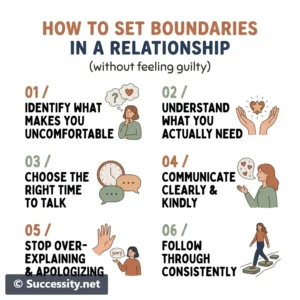
Understanding boundaries is only the beginning. The more difficult part is communicating them, especially if you are used to keeping everyone happy.
These steps can help you approach the conversation with greater confidence.
Step 1: Identify What Is Making You Uncomfortable
Before speaking to your partner, take a moment to understand what is bothering you.
Are you feeling overwhelmed because you have no time alone? Are you frustrated because your opinions are dismissed? Do you feel pressured to share something private?
Try to identify the specific behavior rather than focusing only on the emotion.
For example, instead of thinking, “My partner never respects me,” identify what happened:
“I feel uncomfortable when my partner reads my messages without asking.”
This gives you a clearer starting point for the conversation.
Step 2: Understand What You Actually Need
Once you identify the problem, think about what would help you feel more comfortable.
Perhaps you need:
- More time for yourself.
- A calmer way to discuss disagreements.
- Privacy around your phone and personal belongings.
- More balanced household responsibilities.
- The freedom to say no without being pressured.
Be realistic and specific. A boundary should communicate something meaningful that you can actually maintain.
Step 3: Choose the Right Time to Talk
Whenever possible, discuss important boundaries when both of you are calm and have enough time to listen.
Starting the conversation during an argument may make it harder to understand each other’s perspective.
You could begin with:
“There’s something I would like us to talk about. I am not trying to start an argument. I just want us to understand each other’s needs better.”
If the issue involves immediate safety or unwanted physical contact, you do not need to wait for a perfect moment to protect yourself.
Step 4: Communicate Clearly and Kindly
You can be respectful without making your message so gentle that your partner cannot understand it.
Use direct language and explain how the situation affects you.
A simple structure is:
“I feel [emotion] when [specific behavior] happens. I need [clear request].”
For example:
“I feel overwhelmed when we make plans without checking whether I am available. I need us to discuss weekend plans before committing to them.”
Try to avoid turning the conversation into a list of accusations. Focus on the behavior you want to address and the limit you need.
Step 5: Stop Over-Explaining and Apologizing
If you struggle with people-pleasing, you may feel that every boundary needs a detailed explanation.
You might say:
“I’m really sorry, and I know this sounds selfish, but I was wondering if maybe I could have some time alone tonight.”
You can make the same point more clearly:
“I need some time to myself tonight. Let’s plan something together tomorrow.”
You do not have to apologize for having reasonable personal needs. A short explanation can be helpful, but repeatedly defending your decision may turn a clear boundary into a negotiation you never intended to have.
Step 6: Follow Through Consistently
Communicating a boundary is important, but your actions also matter.
If you have said that you will end a conversation when insults begin, follow through when the conversation becomes insulting.
If you have decided not to answer work messages late at night, make a reasonable effort to keep that time free.
A boundary is not a way to force your partner to behave differently. It is a commitment to how you will respond when something crosses your limit.
How to Stop Feeling Guilty After Setting Boundaries
Feeling guilty after saying no can be uncomfortable. You might worry that you have disappointed your partner, damaged the relationship, or made them feel unimportant.
However, feeling guilty does not automatically mean you have done something wrong.
Sometimes guilt appears because you are doing something unfamiliar. If you are used to agreeing with everyone, expressing a different need can feel uncomfortable even when your request is reasonable.
Here are five ways to handle that feeling.
1. Remember That Discomfort Is Not Proof of Wrongdoing
You may feel uncomfortable the first few times you set a boundary. That feeling deserves attention, but it does not have to make the decision for you.
Ask yourself:
- Was I respectful when I communicated my limit?
- Was my request reasonable?
- Am I protecting a genuine need?
- Am I trying to control my partner, or explaining what I am comfortable with?
If you communicated honestly and respectfully, you do not need to abandon your boundary simply because the conversation felt difficult.
2. You Are Not Responsible for Every Emotion Your Partner Experiences
Your partner may feel disappointed when you cannot attend an event or do not want to discuss something immediately.
You can acknowledge that disappointment without changing your decision.
For example:
“I understand that you wanted me to come tonight, and I am sorry you’re disappointed. I still need to rest because I have had a difficult week.”
Caring about someone’s feelings does not mean you must meet every expectation they have.
3. Stop Equating Saying No With Being Selfish
There is a difference between ignoring someone else’s needs and recognizing your own limits.
If you are exhausted, declining an invitation may be the healthiest choice. If you cannot afford to lend money, saying no may protect your financial stability.
You can be generous and supportive without being available for everything.
4. Practice With Small Boundaries First
You do not have to begin with the most difficult conversation in your relationship.
Start with smaller situations:
- Choose the restaurant you genuinely prefer.
- Decline a plan when you need rest.
- Ask for a little time before answering a difficult question.
- Tell your partner when a joke makes you uncomfortable.
- Keep one regular activity that belongs to you.
Small steps can help you become more comfortable expressing your preferences.
5. Give Yourself Time to Adjust
Changing a long-standing habit takes practice. You might communicate a boundary imperfectly, feel nervous, or struggle to follow through.
Instead of criticizing yourself, review what happened and consider what you could do differently next time.
The goal is not to become distant or unkind. It is to become more honest about what you can give and what you need.
Real-Life Examples of Healthy Relationship Boundaries

Sometimes, a practical example makes it easier to understand how a boundary works. Here are several situations you may recognize.
When Your Partner Wants All Your Free Time
Situation: Your partner expects you to spend every weekend together, but you miss seeing your friends.
What you can say:
“I enjoy our time together, but I also want to keep seeing my friends. I would like to spend some time with them this weekend, and we can plan something together afterward.”
When Your Partner Checks Your Phone
Situation: Your partner regularly reads your private messages without asking.
What you can say:
“I understand that trust matters to both of us, but I am not comfortable with you going through my phone without permission. If something is worrying you, I would rather we talk about it directly.”
When Your Partner Makes Hurtful Jokes
Situation: Your partner makes jokes about your appearance, work, or insecurities in front of other people.
What you can say:
“I do not find those jokes funny. They embarrass me, and I need you to stop making comments like that, especially in front of other people.”
When You Disagree About Money
Situation: Your partner wants to make a purchase using money you share, but you are uncomfortable with the expense.
What you can say:
“I know you want to buy it, but I am not comfortable using our shared money for that purchase without discussing it first. Let’s look at our budget and decide together.”
When You Need a Break During an Argument
Situation: A disagreement becomes heated, and neither person is listening anymore.
What you can say:
“I want to resolve this, but we are both getting upset. I need a short break. Let’s come back to the conversation when we can speak calmly.”
When Your Partner Expects Immediate Replies
Situation: Your partner becomes upset when you do not respond to messages while working or spending time with other people.
What you can say:
“I cannot always reply immediately during the day. If I am working or busy, I will get back to you when I can. It does not mean I am ignoring you.”
These examples are starting points, not scripts you must follow word for word. Adjust them to your situation and use language that feels natural to you.
What to Do When Your Partner Doesn’t Respect Your Boundaries
Setting a boundary does not guarantee that your partner will accept it immediately. They may need time to understand your needs, or they may disagree with the limit you have communicated.
The important distinction is between a partner who is willing to have a respectful discussion and someone who repeatedly dismisses, pressures, or violates your limits.
1. Restate Your Boundary Calmly
If your partner seems confused or forgets what you discussed, explain your boundary again in simple terms.
For example:
“I understand that you want to talk about this now, but I am not ready. I will discuss it with you tomorrow.”
You do not need to repeat a long explanation every time.
2. Follow Through on the Action You Communicated
If you said you would leave a conversation when insults begin, do so when it becomes disrespectful.
If you need to end a phone call because the discussion has become hostile, you can say:
“I am going to end this call now. We can talk again when we are both ready to speak respectfully.”
Choose actions that are realistic and within your control.
3. Recognize Repeated Disrespect
One disagreement does not automatically mean your relationship is unhealthy. People can misunderstand each other, make mistakes, and learn from difficult conversations.
However, pay attention if your partner repeatedly:
- Dismisses your feelings or calls you too sensitive whenever you express a need.
- Pressures you to change a boundary you have clearly communicated.
- Uses guilt, threats, or intimidation to make you agree.
- Monitors your phone, movements, or relationships with other people.
- Ignores your physical or sexual boundaries.
- Punishes you for expressing reasonable limits.
These behaviors deserve serious attention. You do not need to find the perfect words to make someone respect your basic rights.
If you feel afraid, controlled, threatened, or unsafe, prioritize your safety rather than confronting your partner alone. Consider speaking with someone you trust or contacting a qualified local support service.
You can also read our guide to recognizing the signs of a healthy or unhealthy relationship.
How to Maintain Healthy Boundaries as Your Relationship Changes
Boundaries are not necessarily fixed forever. Your needs may change as your relationship develops.
For example, a couple who starts dating may later move in together, share financial responsibilities, or become parents. Each stage can introduce new expectations around privacy, time, money, family, and responsibilities.
That is why it helps to check in with each other regularly.
You might ask:
- Do we both have enough time for ourselves?
- Are we comfortable with how we share household responsibilities?
- Do we respect each other’s privacy?
- Are our financial arrangements still working?
- Do we feel heard when we disagree?
- Have any of our needs or expectations changed?
These conversations should be mutual. Both partners need the opportunity to express their preferences, listen, and discuss possible compromises.
Compromise can be healthy when both people participate freely. However, it should not require one person to repeatedly ignore their comfort, values, or safety just to keep the relationship peaceful.
Final Thoughts
Learning how to set boundaries in a relationship without feeling guilty is not about becoming less caring or creating distance between you and your partner. It is about recognizing that your needs matter too.
You can love someone and still need time alone. You can support your partner without taking responsibility for every emotion they experience. You can be understanding while refusing to accept behavior that makes you uncomfortable.
Start with one boundary that matters to you. Identify what you need, communicate it clearly, and follow through respectfully. You may feel uncomfortable at first, especially if you are used to putting other people’s expectations ahead of your own.
But a healthy relationship should leave room for both people to feel respected, heard, and free to be themselves.
You do not have to choose between caring for your partner and respecting yourself. A relationship built on mutual respect should make space for both.
Frequently Asked Questions
How do you set boundaries in a relationship without feeling guilty?
Start by identifying what makes you uncomfortable and explaining your needs calmly. Use clear language, avoid unnecessary apologies, and remind yourself that having personal limits is not the same as rejecting your partner. Feeling uncomfortable does not automatically mean your boundary is unfair.
What are some examples of healthy boundaries in a relationship?
Examples include asking for personal time, protecting phone privacy, discussing major financial decisions, communicating sexual limits, refusing to accept insults, and agreeing on reasonable expectations around messaging and social media. Healthy boundaries should respect both partners.
Is setting boundaries in a relationship selfish?
No. Setting a reasonable boundary is not inherently selfish. It allows you to communicate what you can accept and what you need to feel comfortable. The important distinction is that boundaries protect your own limits rather than control your partner’s independent choices.
What should you do if your partner gets upset when you set a boundary?
Listen to their concerns if the conversation remains respectful, but do not abandon a reasonable boundary simply because your partner feels disappointed. Explain your position calmly and look for a solution when appropriate. If their reaction involves threats, intimidation, or pressure, prioritize your safety.
How do you enforce boundaries without starting an argument?
Communicate your boundary at a calm time, use specific language, and explain what action you will take if the situation continues. Avoid turning the conversation into a debate about whether you are allowed to have the boundary. If the discussion becomes heated, take a break when it is safe to do so.
Can a relationship survive if one partner refuses to respect boundaries?
A relationship can work through disagreements when both partners are willing to listen and make reasonable adjustments. However, repeated violations, coercion, intimidation, or disregard for consent are serious concerns. One person cannot create a respectful relationship alone.
Is it too late to set boundaries in a long-term relationship?
No. You can communicate new needs at any stage of a relationship. Explain what has changed, why the boundary matters, and what you would like to do differently. Your partner may need time to adjust, but both people should be willing to discuss the change respectfully.
About the Author