Sophia

Time management is not about filling every minute with work. It is about deciding what deserves your attention, making realistic plans, and using your time in ways that support your goals and well-being.
If your to-do list keeps growing, your important tasks get pushed aside, or you regularly reach the end of the day feeling busy but unproductive, the problem may not be that you have too little time. You may need a better system for deciding what to do, when to do it, and what can wait.
The good news is that effective time management does not require a complicated schedule or a collection of productivity apps. A few practical habits can help you organize your responsibilities, reduce avoidable distractions, and make steady progress without treating every hour as a race.
In this guide, you will learn what time management really means, which techniques are worth trying, how to build a realistic daily schedule, and how to make your routine work around your energy, responsibilities, and personal life.
What Is Time Management?
Time management is the process of planning and organizing how you use your time to complete tasks, meet responsibilities, and work toward your goals.
It involves more than writing a to-do list. You also need to decide which tasks matter most, estimate how long they will take, protect time for focused work, and adjust your plans when unexpected situations arise.
For example, imagine that you have a work assignment, several emails to answer, a household responsibility, and a personal goal you want to pursue. Without a plan, you might spend most of your morning responding to messages while postponing the assignment that requires your full attention.
With a time management system, you can identify the assignment as a priority, reserve a suitable period to work on it, and handle less demanding tasks during the remaining time.
Time Management vs. Productivity
Time management and productivity are related, but they are not the same thing.
Time management focuses on how you organize and allocate your time. Productivity focuses on the useful progress or results you achieve during that time.
You can spend eight hours working and still make little progress if you constantly switch between tasks or focus on low-priority activities. On the other hand, a shorter period of concentrated work can sometimes produce a more valuable result.
The goal is not to complete as many tasks as possible. It is to make meaningful progress on the right tasks while leaving room for rest, relationships, and other important parts of life.
Why Is Time Management Important?

Good time management can make everyday responsibilities easier to handle. It gives you a clearer picture of what needs attention and helps you make deliberate choices instead of reacting to every new request.
1. It Helps You Prioritize Important Tasks
Not every task deserves the same amount of attention. Some activities have a direct effect on your goals, while others are routine, optional, or less urgent.
Prioritizing helps you recognize the difference. Instead of starting with the easiest item on your list, you can begin with the task that has the greatest consequence or value.
2. It Reduces Avoidable Stress
Unclear priorities, missed deadlines, and unfinished responsibilities can create unnecessary pressure. A simple plan can help you see what needs to happen next and what can reasonably wait.
The American Psychological Association discusses prioritization, planning, and removing unnecessary commitments as practical ways to address sources of stress. You can read its guidance on stress and health.
Planning cannot eliminate every source of pressure, especially when you have limited control over your workload. However, it can make your responsibilities easier to understand and manage.
3. It Supports Your Long-Term Goals
Large goals often require consistent effort over weeks or months. Whether you want to learn a skill, improve your fitness, study for an exam, or develop a personal project, progress depends on making room for the necessary actions.
A realistic schedule helps turn an ambitious goal into smaller steps you can complete regularly.
4. It Protects Your Personal Time
When work expands to fill every available hour, personal responsibilities and leisure activities can become afterthoughts.
Planning time for family, exercise, hobbies, and rest helps you treat these activities as legitimate priorities rather than rewards you can enjoy only after everything else is finished.
6 Effective Time Management Techniques
There is no single time management method that works equally well for everyone. Some techniques are better for prioritizing, while others help you protect your attention or overcome procrastination.
The most useful approach is to choose a method that solves your actual problem rather than trying to follow every productivity trend.
1. The Eisenhower Matrix
The Eisenhower Matrix helps you sort tasks according to two factors: importance and urgency.
It divides tasks into four groups.
- Important and urgent: Complete these tasks as soon as possible. Examples include a deadline that is approaching or an urgent problem that needs your attention.
- Important but not urgent: Schedule these tasks. Examples include exercise, studying, long-term projects, and planning for the future.
- Urgent but not important: Consider delegating these tasks or limiting the time you spend on them when possible.
- Neither urgent nor important: Remove these tasks or reduce them when they contribute little to your priorities.
The main benefit of this method is that it encourages you to distinguish between urgency and importance.
An email may demand an immediate response without contributing much to your most important goals. Meanwhile, planning a project may not feel urgent today, even though postponing it repeatedly can create problems later.
Use the matrix when you have too many competing responsibilities and need to decide what deserves your attention first.
2. Time Blocking
Time blocking means assigning specific periods of your day to particular tasks or activities.
Instead of keeping a long list and hoping you will find time for everything, you decide when you intend to work on your priorities.
For example, your schedule might include:
- 9:00 to 10:30 AM for an important project.
- 10:30 to 10:45 AM for a break.
- 10:45 to 11:15 AM for email and messages.
- 11:15 AM to 12:00 PM for a second task.
- 12:00 to 1:00 PM for lunch and personal needs.
These times are examples, not a schedule you must copy. Adjust them to your working hours, energy levels, and responsibilities.
The most important rule is to leave enough flexibility for unexpected tasks. If every minute is already occupied, one interruption can disrupt the entire day.
For a detailed explanation of this method, read our guide to the time blocking method.
3. The Pomodoro Technique
The Pomodoro Technique divides work into focused sessions separated by short breaks.
A common version uses 25 minutes of work followed by a 5-minute break. After several sessions, you take a longer break.
Here is how to try it:
- Choose one task you want to complete.
- Set a timer for 25 minutes.
- Work on that task without switching to unrelated activities.
- Take a 5-minute break when the timer ends.
- Repeat the process if the task still needs attention.
You do not have to use exactly 25 minutes. If you need longer periods to concentrate, try 40 or 50 minutes followed by a suitable break. If starting is difficult, a shorter session may feel more manageable.
This technique is particularly useful for studying, writing, administrative work, and other tasks that are easy to postpone.
It may be less suitable when your work involves frequent interruptions, customer requests, or activities that cannot easily be divided into short sessions.
4. Eat the Frog
The Eat the Frog method means tackling one of your most important or most challenging tasks early in your working day, when practical.
The idea is simple. If a meaningful task keeps getting postponed because it feels difficult, giving it a clear place in your schedule can prevent it from being pushed aside by smaller activities.
Suppose you need to prepare a presentation, answer routine emails, and organize a few files. If the presentation has the greatest impact on your goals, you could work on it before opening your inbox.
This does not mean that every difficult task must be completed first. Your schedule may require you to handle an urgent responsibility or work around your natural energy patterns.
The purpose is to stop allowing uncomfortable but important tasks to remain unfinished simply because easier activities feel more appealing.
5. The 80/20 Principle
The 80/20 principle, also called the Pareto principle, suggests that outcomes are often unevenly distributed. In productivity, it encourages you to look for the activities that contribute most to your results.
It should not be treated as a guarantee that exactly 20% of your tasks will produce 80% of your progress. The proportions vary by situation.
To apply the principle, ask yourself:
- Which tasks contribute most to my main goal?
- Which activities create repeated results?
- What am I doing mainly because it has become a habit?
- Which low-value activities could I reduce?
For example, if you are learning a language, regularly practicing essential vocabulary and speaking may contribute more to your progress than spending hours choosing study apps.
Use this principle to direct more attention toward high-value activities, not as an excuse to ignore necessary routine work.
6. Getting Things Done (GTD)
Getting Things Done, commonly known as GTD, is a productivity system built around capturing responsibilities, clarifying the next action, organizing tasks, reviewing commitments, and then doing the work.
It can be useful when you have many projects, appointments, ideas, and personal responsibilities competing for your attention.
Start by writing down everything you need to remember. Then turn vague items into clear actions.
For example, instead of writing “work on website,” write “review the introduction of the next article” or “add internal links to the published guide.”
Next, group related tasks, assign deadlines where necessary, and review your list regularly.
You do not need to adopt the complete GTD system to benefit from it. Even a reliable place to record commitments can reduce the effort required to remember everything.
Which Time Management Technique Should You Choose?
Use this comparison to select a method based on your main challenge.
| Your main challenge | Technique to try | How it helps |
|---|---|---|
| Too many competing tasks | Eisenhower Matrix | Separates important work from less valuable activity |
| An unstructured day | Time blocking | Gives tasks a planned place in your schedule |
| Difficulty staying focused | Pomodoro Technique | Creates manageable periods of focused work |
| Repeatedly postponing a major task | Eat the Frog | Gives an important task an early place in your day |
| Spending time on low-value activities | 80/20 Principle | Encourages attention to the work that matters most |
| Forgetting commitments or feeling mentally overloaded | GTD | Captures tasks and organizes the next actions |
You can combine techniques when each one serves a different purpose. For example, use the Eisenhower Matrix to choose priorities, time blocking to schedule them, and the Pomodoro Technique to stay focused during a work session.
Start with one or two methods. A simple system you use consistently is more useful than a complicated system you abandon after a few days.
How to Improve Your Time Management Skills Step by Step
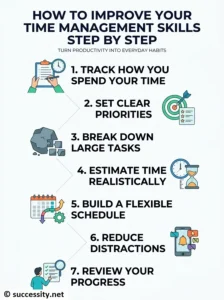
Knowing productivity techniques is only the beginning. To improve your time management skills, you need to turn them into habits that fit your daily life.
Step 1. Track How You Currently Spend Your Time
Before changing your routine, understand where your time goes.
For two or three typical days, record your main activities and approximately how long each one takes. Include work, study, commuting, household tasks, breaks, entertainment, and time spent responding to messages.
You do not need to record every minute perfectly. The aim is to notice patterns.
You might discover that routine messages interrupt your focused work, that a task takes longer than you expected, or that you regularly schedule more activities than your day can accommodate.
Use these observations to identify one or two areas for improvement.
Step 2. Set Clear Priorities
Choose the outcomes that matter most before filling your schedule.
A useful starting point is to identify three priorities for the day. These should be meaningful tasks or outcomes, not every small activity you hope to complete.
For example, your priorities might be:
- Finish the first draft of a report.
- Attend a scheduled appointment.
- Spend 30 minutes practicing a new skill.
Routine tasks still need attention, but identifying your priorities makes it easier to protect time for them.
If you regularly struggle to decide what to do first, use the Eisenhower Matrix described above.
Step 3. Break Large Tasks Into Smaller Actions
A task such as “prepare for an exam” can feel overwhelming because it does not specify what you need to do next.
Break it into actions such as reviewing one chapter, answering practice questions, checking mistakes, and summarizing key concepts.
Smaller tasks are easier to estimate and schedule. They also give you a clear starting point when you are tempted to postpone the work.
Make each action specific enough that you know when you have completed it.
Step 4. Estimate Time Realistically
People often underestimate how long tasks will take, especially when they forget to account for preparation, interruptions, transitions, and follow-up work.
If writing a report usually takes two hours, do not schedule it into a 30-minute gap simply because you want to finish it quickly.
Use your previous experience to estimate task duration. When you are unsure, allow a little extra time and adjust your estimates as you learn more.
A realistic plan is not a sign of low ambition. It is a plan based on the time and resources you actually have.
Step 5. Build a Flexible Daily Schedule
Once you know your priorities and their estimated duration, decide when you will work on them.
Place demanding tasks in periods when you can usually concentrate. Group similar routine activities together when practical, and leave some unplanned time for unexpected responsibilities.
For example, you might reserve the first part of your morning for focused work, handle messages at planned intervals, and complete routine tasks later in the day.
Your schedule should guide you, not control you. If an urgent responsibility changes your plans, adjust the remaining tasks instead of treating the entire day as a failure.
Step 6. Reduce Distractions
Distractions can turn a short task into a much longer activity, especially when you repeatedly switch between work, messages, and unrelated browsing.
You can make focused work easier by:
- Turning off nonessential notifications.
- Keeping unrelated browser tabs closed.
- Putting your phone out of reach when appropriate.
- Choosing a workspace that supports concentration.
- Checking email and messages at planned times when your role allows it.
- Letting others know when you need uninterrupted time.
You may not be able to eliminate interruptions, particularly if you care for children, support customers, or work in a busy environment. In those situations, plan shorter work sessions and identify tasks you can complete when interruptions are likely.
Step 7. Review Your Progress at the End of the Day
Spend a few minutes reviewing what happened.
Ask yourself three questions:
- What did I complete today?
- What interrupted my priorities or took longer than expected?
- What should I change about tomorrow’s plan?
Move unfinished tasks to an appropriate time rather than carrying them forward automatically without reconsidering their importance.
A short review helps you identify patterns and improve your planning gradually. It also gives you a clearer stopping point at the end of the day.
Example of a Realistic Daily Schedule
A daily schedule should reflect your actual responsibilities, not an ideal routine copied from someone else’s life.
Here is an example for someone with a fairly predictable workday.
| Time | Activity | Purpose |
|---|---|---|
| 8:30 to 9:00 AM | Review priorities and prepare | Start with a clear plan |
| 9:00 to 10:30 AM | Focused work | Make progress on an important task |
| 10:30 to 10:45 AM | Short break | Step away from the task |
| 10:45 to 11:30 AM | Continue focused work | Finish or advance the main task |
| 11:30 AM to 12:00 PM | Emails and routine messages | Handle communication in a planned period |
| 12:00 to 1:00 PM | Lunch and personal time | Take a proper break |
| 1:00 to 2:00 PM | Meetings or collaborative work | Handle shared responsibilities |
| 2:00 to 2:15 PM | Short break | Reset before the next task |
| 2:15 to 3:30 PM | Secondary priority | Continue important work |
| 3:30 to 4:00 PM | Routine tasks and follow-ups | Close smaller open items |
| 4:00 to 4:15 PM | Daily review | Prepare for the next day |
This is an example rather than a strict timetable. Your work hours, commute, family responsibilities, and energy levels may require a different arrangement.
Notice that the schedule includes breaks and a review period. It also groups routine communication instead of allowing every message to interrupt the most important work.
If your day is unpredictable, use broader time blocks rather than assigning every task a precise start and finish time.
Common Time Management Mistakes to Avoid

Even a well-designed productivity system can fail if it creates unrealistic expectations or encourages the wrong habits.
1. Making an Overloaded To-Do List
A long list may make you feel organized, but it does not guarantee that the tasks fit into your available time.
Choose a realistic number of priorities, account for routine responsibilities, and keep additional tasks on a separate list for later consideration.
2. Treating Every Task as Urgent
When everything feels urgent, it becomes difficult to distinguish meaningful work from constant reaction.
Before changing tasks, ask whether the request truly needs immediate attention or whether it can be scheduled for later.
3. Planning Every Minute
A schedule without breathing room can collapse when an appointment runs late or an unexpected task appears.
Leave space between demanding activities and reserve some time for work that cannot be predicted. Flexibility is part of effective planning.
4. Switching Between Tasks Too Often
Moving repeatedly between unrelated activities can make it harder to maintain focus and remember where you left off.
When possible, finish a defined part of one task before moving to another. Group similar activities, such as routine emails or administrative work, into a single period.
5. Using Productivity Tools Instead of Doing the Work
It is easy to spend more time comparing apps, redesigning task lists, and adjusting calendars than completing the tasks themselves.
Choose a simple tool that meets your needs and use it consistently. Change your system only when you have identified a specific problem it needs to solve.
6. Ignoring Rest and Personal Responsibilities
A plan that depends on working through every break or sacrificing sleep is difficult to sustain.
Effective time management includes recovery, relationships, and personal commitments. The aim is to organize your responsibilities more effectively, not to turn every available moment into work.
How to Manage Your Energy Along With Your Time
Time is only one part of productivity. Your ability to concentrate, make decisions, and complete demanding tasks also depends on factors such as sleep, workload, health, and the nature of the activity.
That is why two hours of work may feel very different depending on when you do it and what you are trying to accomplish.
Match Tasks to Your Energy Levels
Notice when you tend to feel most alert and when your concentration usually declines.
If you feel focused in the morning, you may want to schedule writing, studying, planning, or problem-solving during that period. If your energy improves later in the day, adjust your schedule accordingly.
Use lower-energy periods for routine activities when practical. This is a personal strategy rather than a rule that everyone must follow.
Take Breaks Before You Become Exhausted
Breaks provide an opportunity to step away from a task, move around, have a drink, or rest your attention.
The right frequency depends on the work. You might prefer a short break after a focused session, while another task may naturally include pauses between stages.
Experiment with different work periods and notice which arrangement helps you remain comfortable and focused.
Protect Your Sleep and Recovery
Reducing rest to create more working hours can undermine your ability to function well over time.
Keep a reasonably consistent sleep routine when possible, and avoid treating tiredness as a problem that can always be solved with greater discipline.
If you regularly feel exhausted, review the overall demands placed on you. The answer may involve reducing commitments, asking for help, changing your workload, or seeking appropriate professional advice.
Recognize When You Need to Slow Down
Being productive does not mean working at maximum intensity all day.
If you are struggling to concentrate, making repeated mistakes, or feeling overwhelmed, take a moment to reassess your workload and priorities.
For further guidance, Harvard Health explains practical ways to manage stress and make everyday changes in its article on stress management and well-being.
How to Stop Wasting Time and Overcome Procrastination

Procrastination is not always caused by laziness. You may delay a task because it feels difficult, unclear, unpleasant, or too large to begin. You may also be distracted by activities that provide immediate enjoyment while offering little progress toward your goals.
The solution depends on the reason you are postponing the task.
Make the First Step Smaller
If you are avoiding a large assignment, reduce it to an action you can begin immediately.
Instead of “finish the entire presentation,” start with “write the presentation title and list the five main points.”
You do not need to feel completely motivated before starting. A clear first step can make the task easier to approach.
Use the Two-Minute Rule Carefully
The two-minute rule is commonly used to encourage action on small tasks. If a task takes about two minutes or less, you can complete it immediately when it is appropriate to do so.
For example, you might confirm a short appointment, file a document, or send a brief response.
However, do not let this rule interrupt important focused work. If you are in the middle of a demanding task, record the small action and return to it later if that better supports your priorities.
Also, do not confuse the two-minute rule with a different strategy of working on a large task for just two minutes to overcome the difficulty of getting started. Both can be useful, but they solve different problems.
Set Boundaries Around Digital Distractions
Social media, notifications, and unrelated browsing can consume time without you noticing how often you return to them.
Try setting specific periods for checking personal messages and entertainment. You can also remove distracting apps from your home screen, silence nonessential notifications, or keep your phone outside your immediate workspace.
The goal is not to eliminate leisure. It is to choose when you enjoy it instead of allowing it to interrupt activities you intended to complete.
Identify Why You Keep Delaying a Task
If you repeatedly postpone the same responsibility, ask what makes it difficult.
Perhaps you need more information, the deadline is unrealistic, the task is too large, or you are worried about the result. Each problem requires a different response.
If you need more information, ask a question. If the task is too large, divide it into smaller steps. If your workload is unrealistic, reconsider the deadline or ask for support.
For more practical strategies, read our guide on how to overcome procrastination with small daily goals.
Best Time Management Tools and Apps
A time management tool should make your routine easier to follow. You do not need a complicated application if a basic calendar and task list already meet your needs.
Choose tools based on the problem you want to solve.
Digital Calendars
A digital calendar is useful for appointments, deadlines, meetings, and time blocking.
It gives you a visual overview of your commitments and helps you avoid scheduling several activities at the same time.
Use calendar reminders for important events, but avoid filling the calendar with every minor task if that makes it difficult to read.
To-Do List Apps
Task list apps help you capture responsibilities, set due dates, and identify what needs attention next.
They are especially useful when you manage several projects or need to keep personal and work tasks organized.
Look for features you will actually use, such as recurring tasks, reminders, priority labels, or simple project lists.
Focus Timers
A timer can help you create a clear beginning and end for a focused work session.
You can use a dedicated focus timer, a basic phone timer, or a clock. The tool matters less than choosing one task and protecting the time you have set aside for it.
Time Tracking Tools
Time tracking tools record how much time you spend on different activities.
They can help you compare your estimates with reality and identify work that regularly takes longer than expected.
You may not need to track your time permanently. A short review period can be enough to reveal useful patterns.
Paper Planners and Notebooks
A paper planner can be a good choice if you prefer writing by hand or want to reduce the number of digital distractions around you.
You can use one page for daily priorities, another for upcoming commitments, and a brief review at the end of the day.
How to Choose the Right Tool
Start with the simplest option that meets your needs.
If you forget appointments, use a calendar. If you lose track of tasks, create a reliable task list. If you spend too long on distractions, try a focus timer or limit access to distracting apps during work sessions.
Avoid adopting several tools that duplicate the same function. A consistent system is more valuable than a collection of applications you rarely use.
Time Management Tips for Different Situations
The best time management system depends on your responsibilities and how predictable your day is.
Time Management for Students
Students often need to balance classes, assignments, exams, personal commitments, and rest.
Start by recording exam dates, assignment deadlines, and recurring classes in one calendar. Break larger assignments into stages and schedule study sessions before deadlines become urgent.
Use focused sessions to study one subject or complete a specific task. Review your progress regularly and give more time to topics that need additional practice.
Avoid planning every study session at the last possible moment. Spreading work across several sessions can make your schedule more manageable.
Time Management for Remote Workers
Remote work can make it difficult to separate professional responsibilities from personal time.
Establish a clear beginning and end to your working day when possible. Use your calendar to protect time for important work, and agree with colleagues on reasonable expectations for meetings and communication.
If your home environment is distracting, create a dedicated workspace or use a consistent signal that tells others when you need uninterrupted time.
At the end of the day, review unfinished tasks and decide when you will address them. This helps prevent work from automatically extending into your personal time.
Time Management for Busy Parents and Caregivers
When you care for children or other family members, your day may include frequent interruptions and responsibilities that cannot be postponed.
Instead of relying on a rigid schedule, identify a few priorities and use flexible blocks of time. Keep a short list of tasks that can be completed in smaller intervals.
Prepare for recurring needs where practical, and ask for help or share responsibilities when support is available.
Some days will not follow your plan. That does not mean your system has failed. A useful plan should adapt to the demands of your life.
Time Management for People With Unpredictable Schedules
If your work involves changing shifts, urgent requests, travel, or irregular hours, planning every task at a fixed time may not be practical.
Use priority lists and flexible time windows instead. Identify the next important task, estimate how long it may take, and choose an appropriate opportunity to complete it.
You can also group tasks by the conditions they require. For example, keep a list of activities you can complete in short gaps and another for tasks that require uninterrupted attention.
This makes it easier to use available time without expecting every day to follow the same pattern.
A Simple 7-Day Time Management Plan
You do not need to change your entire routine at once. Use the following seven-day plan to introduce a few practical habits and discover what works for you.
Day 1: Observe Your Current Routine
Record your main activities and notice where your time goes. Do not try to make every minute productive. Focus on understanding your current habits.
Day 2: Identify Your Priorities
Choose three important outcomes for the day. Separate them from smaller tasks that can be handled later.
Day 3: Try One Planning Method
Use time blocking or the Eisenhower Matrix. Select the method that best addresses the problem you noticed on the first day.
Day 4: Complete One Focused Session
Choose a meaningful task and work on it without unrelated notifications or unnecessary task switching. Use a timer if it helps you concentrate.
Day 5: Reduce One Distraction
Identify a repeated distraction and change one thing about your environment or routine. For example, silence nonessential notifications during your main work session.
Day 6: Review Your Energy and Workload
Notice when you feel most focused and which responsibilities take longer than expected. Adjust your schedule to make it more realistic.
Day 7: Review and Plan the Next Week
Look at what worked, what caused difficulty, and what you want to change. Choose one or two habits to continue rather than adding several new methods at once.
For a more detailed approach, read our guide on how to plan your week for balance and efficiency.
The purpose of this plan is to build a system you can maintain. If a method does not fit your responsibilities, adapt it instead of forcing yourself to follow it exactly.
Time Management Without Toxic Productivity

Time management should help you live more intentionally, not make you feel guilty whenever you rest.
Toxic productivity occurs when the pressure to achieve more begins to dominate your decisions, even when additional work is unnecessary or comes at the expense of your well-being.
A schedule can become counterproductive if you treat every break as wasted time, measure your worth by completed tasks, or ignore important personal needs to meet unrealistic expectations.
Set Realistic Expectations
You cannot complete everything every day. New responsibilities will appear, tasks will take longer than expected, and some priorities will change.
Decide what a reasonable amount of progress looks like before you begin. If your plan regularly exceeds the time available, reduce the workload or adjust your expectations.
Make Rest Part of Your Routine
Rest does not have to be earned by completing every item on your list.
Include breaks, meals, sleep, movement, and personal activities in your routine. These are important parts of a sustainable life, not obstacles to productivity.
Create Boundaries Between Work and Personal Life
When possible, establish a stopping point for work and avoid checking messages throughout your personal time.
If your job or caregiving responsibilities make strict boundaries difficult, identify small ways to protect personal time. Even a consistent end-of-day review or a short period away from work can help you transition to another activity.
For more guidance, read our article on how to create a healthy work-life balance.
Measure Progress, Not Just Hours
Working longer does not always mean achieving better results.
Look at whether you are completing meaningful tasks, making progress toward your goals, meeting important commitments, and maintaining a reasonable level of well-being.
Your time management system should support those outcomes. If it creates more pressure without improving your results, it is worth changing.
Final Thoughts
Effective time management begins with understanding what matters most and making deliberate choices about how you use your time.
You do not need to follow every productivity method or plan every minute of your day. Start by identifying your priorities, choosing a simple technique, and creating a schedule that reflects your real responsibilities.
Pay attention to what works, adjust what does not, and leave room for the unexpected. Most importantly, remember that productivity is not about staying busy at all times. It is about making meaningful progress while protecting the time and energy you need for the rest of your life.
Choose one improvement you can begin today. It could be planning tomorrow’s priorities, setting aside time for an important task, or removing one repeated distraction. Small, consistent changes can help you build a more organized and sustainable routine.
Frequently Asked Questions
What is the best way to manage time effectively?
Start by identifying your most important tasks, estimating how long they will take, and scheduling time to complete them. Reduce avoidable distractions and review your progress at the end of the day. The best method is one that fits your responsibilities and that you can use consistently.
What are the most effective time management techniques?
Useful techniques include the Eisenhower Matrix, time blocking, the Pomodoro Technique, Eat the Frog, the 80/20 principle, and Getting Things Done. Each addresses a different challenge, so choose based on whether you need better prioritization, focus, planning, or task organization.
How can I improve my time management skills?
Track how you spend your time, set clear priorities, break large tasks into smaller actions, and build a realistic schedule. Review your results regularly and make gradual adjustments rather than changing your entire routine at once.
How do I stop procrastinating and start working?
Identify why you are delaying the task and make the first step smaller. Remove an avoidable distraction, define a specific action, and begin with a manageable work session. If you repeatedly postpone the same task, check whether you need more information, additional support, or a more realistic deadline.
How do I manage time when I have too much to do?
Separate essential tasks from activities that can wait, be delegated, or be removed. Choose the most important priorities and estimate the time they require. If the total workload exceeds your available time, you may need to renegotiate deadlines, ask for help, or reduce your commitments.
How can I manage time without feeling overwhelmed?
Keep your daily plan realistic, focus on a small number of priorities, and leave room for unexpected responsibilities. Break large tasks into manageable steps and include time for rest. A good system should make your responsibilities clearer rather than add another source of pressure.
Is multitasking an effective time management strategy?
Multitasking is not always effective, especially when you switch repeatedly between tasks that require concentration. When possible, focus on one demanding activity at a time and group similar routine tasks together. Some simple activities can be combined safely, but important work usually benefits from a clearer focus.
How can I balance work and personal life?
Set realistic work priorities, establish boundaries where possible, and reserve time for relationships, health, and personal interests. Review your schedule when work regularly takes over your personal time. If your responsibilities exceed the time available, consider what can be reduced, shared, or rescheduled.
How long does it take to develop good time management habits?
It depends on the habit, your circumstances, and how consistently you practice it. Start with one manageable change, such as planning your top priorities each morning or reviewing your schedule each evening. Give yourself time to adjust the system and judge it by whether it helps you manage your responsibilities more effectively.
About the Author