Sophia

Have you ever stared at a blank page, struggled to solve a problem, or felt that every idea you came up with had already been tried? Creative blocks happen to almost everyone. They can make you question your abilities, especially when you need a fresh idea and nothing seems to work.
The good news is that creativity is a skill you can practice and develop. You do not need to be an artist, designer, or inventor to think creatively. Whether you want to write better, solve problems at work, improve a project, or make everyday life easier, learning how to enhance creativity can help you explore more possibilities and find useful solutions.
The key is not to wait for inspiration. Instead, use practical techniques that encourage you to look at familiar problems from new angles, generate several possible answers, and test the ideas that show promise.
In this guide, you will discover seven practical ways to improve creative thinking, build habits that support new ideas, and overcome creative blocks without putting unnecessary pressure on yourself.
What Is Creativity, and Can You Improve It?
Creativity is the ability to develop ideas, connections, or solutions that are both original and useful. It can appear in many forms, from designing a product and writing a story to finding a simpler way to organize your day.
Creative thinking does not always mean inventing something completely new. Sometimes, it means combining existing ideas, improving an established process, or approaching a familiar challenge differently.
For example, a small business owner might improve customer service by borrowing an idea from a hotel. A student might remember a difficult subject by turning notes into a visual map. A parent might make a morning routine easier by changing the order of everyday tasks.
These are all examples of practical creativity.
Divergent Thinking vs. Convergent Thinking
Two useful concepts help explain how creative problem-solving works.
Divergent thinking means generating multiple possible ideas or solutions. During this stage, you explore alternatives instead of immediately deciding which one is best.
Convergent thinking means evaluating those ideas, comparing their strengths and weaknesses, and choosing an option that fits your goal.
Imagine that you want to attract more visitors to a website. Divergent thinking might produce ideas such as publishing tutorials, creating useful checklists, improving existing articles, or collaborating with another website. Convergent thinking helps you compare the time, cost, and likely value of each option.
A common mistake is trying to generate and judge ideas at the same time. If you reject every suggestion as soon as it appears, you may never explore a promising possibility.
A better approach is to separate the stages. Generate ideas first, then evaluate them.
7 Practical Techniques to Enhance Creativity
You do not need to use every technique at once. Choose the method that fits your current challenge and experiment with it. Different problems often benefit from different approaches.
1. Embrace Constraints to Generate Better Ideas
It may seem that unlimited freedom should produce the most creative results. In practice, having too many choices can make it difficult to decide where to begin.
Constraints give your thinking a clear direction. A word limit, a small budget, a deadline, or a specific audience can encourage you to explore solutions you might otherwise overlook.
For example, imagine you need to create a short presentation about a complicated subject. Instead of trying to include everything, limit yourself to five slides. You must decide which points matter most and how to communicate them clearly.
You can apply the same principle to writing, business, design, and everyday problem-solving.
Try this exercise:
- Choose a problem you want to solve.
- Set one reasonable limitation, such as a budget, time limit, or word count.
- Generate five possible solutions that respect the limitation.
- Review the ideas and identify which ones are worth testing.
The goal is not to make the task unnecessarily difficult. It is to use a clear boundary to encourage more focused thinking.
2. Use the SCAMPER Technique

When you feel stuck with an existing idea, product, routine, or project, the SCAMPER technique gives you a structured way to explore alternatives.
SCAMPER is a creative thinking framework associated with Bob Eberle’s work on idea-generating questions. It encourages you to examine an idea through seven different actions. You can explore its development in the original article, Developing Imagination Through SCAMPER.
Here is how each letter works.
- S – Substitute: What could you replace with something else?
- C – Combine: What could you bring together to create a better result?
- A – Adapt: What could you borrow or adapt from another situation?
- M – Modify: What could you change in size, format, appearance, or function?
- P – Put to another use: Could you use the idea for a different purpose or audience?
- E – Eliminate: What could you remove to make the result simpler?
- R – Reverse or rearrange: What would happen if you changed the order or did the opposite?
Consider a simple example. Suppose you want to make your daily study routine more effective.
You could substitute long reading sessions with shorter sessions, combine reading with practice questions, adapt a method used by language learners, modify your schedule, use old notes to create flashcards, eliminate phone notifications, or reverse your routine by tackling the hardest task first.
Each question gives you a different direction to explore.
Try this exercise: Choose one product, habit, or problem and write one answer for each SCAMPER question. You do not need to use every answer. Look for the one that offers the clearest practical benefit.
3. Change Your Environment or Take a Different Kind of Break
Working in the same place, following the same routine, and looking at the same information can make a problem feel harder than it is.
A change of surroundings may help you notice different details or interrupt an unproductive pattern of thinking. You could move to another room, work somewhere quieter, organize your desk, or take a short walk.
The important point is not that a particular environment automatically makes you more creative. It is that changing your routine can provide a useful reset when you feel mentally stuck.
A break can also give you time away from a problem. Research on creative incubation suggests that stepping away from a task may sometimes help people return to it with new ideas, although the effects depend on the task and circumstances. One study explored this relationship in research on mind wandering and creative incubation.
Try this exercise:
- Work on a problem for 15 to 25 minutes.
- Write down what you have tried and where you are stuck.
- Take a short break by walking, stretching, or doing a simple routine task.
- Return to the problem and list three approaches you have not considered.
Avoid turning every break into another period of scrolling through notifications. Choose an activity that genuinely lets you step away from the problem.
4. Look at the Problem From a Different Perspective
Sometimes, a lack of creativity is really a problem of perspective. You keep asking the same question, so you keep producing similar answers.
To overcome a creative block, change the way you frame the challenge.
For example, instead of asking, “How can I work faster?” ask, “Which steps could I remove?” Instead of asking, “How can I attract more customers?” ask, “Why might a potential customer decide not to buy?” Each question directs your attention toward a different set of possibilities.
You can also imagine how someone from another profession might approach the issue.
- A teacher might focus on making the process easier to understand.
- A designer might look for unnecessary steps.
- A scientist might question the assumptions behind the problem.
- A customer might identify what feels confusing or inconvenient.
You do not need to become an expert in another field. You simply need to borrow a different way of looking at the situation. Practicing critical thinking skills can help you question assumptions, examine alternative explanations, and evaluate which creative ideas are genuinely useful.
Try this exercise: Write your problem in one sentence. Then rewrite it as three different questions. Choose the version that reveals a new opportunity rather than repeating the original concern.
This technique is particularly useful when you have spent a long time on the same task without making progress.
5. Build a Mind Map

A mind map is a visual way to organize ideas and explore connections. Instead of writing a straight list, you place the main topic in the center of a page and draw branches for related ideas.
This method can be useful when a subject has several parts or when you need to explore a topic before deciding how to organize it.
Suppose you want to start a small online business. Put “Online Business” in the center of the page. Create branches for products, customers, marketing, costs, delivery, and customer service. Then add smaller branches under each category.
Under marketing, for example, you might list search engines, email, social media, partnerships, and useful free resources. Under customer service, you might list response times, frequently asked questions, returns, and feedback.
Seeing the ideas together may reveal a connection you had not considered. You might discover that answering common customer questions could help both your support process and your website content.
How to create a useful mind map:
- Write your main question in the center.
- Add four to six branches for major themes.
- Expand each branch with examples, questions, or possible solutions.
- Draw connections between related ideas.
- Circle the ideas that seem useful, surprising, or worth investigating.
Do not worry about making the map look attractive. Its purpose is to help you explore possibilities, not to create a perfect diagram.
6. Separate Different Modes of Thinking With the Six Thinking Hats Method
Group discussions can lose their creative energy when people evaluate ideas before everyone has had a chance to contribute. One person proposes an option, another immediately points out a problem, and the conversation becomes an argument about whether the idea will work.
The Six Thinking Hats method, developed by Edward de Bono, offers a structured way to examine a question from different perspectives.
Each hat represents a mode of thinking.
- White Hat: Focus on facts, information, and what is still unknown.
- Red Hat: Consider feelings, intuition, and immediate reactions.
- Black Hat: Identify risks, weaknesses, and potential problems.
- Yellow Hat: Explore benefits, opportunities, and positive outcomes.
- Green Hat: Generate new ideas and alternative approaches.
- Blue Hat: Organize the discussion and decide what should happen next.
For example, imagine your team is considering a new service.
Start by identifying what you know about customers and costs. Then explore how people might react, identify possible risks, consider the potential benefits, generate alternative versions of the service, and finally decide what information you need before moving forward.
The main benefit is that everyone can explore one aspect of the problem before the group settles on a decision.
You can also use the method alone. Write down your idea, then examine it from each perspective in turn.
When to use it: This technique is especially useful for team projects, business decisions, planning, and problems that require both original thinking and careful evaluation.
7. Make Space for Boredom and Mind-Wandering
Many people fill every quiet moment with a phone, a video, music, or another source of stimulation. Although these activities can be enjoyable, they leave little room for unstructured thought.
Allowing your attention to wander occasionally may help you make connections between ideas or return to a difficult problem with a different perspective. However, mind-wandering does not guarantee inspiration, and research findings vary according to the task and situation.
The practical lesson is simple. You do not need to fill every spare moment with information.
Try walking without checking your phone, sitting quietly after finishing a task, or doing a familiar activity while giving your mind a little room to wander. If distractions make it difficult to settle your attention, practicing meditation for focus and clarity may provide another way to build a calmer routine.
Keep a notebook or notes app nearby so you can capture any useful thought that appears. Do not pressure yourself to produce a brilliant idea every time you take a break.
Try this exercise: Spend five to ten minutes away from your usual sources of stimulation. Think about a question you have been working on, or let your thoughts move freely. When you finish, write down anything that seems worth exploring.
If the exercise does not produce an idea, that is fine. Rest and quiet time can be useful even when no immediate creative breakthrough occurs.
Daily Habits That Support Creative Thinking
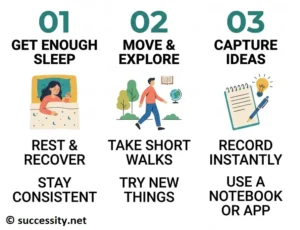
The seven techniques above can help you approach problems differently. Everyday habits can also support your ability to concentrate, explore ideas, and work through challenges over time.
You do not need a complicated routine. Focus on a few habits that fit your schedule.
Get Enough Sleep and Allow Time to Recover
It is harder to concentrate, evaluate information, and work through difficult problems when you are exhausted. Adequate sleep supports attention, learning, memory, and other cognitive functions that contribute to creative work.
If you have been struggling with a task for hours, working longer is not always the best answer. You may benefit more from taking a break and returning when you are rested.
Try to maintain a consistent sleep schedule when possible. Avoid treating sleep as wasted time that must be sacrificed whenever you need to produce an idea.
Use Movement and Varied Experiences to Refresh Your Thinking
A short walk or another form of movement can provide a useful break from prolonged sitting. It also changes what you see and experience, which may help you approach a problem differently.
Varied experiences can broaden the material you draw on when developing ideas. Reading outside your usual interests, learning a practical skill, visiting a new place, or speaking with someone who has a different perspective can introduce you to unfamiliar approaches.
For example, a writer who studies architecture may discover a new way to explain how a system is structured. A business owner who learns about teaching may find better ways to explain a product to customers.
The aim is not to collect random information without purpose. It is to stay curious and expose yourself to ideas beyond your usual routine.
Capture Ideas Before You Forget Them
Creative thoughts do not always appear when you are sitting at your desk. You might notice a useful connection while walking, cooking, reading, or talking with someone.
Create a simple system for recording ideas. You could use a notebook, a notes app, or a document organized by topic.
For each idea, record three things:
- The idea itself.
- The problem it might help solve.
- The next step you could take to explore it.
You do not need to act on every idea immediately. Capturing it allows you to return to it later instead of relying on memory.
If journaling helps you reflect on experiences and recognize patterns in your thinking, you can also explore this guide to journaling for self-reflection.
How to Overcome a Creative Block
A creative block can happen when you are tired, under pressure, uncertain about what to do next, or overly focused on producing a perfect result.
Instead of treating the block as proof that you are not creative, treat it as a signal to change your approach.
Stop Judging Ideas Before You Have Generated Them
Self-criticism can make it difficult to explore possibilities. If you reject every idea before developing it, you may never discover whether it could become useful.
Separate brainstorming from editing.
During brainstorming, write down ideas without evaluating each one. Once you have several options, review them more carefully.
For example, if you need a title for an article, generate ten possible titles before choosing the strongest three. Some will be weak, but they may help you discover a better direction.
The first version of an idea does not need to be excellent. It needs to give you something to work with.
Try a Deliberately Bad-Idea Exercise
If you feel too much pressure to produce a brilliant solution, reverse the challenge and generate the worst ideas you can imagine.
Suppose you want to improve a website. You might ask:
- How could we make the website harder to navigate?
- How could we make the content less useful?
- How could we frustrate visitors?
Your answers may reveal problems worth fixing. If confusing navigation is one of the worst ideas, a clearer menu becomes an obvious improvement.
This exercise can reduce the pressure to be original and help you identify assumptions you had not questioned.
Once you have listed several bad ideas, turn each one around and ask what its opposite would look like.
Use AI as a Brainstorming Partner, Not a Replacement for Your Judgment
AI tools can help you explore alternative perspectives, generate starting points, or organize a collection of ideas. They are most useful when you give them a clear task and evaluate the results yourself.
For example, you could ask an AI tool to:
- Suggest ten different ways to explain a difficult concept.
- Identify weaknesses in a proposed plan.
- Generate questions that challenge your assumptions.
- Suggest alternative uses for an existing product.
- Compare several approaches to the same problem.
Do not assume that an AI-generated idea is original, accurate, or appropriate simply because it sounds convincing. Check factual claims, consider your audience, and adapt useful suggestions to your own situation.
The goal is to expand your options and improve your thinking, not to hand over the entire creative process.
How to Practice Creativity in Everyday Life

You do not need a major project to practice creative thinking. Small, regular exercises can help you become more comfortable exploring alternatives and solving everyday problems.
A Simple 10-Minute Creativity Exercise
Use this exercise whenever you want to generate ideas or get unstuck.
Minutes 1 to 2: Define the challenge.
Write one clear question, such as “How can I make my mornings less stressful?” or “How can I explain this topic more clearly?”
Minutes 3 to 6: Generate ideas.
Write down as many possible solutions as you can. Do not stop to judge them. Include practical options, unusual suggestions, and combinations of existing ideas.
Minutes 7 to 8: Find connections.
Look for ideas that could be combined, simplified, or adapted from another situation.
Minutes 9 to 10: Choose one action.
Select one promising idea and decide how to test it. Keep the first test small enough to complete without a major commitment.
For example, if your goal is to make mornings less stressful, you might prepare your clothes the night before, move essential items near the door, or write a short morning checklist. Test one change before redesigning your entire routine.
A Seven-Day Creativity Practice Plan
Use this simple plan to experiment with different techniques throughout the week.
| Day | Practice | Goal |
|---|---|---|
| Day 1 | Generate ten possible solutions to one problem | Practice divergent thinking |
| Day 2 | Apply the SCAMPER questions to an object or routine | Explore alternatives |
| Day 3 | Change your workspace or take a mindful walk | Break your usual pattern |
| Day 4 | Create a mind map for a project | Discover connections |
| Day 5 | Examine one idea from different perspectives | Improve evaluation |
| Day 6 | Spend a few quiet minutes without your usual distractions | Allow room for reflection |
| Day 7 | Review your ideas and test one small improvement | Turn thinking into action |
At the end of the week, review what you learned. Which technique helped you see the problem differently? Which method was easiest to use? Which idea was worth testing?
You can repeat the methods that suit you and adapt the others. The purpose is not to follow a perfect schedule. It is to build a practical habit of exploring possibilities instead of relying on the first answer that comes to mind.
Final Thoughts
Learning how to enhance creativity is less about waiting for inspiration and more about developing a process you can use when you need new ideas. Constraints can give your thinking direction, SCAMPER can help you explore alternatives, mind maps can reveal connections, and changes in perspective can help you move beyond familiar answers.
You can also support your creative work by getting enough rest, exploring unfamiliar subjects, recording useful ideas, and giving yourself time away from difficult problems.
You will not find every technique equally effective in every situation. Some methods work better for generating ideas, while others help you evaluate options or make decisions. Experiment with them and pay attention to what helps you make progress.
Your next step: Choose one problem you are facing today. Spend ten minutes generating possible solutions without judging them, then select one idea you can test. You do not need to solve everything at once. You only need to begin exploring a different possibility.
Frequently Asked Questions
Can creativity be learned, or is it something you are born with?
Creativity is influenced by several factors, including experience, knowledge, and individual differences. Many creative thinking skills can be practiced through exercises such as brainstorming, mind mapping, and reframing problems.
What is the fastest way to generate new ideas?
Start by defining the problem clearly, then generate several possible solutions before evaluating them. If you feel stuck, try SCAMPER, change your perspective, or take a short break before returning to the task.
Why do I struggle to think creatively?
You may be tired, distracted, uncertain about the problem, or judging ideas too early. Try simplifying the task, exploring different approaches, and separating idea generation from evaluation.
Is it better to brainstorm alone or with a team?
Both approaches can be useful. Working alone gives you time to develop ideas independently, while collaboration introduces different perspectives. A practical approach is to let everyone generate ideas individually before discussing and evaluating them together.
Does boredom help creativity?
A quiet period can give you room to reflect or let your thoughts wander, which may sometimes support creative thinking. However, boredom does not automatically produce better ideas, and the effect varies with the person and task.
How long does it take to overcome a creative block?
There is no fixed timeline. A short break or a different approach may help with a temporary block, while longer difficulties may require changes to your workload, expectations, or working habits. Focus on the next manageable step rather than forcing an immediate breakthrough.
About the Author