Sophia

Fear can stop you from doing things you genuinely want to do. It may keep you from applying for a better job, speaking in front of others, starting a new relationship, or trying something unfamiliar. Sometimes, the situation itself is not especially dangerous, but the possibility of failure, rejection, or embarrassment feels overwhelming.
The problem is not that you experience fear. Fear is a natural response designed to protect you from potential danger. The real challenge begins when that response prevents you from making decisions, pursuing opportunities, or enjoying everyday life.
Overcoming Fear does not mean becoming fearless or pretending that nothing makes you uncomfortable. It means understanding what triggers your fear, learning how to respond to it, and taking manageable steps forward even when uncertainty remains.
In this guide, you will discover seven practical ways to face your fears, build courage, and stop allowing uncomfortable feelings to make every important decision for you.
Why Do We Feel Fear? Understanding the Brain’s Response
Fear is a natural emotional and physical response to a perceived threat. It helps you recognize potential danger and prepare to protect yourself.
When your brain detects something it interprets as threatening, it activates a series of responses throughout your body. Your heart may beat faster, your breathing may become quicker, your muscles may tense, and your attention may become focused on the possible danger.
This reaction is commonly known as the fight-or-flight response. It prepares you to respond to a threat by confronting it, escaping from it, or sometimes freezing.
These reactions can be useful when you face genuine physical danger. However, your body can also respond strongly to situations that involve emotional or social risks.
For example, you might experience fear before:
- Giving a presentation at work.
- Having an uncomfortable conversation.
- Applying for a position you really want.
- Meeting new people.
- Making an important life decision.
- Trying something you have never done before.
In these situations, your brain may interpret uncertainty, possible embarrassment, or the chance of failure as a threat.
Understanding this response is an important first step. It helps you recognize that feeling afraid does not automatically mean you are in danger. Sometimes, it means you are facing something unfamiliar or important to you.
The 4 Common Types of Fear That Hold You Back
Fear takes different forms, and recognizing the type you experience can help you understand what is keeping you from moving forward.
Here are four common fears that influence everyday decisions.
1. Fear of Failure
Fear of failure makes you focus on what could go wrong rather than what you could learn or achieve.
You might avoid starting a business because you worry it will fail, delay applying for a new job because you think you are not qualified enough, or abandon a personal goal because you are afraid of making mistakes.
This fear can create a cycle of hesitation. The longer you avoid taking action, the more intimidating the challenge may become.
A more useful approach is to treat failure as information rather than a final judgment about your abilities. Every attempt gives you an opportunity to learn, adjust, and improve.
2. Fear of the Unknown
The unknown can feel uncomfortable because you cannot predict exactly what will happen.
Starting a new career, moving to another city, entering a relationship, or making a major life change can create uncertainty about the future.
Your mind may respond by imagining negative outcomes, even when you do not have enough information to know whether they are likely.
You cannot remove every uncertainty from life. Instead, focus on what you can prepare for and accept that some answers will only become clear after you take the first step.
3. Fear of Rejection
Fear of rejection can make you avoid situations where another person might criticize, disagree with, or turn you down.
It may stop you from sharing an idea, expressing your feelings, asking for an opportunity, or meeting new people.
The difficulty is that avoiding rejection also means avoiding many opportunities for connection and personal growth.
Remember that another person’s response does not determine your worth. Rejection can be disappointing, but it does not mean you are incapable, unlikable, or unworthy of success.
4. Fear of Success
Fear of success may sound unusual, but achieving an important goal can bring new responsibilities, expectations, and changes.
You might worry about whether you can maintain your success, handle greater responsibility, or manage other people’s expectations.
For example, someone who receives a promotion may feel uncomfortable about becoming a team leader because they are afraid of making mistakes or disappointing others.
Instead of assuming you must be ready for everything before accepting an opportunity, recognize that new responsibilities often come with a learning process.
Fear vs. Anxiety – What’s the Difference?

Fear and anxiety are closely related, but they are not exactly the same.
Fear usually occurs in response to an immediate or clearly identified threat. For example, you may feel afraid when a car suddenly approaches you while crossing the road.
Anxiety often involves worrying about something that might happen in the future. You may feel anxious about an upcoming interview, an important conversation, or a decision whose outcome you cannot predict.
Here is a simple comparison:
| Fear | Anxiety |
|---|---|
| Often responds to an immediate threat. | Often focuses on a possible future threat. |
| May decrease when the danger disappears. | Can continue even when no immediate danger exists. |
| Often prepares you to react quickly. | Can involve repeated worry and uncertainty. |
| Example: A dog suddenly runs toward you. | Example: Worrying for days about meeting an unfamiliar dog. |
Both experiences are normal parts of human life. However, persistent or overwhelming anxiety may require additional support.
If fear or anxiety regularly interferes with your daily activities, relationships, sleep, or work, consider speaking with a qualified mental health professional. You can also explore these practical ways to manage anxiety for additional guidance.
7 Practical Steps for Overcoming Fear
You do not need to change your entire life overnight. Small, consistent actions can help you respond differently to situations that once felt overwhelming.
These seven steps offer a practical starting point.
1. Identify Exactly What You Are Afraid Of
The first step is to stop treating fear as one large, confusing feeling. Try to identify the specific situation, outcome, or possibility that makes you uncomfortable.
For example, if you are afraid of speaking in public, ask yourself what actually worries you.
Is it making a mistake? Forgetting what to say? Being judged by the audience? Looking nervous? Receiving negative feedback?
The more clearly you understand the source of your fear, the easier it becomes to work on it.
Try answering these three questions:
- What situation am I avoiding?
- What do I believe might happen?
- What is the part of this situation that scares me most?
Write your answers in a notebook. Putting your thoughts into words can help you examine them more clearly instead of allowing them to remain vague worries.
Practical example: If you avoid job interviews because you fear rejection, identify whether the main concern is answering questions incorrectly, lacking experience, or hearing that another candidate was selected.
Each concern may require a different solution.
2. Challenge Your Worst-Case Scenario
Fear often becomes stronger when you repeatedly imagine the worst possible outcome.
You might think that one mistake will ruin your reputation, one failed attempt will destroy your future, or one awkward conversation will permanently damage a relationship.
But is that outcome certain?
Instead of accepting every fearful thought as a fact, examine the situation more realistically.
Ask yourself:
- What is the worst realistic outcome?
- How likely is it to happen?
- What is the most likely outcome?
- If something goes wrong, what could I do next?
- What evidence supports my fear, and what evidence challenges it?
This exercise does not mean ignoring genuine risks. It means separating realistic concerns from assumptions and exaggerated predictions.
Practical example: Imagine that you are preparing to give a presentation and fear embarrassing yourself.
Your worst-case scenario might be forgetting part of your speech. But even if that happens, you could pause, check your notes, take a breath, and continue.
The situation may be uncomfortable, but it is unlikely to be as disastrous as your imagination suggests.
3. Face Your Fear Gradually
Avoiding something frightening can provide temporary relief. However, repeatedly avoiding the same situation may make it feel even harder to approach next time.
A more useful strategy is gradual exposure. This means facing a fear through small, manageable steps instead of forcing yourself into the most difficult situation immediately.
For example, if you are afraid of public speaking, you could:
- Practice speaking alone for a few minutes.
- Record yourself and watch the video.
- Speak in front of one trusted person.
- Share an idea during a small group discussion.
- Give a short presentation to a larger audience.
Each step helps you become more familiar with the situation before increasing the challenge.
The UK’s National Health Service explains this approach in its guide to facing your fears, which recommends breaking frightening situations into smaller steps and starting with the least difficult one.
The goal is not to eliminate every uncomfortable feeling before moving forward. It is to learn that you can handle manageable levels of discomfort without immediately escaping the situation.
Important: Gradual exposure is intended here as a self-help approach for mild, everyday fears. If you are dealing with trauma, severe anxiety, phobias, or another mental health condition, seek guidance from a qualified professional rather than attempting difficult exposure exercises alone.
4. Reframe Your Fearful Thoughts

The way you interpret a situation can influence how strongly you experience fear.
For example, imagine that you are about to attend a professional event.
You might think:
“I will not know what to say. Everyone will notice how uncomfortable I am.”
That thought makes the situation seem more threatening than it needs to be.
Try replacing it with something more balanced:
“I may feel uncomfortable at first, but I can start by introducing myself to one person. I do not need to impress everyone.”
This is not about forcing yourself to think positively. It is about replacing extreme assumptions with realistic and helpful thoughts.
Here are a few examples:
| Fearful thought | More balanced thought |
|---|---|
| I will definitely fail. | I cannot predict the outcome, but I can prepare. |
| Everyone will judge me. | Some people may have opinions, but I cannot know what everyone thinks. |
| I am not good enough. | I can improve through practice and experience. |
| I must get everything right. | Making mistakes is part of learning. |
| I cannot handle this. | I can take it one step at a time. |
Over time, practicing this approach can help you respond to challenging situations with more flexibility.
5. Manage Your Physical Response
Fear is not only a mental experience. It can also create noticeable physical sensations, such as a racing heart, tense muscles, shallow breathing, and restlessness.
Learning to manage these reactions can make difficult situations easier to handle.
One simple technique is slow, controlled breathing.
Try this exercise:
- Sit comfortably and relax your shoulders.
- Breathe in gently through your nose.
- Breathe out slowly without forcing it.
- Repeat for a few minutes.
- Bring your attention back to the present moment whenever your thoughts start racing.
You can also try relaxing your jaw, lowering your shoulders, and placing both feet firmly on the floor.
These techniques will not make every fear disappear. However, they may help you feel calmer and more prepared to respond.
It is also worth paying attention to your daily habits. Regular physical activity, enough sleep, and consistent routines can support your ability to manage everyday stress.
6. Focus on What You Can Control
Fear often grows when you spend too much time thinking about things outside your control.
You cannot control whether someone likes your idea, whether every job application succeeds, or whether every decision produces the result you expect.
However, you can control how you prepare, what actions you take, and how you respond when things do not go according to plan.
A useful way to approach a difficult situation is to divide it into two categories.
What you cannot control:
- Other people’s opinions.
- The final outcome of every decision.
- Unexpected changes.
- Past mistakes.
- Every possible future problem.
What you can control:
- Your preparation.
- Your effort.
- Your daily actions.
- How you communicate.
- Whether you learn from experience.
- The next step you choose to take.
This idea is closely connected to Stoic philosophy, particularly the distinction between what is within your control and what is not.
When you focus on your own actions instead of trying to predict every possible outcome, you give yourself a clearer direction.
Practical example: If you are afraid of a job interview, you cannot control the interviewer’s final decision. But you can research the company, prepare thoughtful answers, practice speaking, and arrive on time.
Put your energy where it can make a difference.
7. Take Action Before Overthinking Takes Over
Thinking carefully before making an important decision is useful. However, excessive thinking can become another way of avoiding action.
You might spend weeks researching a course without enrolling, repeatedly rewrite an important email without sending it, or wait for the perfect moment to start a project.
The problem is that confidence does not always arrive before action. Sometimes, it develops through experience.
Instead of waiting until you feel completely ready, choose one small action you can take today.
For example:
- Send the email you have been delaying.
- Spend 15 minutes working on a personal project.
- Ask one question during a meeting.
- Apply for one opportunity.
- Start a conversation you have been avoiding.
You do not need to solve the entire problem at once. You only need to make the next reasonable move.
Every small action gives you an opportunity to learn that fear does not have to make your decisions for you.
How to Build Courage Through Gradual Exposure
Courage is not a personality trait that some people are born with and others lack. It can develop through repeated experiences of facing manageable challenges.
One practical method is to create a fear ladder.
A fear ladder is a list of situations connected to one particular fear, arranged from the least uncomfortable to the most challenging.
For example, someone who fears meeting new people might create this ladder:
| Step | Action | Difficulty |
|---|---|---|
| 1 | Make eye contact and smile at someone. | Low |
| 2 | Say hello to a new person. | Low |
| 3 | Start a short conversation. | Moderate |
| 4 | Join a small group discussion. | Moderate |
| 5 | Attend a social event independently. | High |
Start with a manageable step and repeat it in a safe setting. Once it becomes easier, move to the next challenge.
Do not rush through the ladder just to finish it. The purpose is to build familiarity and confidence through experience.
Research-based guidance from the University of California, Berkeley’s Greater Good Science Center also recommends starting with small, safe doses of a feared activity, repeating the experience, and gradually increasing the challenge. You can explore its practical guide to overcoming a fear for more examples.
Try Micro-Bravery Every Day
You do not need dramatic challenges to develop courage. Small actions can help you practice responding differently to discomfort.
Try one manageable action each day:
- Express your opinion respectfully.
- Ask for help when you need it.
- Try a new activity.
- Make a decision without seeking endless reassurance.
- Set a reasonable boundary.
- Introduce yourself to someone new.
- Complete a task you have been postponing.
These actions may seem ordinary, but they encourage you to stop automatically choosing avoidance whenever something feels uncomfortable.
Track Your Progress
Fear can make you forget how much you have improved. Keeping a simple record helps you recognize progress that might otherwise go unnoticed.
At the end of each day or week, write down:
- What situation did I face?
- How uncomfortable did I feel before taking action?
- What did I actually do?
- What happened afterward?
- What did I learn from the experience?
You may discover that situations you once avoided are becoming easier to handle.
Progress does not mean that you will never feel afraid again. It means that fear gradually becomes less influential in your decisions.
How to Step Out of Your Comfort Zone
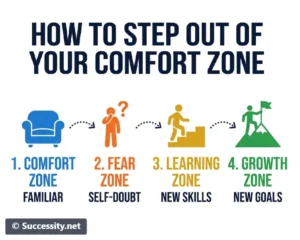
Your comfort zone consists of familiar situations, routines, and activities that usually feel predictable.
Staying within it can provide stability, but avoiding every unfamiliar experience may also limit your opportunities to learn and grow.
A popular self-development model describes four zones:
1. Comfort Zone
This is where familiar routines and activities feel relatively easy. You know what to expect, and there is little uncertainty.
For example, you may prefer doing tasks you already understand rather than accepting a new responsibility.
2. Fear Zone
This is where unfamiliar situations create discomfort and self-doubt.
You may worry about making mistakes, being judged, or discovering that you are not as capable as you hoped.
3. Learning Zone
In this zone, you begin experimenting with new experiences, developing skills, and discovering how to handle challenges.
You may still feel nervous, but you are becoming more familiar with the situation.
4. Growth Zone
This is where new skills and experiences can help you pursue larger goals and take on responsibilities that once seemed intimidating.
These zones are an illustrative self-development model, not a scientific diagnosis or a fixed sequence that everyone experiences in the same way.
The important lesson is simple: growth often requires some discomfort, but that does not mean you should ignore your limits or put yourself in unsafe situations.
Choose challenges that are meaningful, manageable, and appropriate for your circumstances.
When Fear Becomes Too Much – Knowing When to Seek Help
Everyday fear is a normal human experience. However, some fears can become so intense or persistent that they interfere with daily life.
Consider seeking professional support if:
- You regularly avoid important activities because of fear.
- Fear prevents you from working, studying, or maintaining relationships.
- You experience frequent panic or overwhelming distress.
- Your worries interfere with sleep or everyday responsibilities.
- You feel unable to manage your reactions despite repeated attempts.
A qualified mental health professional can help you understand what is happening and recommend an appropriate approach.
Depending on your situation, treatment may include cognitive behavioral therapy, exposure-based approaches, or other forms of support.
There is no need to wait until your difficulties become unbearable before asking for help. Seeking support is a practical step toward taking care of yourself, not a sign of weakness.
Final Thoughts
Fear is part of being human. It can warn you about genuine danger, but it can also make unfamiliar situations seem more threatening than they really are.
The goal of Overcoming Fear is not to remove every uncomfortable feeling from your life. It is to recognize what you are afraid of, challenge unhelpful assumptions, and take manageable action instead of allowing avoidance to become your default response.
Start by identifying one fear that is holding you back. Break it into smaller steps, practice facing it safely, and pay attention to what you learn along the way.
You may not feel confident every time you take action. That is okay. Courage is built through the decisions you make when things feel uncertain.
You do not have to wait until fear disappears to move forward. You can begin with one small step today.
Frequently Asked Questions
What is the best way to overcome fear?
Start by identifying what you are afraid of, examining the thoughts behind it, and facing the situation through small, manageable steps. Consistent practice can help reduce avoidance and build confidence.
Why am I afraid of things that are unlikely to happen?
Your brain can respond to perceived threats even when the actual danger is low. Past experiences, uncertainty, and negative expectations may influence how threatening a situation feels.
Can you train your brain to be less afraid?
You can learn to respond differently to everyday fears through gradual exposure, realistic thinking, and repeated practice. These experiences may help you develop less fearful associations with situations that once felt threatening.
How can I overcome the fear of failure?
Focus on what you can learn from an attempt rather than treating the outcome as a judgment of your worth. Break large goals into smaller actions and accept that mistakes are part of the learning process.
How do I stop letting fear control my decisions?
Recognize when fear is influencing your choices, separate realistic risks from assumptions, and identify one practical action you can take. You do not need to feel completely comfortable before making progress.
Does avoiding fear make it stronger?
Avoidance can provide short-term relief, but repeatedly escaping situations you fear may make them more difficult to face over time. Gradual, safe exposure can help you become more comfortable with everyday challenges.
When should I seek professional help for fear?
Consider professional support when fear is persistent, overwhelming, or interferes with your work, relationships, sleep, or daily activities. A mental health professional can help you find an approach suited to your needs.
About the Author