Sophia

You sit down to work, open your laptop, and promise yourself you’ll focus for the next hour. Five minutes later, you’re checking your phone. You open Instagram to reply to a message, watch a few videos, and suddenly realize you’ve lost half an hour.
Why is it so difficult to stop scrolling, even when you know you have something more important to do?
Part of the answer lies in how your brain learns from rewards. Social media combines social feedback, unpredictable content, and easy access in ways that can encourage repeated checking. The result can be a habit that feels automatic, even when scrolling no longer feels enjoyable.
But does social media actually damage your dopamine system? Does it permanently reduce your attention span? And can you reverse the effects by taking a break?
The science is more complicated than the popular claims about dopamine addiction suggest.
This guide explains how social media interacts with the brain’s reward system, what research says about attention and well-being, and how to build healthier digital habits without giving up your phone completely.
The Bottom Line
Social media can encourage repeated checking by engaging reward-learning mechanisms involved in motivation and social feedback. Notifications, likes, and unpredictable content may make checking feel rewarding, while continuous feeds remove natural stopping points.
However, there is no strong evidence that ordinary social media use permanently damages dopamine receptors or that everyone needs a 30-day dopamine reset.
You can start changing your habits by reducing unnecessary notifications, creating clear stopping points, and making time for activities that matter to you.
What Is Dopamine, Really?
Dopamine is a chemical messenger that helps nerve cells communicate. It plays important roles in movement, motivation, learning, and the brain’s response to rewards.
Although dopamine is often called the “pleasure chemical,” that description is incomplete.
Dopamine is involved in learning which experiences are worth pursuing, anticipating rewards, and motivating behavior. Pleasure itself depends on several interacting brain systems.
Understanding this distinction helps explain why you might keep checking social media even when you no longer enjoy what you see.
Dopamine, Motivation, and Reward Learning
Imagine discovering a new restaurant that serves your favorite food. After a few visits, you learn that walking past a particular street might lead to a satisfying meal.
Your brain can begin responding to the cues associated with that reward. The anticipation may motivate you to visit the restaurant again.
Social media can involve similar learning processes.
When you receive a message from a friend, see an interesting post, or get positive feedback, your brain can learn to associate checking the app with a potentially rewarding experience.
This does not mean every notification produces a large dopamine release. Dopamine activity varies with the situation, and the effects of social media differ between people.
Research published in Nature Communications found that social media engagement follows patterns consistent with reward learning. The researchers analyzed more than one million posts from over 4,000 users and conducted an experiment showing that social rewards influenced behavior.
The study supports a role for reward learning in social media engagement. It does not establish that social media causes addiction or permanently changes the brain.
Read the research on social media and reward learning
Why Dopamine Is Not Simply a Pleasure Chemical
You can want something without enjoying it very much.
Think about checking your phone for the tenth time in an hour. You may feel compelled to look, even though you expect to find nothing particularly interesting.
That difference between wanting and enjoying is important.
A familiar notification, a new message, or the possibility of finding something interesting can encourage you to check again. The behavior may continue even when the experience itself is no longer satisfying.
This is one reason why understanding the relationship between dopamine and social media requires more than simply counting how many rewards a person receives.
How Social Media Can Influence Reward-Seeking Behavior

Social media platforms combine several features that can encourage people to return frequently.
The most relevant include social feedback, unpredictable content, and the ease of continuing to scroll.
These features do not affect everyone in the same way, but they can help explain why some people find it difficult to put their phones down.
Notifications, Likes, and Unpredictable Rewards
Imagine checking your phone and finding a message from someone you care about. The next time you check, there may be nothing new.
This uncertainty can make checking more tempting because you do not know exactly when a rewarding experience will occur.
Social media also provides different kinds of feedback, including likes, comments, messages, and reactions. These interactions can be meaningful because people naturally value social connection and feedback.
The combination of social rewards and unpredictable outcomes can encourage repeated checking.
However, social media is not simply a slot machine. People use these platforms for communication, entertainment, information, and many other reasons.
The same feature can be enjoyable or useful in one context and distracting in another.
Infinite Scrolling and Autoplay
Think about the last time you watched a television episode. When the episode ended, you had a natural opportunity to decide whether to continue.
Social media feeds often work differently.
You can scroll through one post after another without reaching a clear stopping point. Autoplay can begin the next video before you have decided whether you want to watch it.
These features can make it easier to continue using an app without consciously choosing to do so.
The solution is not necessarily to stop using social media altogether. It is to create stopping points that help you decide when you have had enough.
Why Short-Form Videos Can Be So Engaging
Short-form videos provide a steady stream of changing content. Each new video offers another opportunity to find something funny, interesting, surprising, or useful.
This rapid sequence can make it easy to lose track of time.
However, it would be inaccurate to claim that short-form videos automatically destroy attention spans or affect everyone’s brain in the same way.
The important question is whether your own use is interfering with sleep, work, relationships, or other activities you value.
Does Social Media Affect Attention, Mood, or Sleep?
Social media can affect your daily experience in different ways, but the relationship between usage and well-being is not straightforward.
Research has found associations between some patterns of social media use and mental health outcomes. However, findings vary depending on the person, the platform, the type of activity, and the outcome being measured.
A 2024 meta-analysis of 141 studies found that many relationships between active or passive social media use and well-being were small or negligible. Some associations varied depending on how people used social media and their circumstances.
This is an important reminder that time spent online alone does not tell the whole story.
Social Media and Concentration
Have you ever tried to read a report while checking your phone every few minutes?
Even if each interruption is brief, switching between activities can make it harder to maintain your place and return to the task.
If you regularly interrupt demanding work to check social media, you may find it more difficult to complete that work efficiently.
But this does not prove that your dopamine levels have been depleted or that your brain has lost the ability to concentrate.
Attention is influenced by many factors, including sleep, stress, the difficulty of the task, and your working environment.
If you are struggling to focus, consider these factors alongside your social media habits.
Social Media, Mood, and Sleep
Social media can provide valuable connection and support. It can also expose you to upsetting content, social comparison, or pressure to remain available.
The effects depend partly on what you encounter and how you use the platform.
Sleep is another important consideration. Checking your phone late at night can delay bedtime or interrupt your wind-down routine.
If scrolling is regularly keeping you awake, try creating a phone-free period before bed.
For more practical guidance, see How Sleep Impacts Daily Life.
When Social Media Use Becomes a Problem
Frequent social media use does not automatically mean you have an addiction.
However, it may be worth changing your habits if you regularly experience problems such as:
- Spending much longer scrolling than you intended.
- Repeatedly checking your phone during important tasks.
- Losing sleep because you continue using social media.
- Finding it difficult to stop even when you want to.
- Neglecting responsibilities or relationships because of your use.
These are reasons to examine your habits, not a diagnosis.
If social media use is causing significant distress or interfering with your daily life, consider speaking with a qualified mental health professional.
How to Reduce Compulsive Social Media Checking
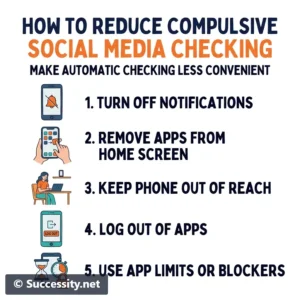
You do not need to rely on willpower alone to change your habits.
A useful starting point is to make automatic checking less convenient and intentional activities easier to begin.
Make Unnecessary Checking Less Convenient
Start by identifying the situations in which you check your phone without thinking.
Perhaps you reach for it whenever you feel bored, whenever you encounter a difficult task, or whenever a notification appears.
Once you know the trigger, change the environment around it.
Try these practical adjustments:
- Turn off notifications that do not require an immediate response.
- Remove social media apps from your home screen.
- Keep your phone out of reach while working.
- Log out of apps that you tend to open automatically.
- Use app limits or website blockers if they help you follow your intentions.
You do not need to use every strategy. Choose the changes that address your most common triggers.
Set Boundaries Around Social Media
Instead of checking social media whenever you feel the urge, try choosing specific times to use it.
For example, you might decide to check messages during a lunch break rather than throughout the morning.
The goal is not to follow a perfect schedule. It is to create a little more space between the urge to check and the decision to open an app.
You can also create stopping points.
Before opening social media, decide what you want to do and when you will stop. That might mean replying to a message, watching one video, or spending ten minutes catching up with friends.
A clear intention can make it easier to recognize when you have finished.
Replace Automatic Checking With Another Activity
Sometimes social media becomes a way to respond to boredom, stress, or an uncomfortable task.
If you simply remove the app without addressing the reason you reach for it, the urge may remain.
Try identifying what you need in that moment.
If you are bored, take a short walk or listen to music.
If you are overwhelmed by work, break the task into a smaller step.
If you want connection, send a message to a friend or arrange a conversation.
If you are tired, consider whether a short rest would be more helpful than another round of scrolling.
The best replacement is one that actually meets the need that triggered the habit.
Create a Simple Social Media Plan
You can begin with a small experiment rather than attempting a complete digital detox.
For the next seven days:
- Choose one situation in which you will avoid automatic checking, such as the first 30 minutes after waking up.
- Turn off notifications that interrupt you unnecessarily.
- Decide when you will check social media during work or study.
- Keep your phone away from your bed if nighttime scrolling is a problem.
- Review your screen-time report at the end of the week.
Notice what changes.
Are you getting more work done? Are you sleeping better? Do you feel less distracted? Or did the changes make little difference?
Use what you learn to adjust your routine.
Research on digital detox interventions suggests that reducing social media or smartphone use may be helpful for some people, but outcomes vary. Complete abstinence is not necessary for everyone.
The aim is to develop a healthier relationship with technology, not to follow a rigid rule.
For more practical ideas, see The Science of Habit Building and Breaking Bad Habits.
Conclusion – Build a Healthier Relationship With Social Media
Social media can be engaging because it connects us with other people, provides interesting content, and offers unpredictable rewards.
These experiences can encourage repeated checking, especially when the habit becomes part of your daily routine.
But the science does not support the idea that every scroll damages your brain or that you need a fixed dopamine detox to recover.
You do not have to abandon technology to regain control of your attention.
Start with one small change. Put your phone away during an important task, turn off a distracting notification, or create a phone-free period before bed.
Pay attention to how the change affects your day, then build on what works.
The goal is not to eliminate dopamine or avoid every enjoyable experience. It is to make deliberate choices about how you spend your time and attention.
Frequently Asked Questions
Does social media cause dopamine addiction?
Social media can engage reward-learning processes and encourage repeated checking. However, dopamine activity alone does not establish addiction, and frequent social media use is not automatically a disorder.
How long does it take for dopamine levels to reset after quitting social media?
There is no established universal timeline for dopamine levels to reset after quitting social media. Some people notice changes in their habits or well-being after reducing use, but the effects and timing vary.
Does social media damage the brain?
Current research does not establish that ordinary social media use permanently damages the brain. Studies of problematic use have reported differences in brain activity and structure, but the evidence is limited and does not prove that social media caused those differences.
Does social media cause ADHD in adults?
Social media use is not an established cause of ADHD. Digital distractions may make it harder to concentrate, but attention difficulties can have many causes. If you are concerned about ADHD, seek an assessment from a qualified healthcare professional.
Can I use social media without constantly checking it?
Yes. You can make checking more intentional by turning off unnecessary notifications, setting specific times for social media, and keeping your phone away during important activities.
About the Author